There is a distinct, unspoken choreography to an orderly queue—a societal contract built on patience, fairness, and the gentle art of waiting one’s turn. Yet, for all the civilised expectations associated with modern transit, travel
hubs have a peculiar habit of descending into chaos when the boarding gates open. This morning proved to be no exception, as staff checking passports and tickets at the gate seemingly sought to inject an element of unpredictability into the proceedings by triggering a minor human stampede.
The trouble began when passengers designated for group five were inexplicably permitted to surge ahead of group one—a sequence of events that immediately struck at the heart of travel justice. Seizing upon this operational lapse, a contingent of older ladies equipped with remarkably sharp elbows emerged from the sidelines, executing a textbook maneuver to insert themselves into prime boarding positions. As another member of their traveling party aggressively pressed forward right beside me, I made a tactical decision, edging my suitcase forward a few strategic inches to repel the advance.
The response was immediate and vocal. “Oh, you’ll let everyone else in but not me,” she remarked, pitching her voice just high enough to ensure maximum discomfort for those in the immediate vicinity. Seeking to mobilize public sympathy, she escalated her campaign with a theatrical flourish. “It’s like we are back in England already,” she proclaimed, attempting to rally the surrounding passengers to her cause. “Are you happy now?” she added, casting a look that carried the heavy grievance of a child robbed of an inheritance by a wicked uncle. I calmly assured her that I was, even if the ordeal had caused me to perspire just a fraction more than usual. Fate, as it so often does in these scenarios, delivered a poetic punchline: we turned out to be seat neighbors. Squeezed-in-economy-seat neighbors, with elbows touching for the duration of the flight.
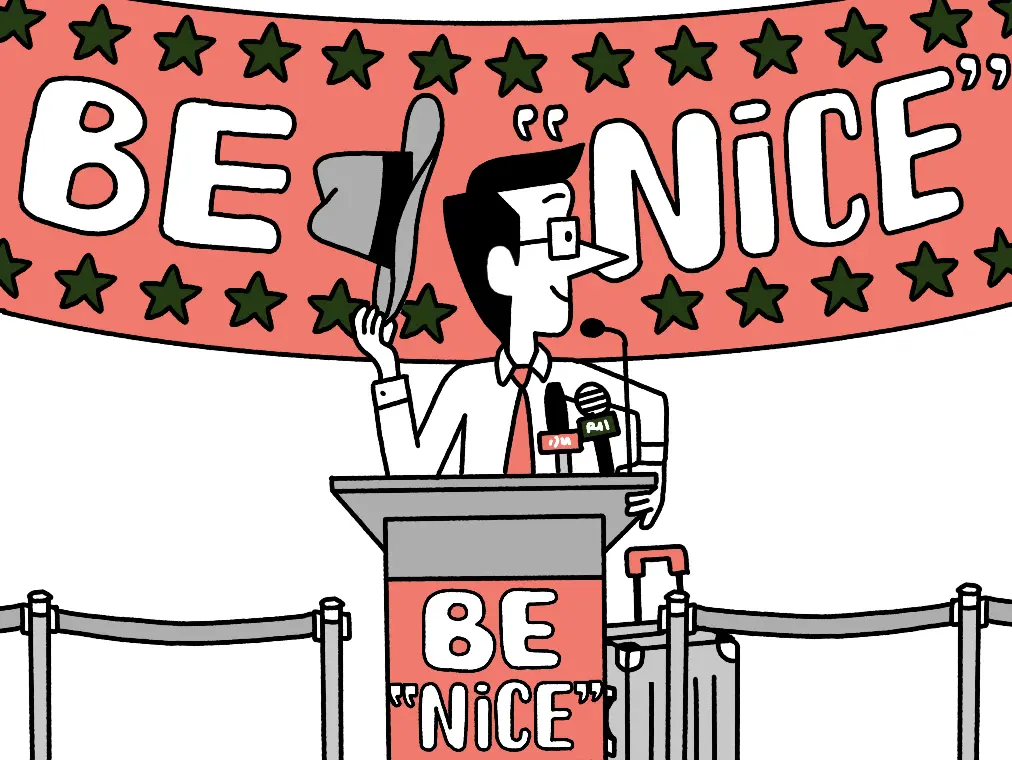
Reflecting on the encounter later, I resolved that my future dealings with opportunistic queue-jumpers should take inspiration from a more temperate approach—specifically, the demeanor of figures like Texas senator-elect James Talarico. Watching his recent campaigning and subsequent victory, what struck me wasn’t merely his youthfulness and integrity, but the refreshing realization that he projects the demeanor of a genuinely nice man.
"Nice" is an interesting word, and one that has historically faced skepticism in literary and academic circles. English-language teachers of yore frequently cautioned students against its use, urging them instead to hunt for richer, more evocative adjectives. Nice, we were taught, hinted at something mediocre—pleasant enough, perhaps, but ultimately bland and devoid of character.

Yet, looking at the broader cultural and political landscape, that definition feels increasingly outdated. Nice is calm, enduring, welcoming, and serves as a vital safe haven. After years of relentless political egoism and public vitriol running amok, it is hard to escape the feeling that being nice is having a distinct moment. Talarico certainly embodies the trait with ease, while figures such as the UK prime minister, Andy Burnham, and Mark Carney project a similar steady, agreeable temperament. Whether this heralds a broader cultural shift remains to be seen, but there is a distinct sense that the era of the nice guy might finally be staging a comeback.
This appreciation for thoughtful consideration and human connection extends far beyond the realm of transit etiquette and political posturing. Recently, while hosting an episode of The Urbanist, I had the opportunity to interview Amanprit Arnold, an accessibility activist for the deaf community. Arnold is currently campaigning for the establishment of Deafcity Hub, which is envisioned as London’s first dedicated cultural and business center for the deaf. Listening to her insights offered a powerful reminder of how thoughtful design can dismantle barriers and prevent isolation. Echoey restaurants, for example, create sensory nightmares for individuals who wear hearing aids, while expansive glass computer screens in modern open-plan offices frequently render lipreading entirely impossible.
Arnold’s advocacy struck a personal chord, drawing on family history that underscores the profound dangers of sensory deprivation. I had an aunt, long since passed, who was inside a building directly struck by a Luftwaffe bomb during the Second World War. Miraculously, she survived the blast, but as the decades passed, her hearing steadily deserted her. Early on, hearing aids managed to bridge the gap, but in her advanced age, the struggle intensified until she found herself entirely surrounded by a wall of silence. It was precisely during this period of deepening isolation that the dementia set in.
Experiences of this nature reinforce a long-held understanding of the dangers that isolation poses to human well-being, confirming that rich friendships, active conversation, and robust community engagement are fundamental to defending our cognitive health as we age. This vital theme is set to be explored further in upcoming editions of Monocle, which profile researchers investigating the direct link between social environments and cognitive longevity, identifying specific geographic pockets where conditions like dementia remain remarkably rare. Beyond the protective shield of community, these researchers emphasize the physiological necessity of maintaining a vegetable-rich, protein-forward diet to keep the brain functioning smoothly, while pointedly advising against the consumption of heavily processed foods.
The practical challenges of maintaining brain health were brought into focus during a Thursday lunch with a long-standing colleague and mentor. A veteran of the journalism industry whose early encouragement helped instill the confidence I needed to pursue my career, she remains entirely unchanged—funny, sharp, and currently immersed in editing a new publication. Over our meal, she mentioned that she had been reading a specialized recipe book focused explicitly on cognitive health, which casually prescribed a daily target of consuming 10 different varieties of vegetables.
To the average person, consuming ten distinct vegetables a day sounds like an ambitious quota, more suited to the dietary habits of a domestic pet rabbit than a working professional. Yet, as our Scandi-inspired lunch concluded, I observed her intently scanning our cleared plates with the precision of a detective. "We might have done ten," she declared with considerable confidence. Her forensic culinary audit, it turned out, generously factored in the grated carrot embedded within the slice of cake we had just enthusiastically consumed.
Attempting to balance the twin virtues of maintaining equanimity toward pushy fellow travelers and hitting an ambitious new daily vegetable target certainly feels like an extensive self-improvement agenda to embrace all at once. Even so, the endeavor is worth pursuing, anchored by a new personal rallying cry: nice guys eat cake.