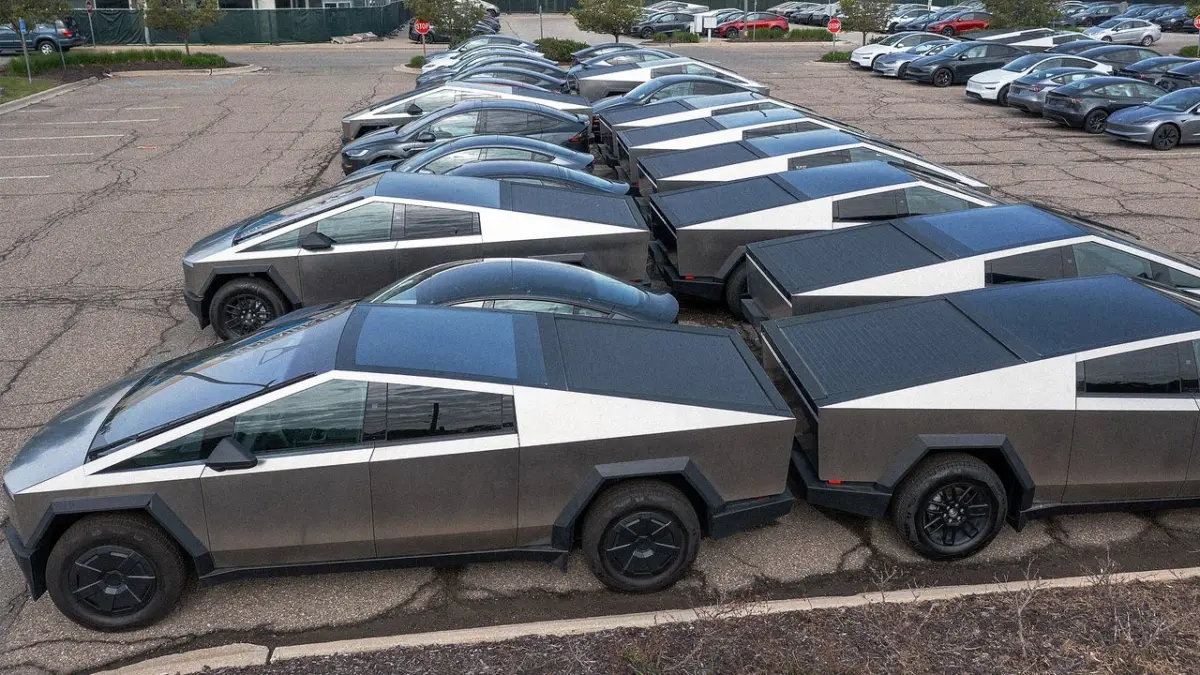
The story of the Cybertruck began in Los Angeles on November 21, 2019, when Musk unveiled the angular vehicle with a promised starting price of $39,900 and a 2021 delivery date. Despite the infamous moment during its very first public demonstration when its allegedly unbreakable glass windows were shattered by a metal ball, its radical appearance immediately captured the imagination of tech enthusiasts, fanboys, and a demographic of buyers drawn to avant-garde industrial design. For its dedicated audience, the vehicle’s stark, stainless-steel exterior represented the future of car design.
Behind the futuristic facade, however, the Cybertruck spent its early life struggling on the factory floor. Tesla designers and assembly line workers faced an uphill battle trying to transform the concept into a viable production model. Industry designers had warned as early as January 2023 that the vehicle’s sharp, polygonal body could never be mass-produced in a reliable, consistent way. The stark design demanded sub-ten-micron, Lego-like precision from manufacturing equipment, a level of exactness that remains next to impossible to accomplish reliably in any contemporary automotive manufacturing plant.
Eventually, as production deadlines pressed forward, Tesla relaxed its strict adherence to absolute manufacturing precision, and the Cybertruck was finally deemed ready for the market. It reached the hands of early adopters in late 2023 carrying a significantly higher starting price tag of $60,990 and featuring visibly misaligned body panels. As industry experts had predicted, each manufactured unit varied slightly from the next due to the immense difficulties of working with the material. Musk himself acknowledged these manufacturing realities in a leaked internal email, writing that due to the nature of the Cybertruck, which is made of bright metal with mostly straight edges, any dimensional variation shows up like a sore thumb.
Throughout its brief and turbulent lifespan, the Cybertruck was plagued by a multitude of technical ailments and quality control issues. Owners and observers documented chronic panel misalignment, recurring trim detachment, accelerator pedals that were prone to jamming, front trunks capable of closing with enough force to injure fingers, and windshields that proved vulnerable to heavy hail. Other reported issues included erratic behavior from the driver-assistance systems, sudden vehicle failures shortly after delivery, and a systemic rust condition appearing on the vehicle’s supposedly stainless-steel exterior. Veteran automotive designer Adrian Clarke summarized the prevailing sentiment within the car design community by observing that the vehicle was a low-polygon concept that struggled to transition successfully into mass production.
The trajectory of the vehicle was continually punctuated by a series of high-profile recalls and unfulfilled software promises. Features like the locking differential remained perpetually labeled as "Coming Soon" without ever reaching customers. Regulatory interventions included over-the-air recalls to adjust warning-light font sizes, a recall for thousands of units due to accelerator pedals that could become dislodged with the aid of soap lubricants, and a major recall involving tens of thousands of trucks whose exterior trim panels could detach at highway speeds. Additional manufacturing challenges included glued-on light bars and isolated incidents where vehicle wheels could detach entirely.
As these persistent failings became more widely known, public reception of the Cybertruck shifted from initial curiosity and popularity to widespread indifference, disdain, and, in some cases, active hostility. After reaching a peak registration volume of 5,175 units in July 2024, monthly registrations declined steadily, dropping to around 2,000 by April 2025. Total registrations for the full year reached approximately 20,237 units, a figure that included internal corporate purchases made by Musk’s aerospace company, SpaceX. That total amounted to barely eight percent of the ambitious 250,000 annual sales figures Musk had originally projected.
In its final months on the market, Tesla attempted to stimulate demand through various pricing adjustments and promotional discounts, but consumer interest failed to recover. Facing persistently low demand and insurmountable manufacturing hurdles, Musk ultimately acknowledged defeat, bringing an early close to the production run of one of the most polarizing experiments in modern automotive history.