As Dubai Design Week runs through its final days toward its conclusion on Sunday, November 8, the prevailing sentiment among observers is that this year’s edition will be judged less by grand spectacles and more by who actually shows up. Against a backdrop marked by fewer international exhibitors and a wider regional climate where the Gulf finds itself bracing for renewed geopolitical tensions and an escalation in the war with Iran, attendance figures and participation levels are bound to invite heavy speculation regarding business confidence in the wider Middle East. Despite these palpable headwinds, the annual creative festival undeniably deserves steadfast support. Designers desperately need clients, and clients, in turn, need compelling reasons to keep making long-term plans. Even so, the organizers and institutions behind the event must firmly resist the temptation to present the mere existence of the festival as definitive proof that economic and regional uncertainty has definitively passed.
A crowded opening night can certainly provide a momentary sense of reassurance, yet it reveals very little about a studio’s actual financial prospects or pipeline six months down the line. Furthermore, a nervous and jittery commercial climate naturally encourages risk-averse stakeholders to lean heavily on familiar choices rather than backing bold innovations. This economic reality means that this year, more than ever, the festival requires genuine curatorial nerve. It demands a distinct willingness to carve out space for creative experiments whose commercial value is not immediately obvious to a cautious corporate sponsor or a hesitant retail buyer—particularly if the creators taking those professional risks are locally based in the United Arab Emirates.
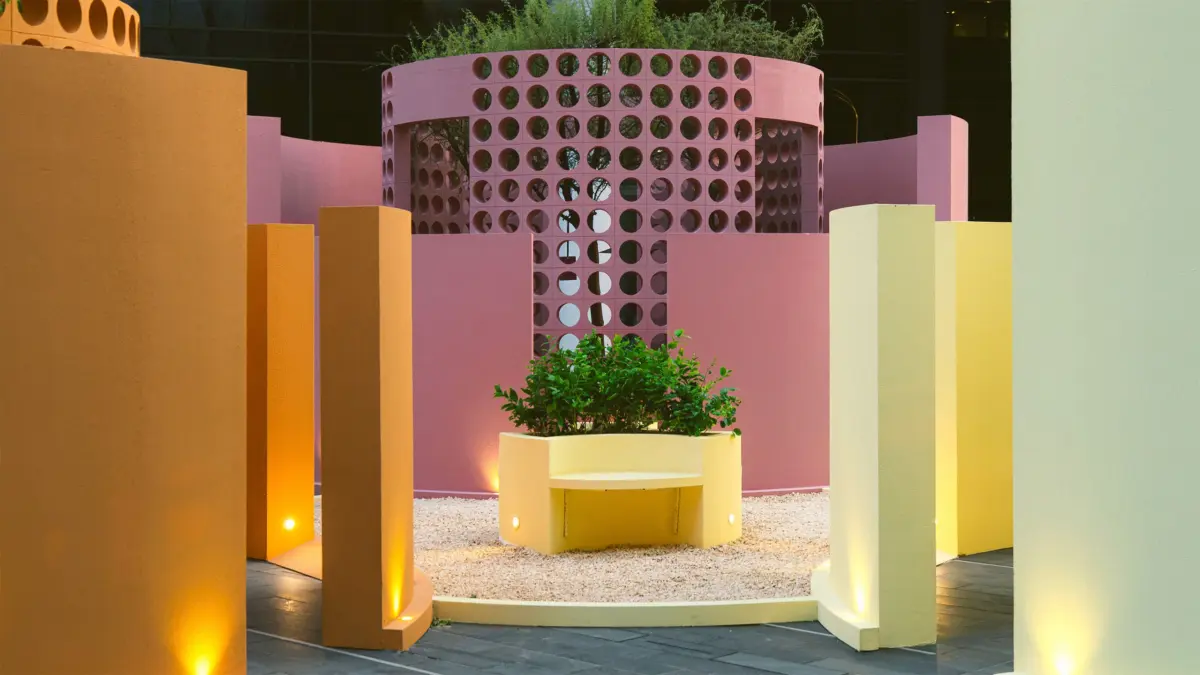
A clear case in point can be found in the work of Nao Architects, a dynamic practice founded by Reem Nassour. Their innovative project, titled Three Gardens and a Room, was selected as one of this prestigious year’s Urban Commissions. This well-earned win has allowed the Dubai-based architectural and design practice to construct a site-specific installation thoughtfully engineered to soften the harsh, unforgiving concrete and metal surfaces of the Dubai Design District through carefully calibrated shade and filtered natural light. Simultaneously, the UAE Designer Exhibition, which this year centers around the evocative theme Inherited Futures shaped by architect and designer AlZaina Lootah, sharply spotlights contemporary, forward-looking approaches to working with inherited materials and traditional artisanal ways of making. Together, these standout projects successfully place a deep understanding of the everyday needs, climatic challenges, and cultural realities of Gulf residents directly at the center of the festival.
Other creative outfits operating within the region are similarly stepping up to give back to their immediate urban communities. The Dubai- and Milan-based Isola Design Group, for instance, has commissioned a series of playful, interactive works designed to populate and animate the lively neighborhood surrounding its operational base on The Lana Promenade. Among the key highlights drawing crowds are Serotonin, an exuberant installation created by the Milan-based Sara Ricciardi Studio that features intensely vibrant colors and mesmerizing optical geometries. Another major attraction is a striking showcase of grand, monumental ceramic forms painted intricately with sweeping landscapes, titled Where the Land Remains. This collaborative artistic endeavor was brought to life by Pots and Pines, a studio rooted in both Tehran and Dubai, in active partnership with talented artist Sayeh Mansor.
Historically speaking, broad international participation has long played a vital role in Dubai Design Week because it reliably attracts global buyers, fresh intellectual ideas, and long-lasting professional relationships. Consequently, the noticeable reduction in international exhibitors this year represents an undeniable loss for the ecosystem. At the same time, while the word "local" should perhaps never become a default or blanket term used to describe creatives operating in a city whose demographic and cultural origins are so remarkably diverse, the local talent pool is forcefully demonstrating that it possesses the chops, vision, and resilience to stand out proudly on its own terms.
Yet, for all the brilliant innovation and artistic flair on display across the district, a critical question remains: what will happen after the temporary installations are packed up, disassembled, and dispersed? Will Nassour’s thoughtful, localized approach to shade and shared communal spaces genuinely influence the design of ordinary neighborhoods across the wider emirate? Will independent designers successfully secure lucrative, long-term commissions from the real estate developers and hoteliers who walk the exhibition floors? And will Isola Design Group’s playful neighborhood interventions manage to permanently recharge and invigorate its local community long after the foot traffic fades?
Greater public visibility ultimately means very little if it never successfully translates into a concrete purchasing decision or a sustainable business model. Perhaps this is precisely where the festival organizers can play an outsized and critical role this year. Concerted efforts to connect the city’s vibrant local design studios directly to regional manufacturers, fabricators, and commercial buyers must continue long after the main event has officially shut its doors.
Inzamam Rashid is Monocle’s Gulf correspondent. For more opinion, analysis and insight, subscribe to the magazine today.