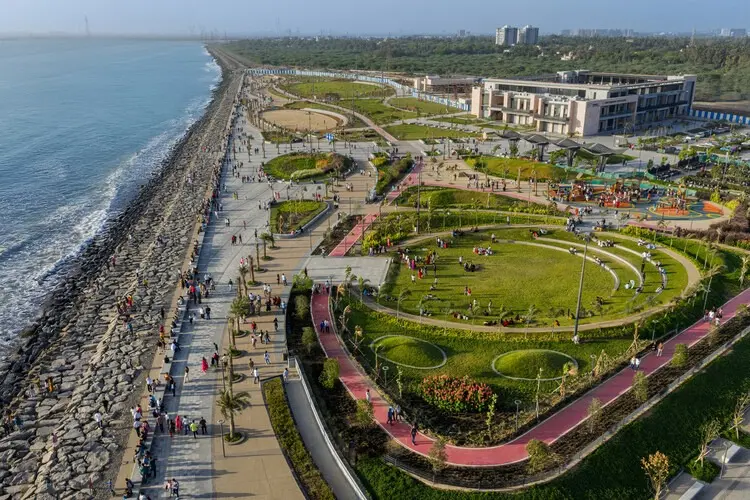
For decades, the western Indian city of Surat has shared a complex, often distant relationship with the Arabian Sea. While the city flourished into one of the country’s most dynamic industrial and economic hubs, its coastal periphery remained largely disconnected from everyday civic life. Along the historic Dumas coastline, a landscape defined by significant cultural memory and recreational tradition, the interface between land and water suffered from decades of piecemeal intervention, physical neglect, and fragmented development. Today, an ambitious masterplan designed by Ahmedabad-based INI Design Studio seeks to comprehensively rewrite this urban-coastal narrative. The Dumas Sea Face Masterplan reimagines the historic shoreline not merely as a decorative edge or a defensive barrier, but as a living coastal landscape designed to weave ecology, community engagement, and civic identity into a coherent public realm.
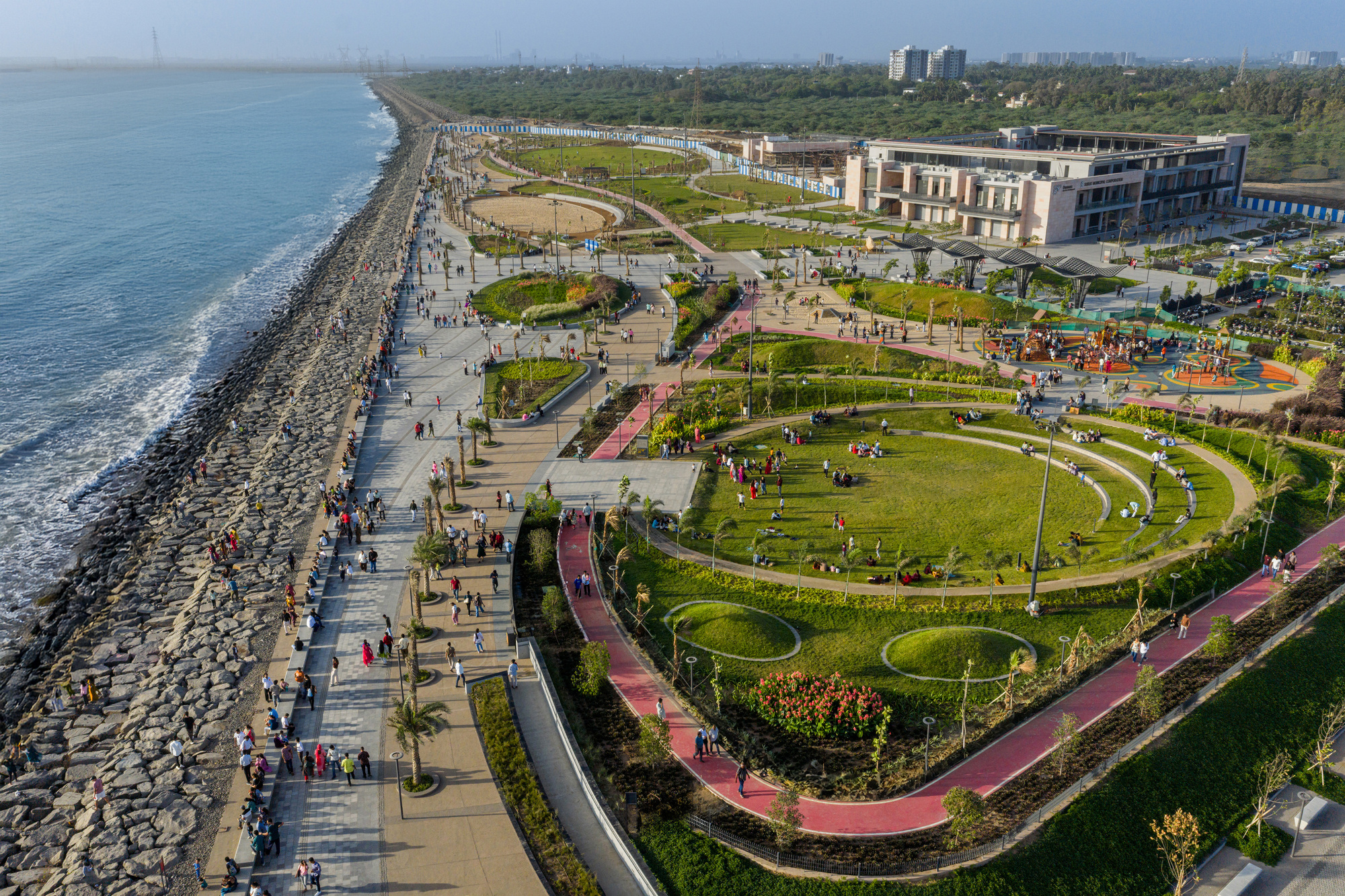
Surat’s rapid evolution into one of India’s fastest-growing metropolitan centers has generated an unprecedented demand for accessible, high-quality public open spaces. In dense, expanding urban environments, the availability of well-designed civic infrastructure directly influences public health, social cohesion, and the collective quality of life. Historically, Dumas served as a cherished destination for local residents seeking respite, open breezes, and proximity to the maritime horizon. Yet, despite this enduring popularity, the shoreline struggled under the weight of uncoordinated growth. The absence of a cohesive master vision left the coastal expanse divided into disjointed segments, characterized by uneven access, inadequate amenities, and underutilized open ground. Visitors were frequently confined to localized pockets of activity, while vast stretches of the waterfront remained severed from the broader city fabric.
The masterplan developed by INI Design Studio directly confronts these systemic spatial challenges. By establishing a unified urban and ecological framework, the project shifts away from ad-hoc planning in favor of an integrated, linear system that reconnects Surat with its maritime border. Central to this strategic vision is the concept of a continuous waterfront journey. Rather than treating the coastline as a series of isolated recreational points, the design stitches disparate sections into an uninterrupted spatial sequence. This continuous corridor provides generous pedestrian connectivity, structured public promenades, and barrier-free access routes that invite the surrounding urban populace to experience the shoreline as an expansive, shared communal resource.
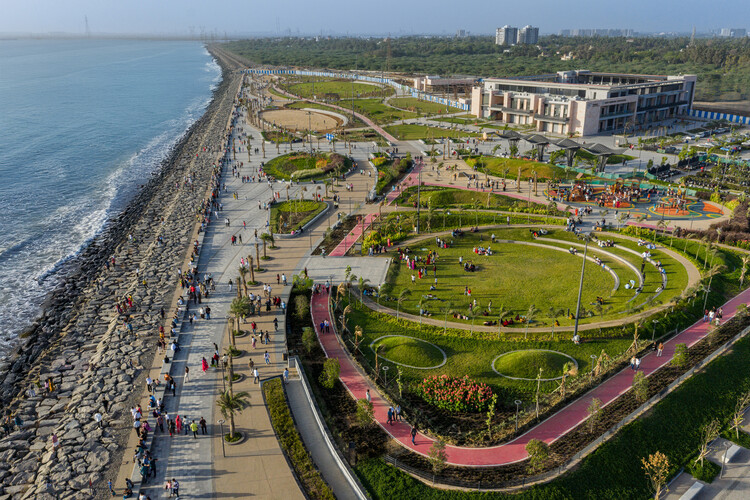
The architectural and landscape philosophy guiding the Dumas Sea Face Masterplan balances the demands of contemporary civic life with the realities of coastal ecology. Modern coastal master planning increasingly recognizes that shorelines cannot remain rigid concrete edges. Instead, coastal transitions must function as dynamic, resilient ecosystems capable of accommodating seasonal shifts, tidal flows, and broader environmental pressures. INI Design Studio’s proposal approaches the Dumas shoreline as an active, living ecosystem. Through carefully considered grading, naturalized landscape interventions, and environmental restoration, the masterplan integrates ecological resilience into the very fabric of the public spaces. Green buffers, porous surfaces, and resilient coastal plantings are woven into the pedestrian networks, creating environmental stabilization while shielding surrounding areas and offering shade and comfort to visitors.
This synthesis of ecological sensitivity and urban utility establishes a renewed sense of place along the Arabian Sea. The Dumas coast has long occupied a special place in the regional consciousness, tied to traditions of community gatherings, leisure walks, and cultural observances. The masterplan honors this legacy by transforming the formerly neglected grounds into spaces programmed for collective civic life. Structured plazas, open lawns, shaded seating nodes, and vantage points overlooking the sea are arranged to accommodate a spectrum of activities—from solitary contemplation to large-scale cultural gatherings and community celebrations. By democratizing access to the water’s edge, the design ensures that the waterfront serves as an inclusive environment welcoming citizens of all ages and socio-economic backgrounds.
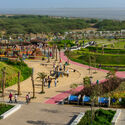
Spatial connectivity forms the backbone of INI Design Studio’s planning intervention. In the site’s previous state, visitors often encountered physical barriers, unpaved terrain, vehicular congestion, and abrupt dead ends that curtailed pedestrian movement and obscured direct visual links to the water. The masterplan systematically remedies these bottlenecks by establishing clear spatial hierarchies. Vehicular traffic, drop-offs, and parking are organized to prevent vehicular encroachment onto pedestrian precincts. From these transit thresholds, clear, inviting pathways guide visitors smoothly down toward the water. Visual corridors are maintained and opened across the masterplan, drawing the sea deep into the public realm and reinforcing a visual orientation that keeps the expanse of the Arabian Sea constantly in focus.
The visual narrative of this transformation has been meticulously documented by architectural photographer Vinay Panjwani. The photographic documentation highlights the project’s delicate dialogue between monumental coastal scale and human-centered design. In capturing the sweeping expanses of the new masterplan against the backdrop of the changing tides, the imagery conveys how the built landscape yields to the maritime horizon. Panjwani’s photographs capture the tactile qualities of the public infrastructure, the play of coastal sunlight across wide pathways, and the emerging interactions of local residents as they inhabit, navigate, and claim the newly structured spaces. Through this documentation, the project’s ambition to restore dignity, accessibility, and architectural clarity to a neglected shoreline becomes visually evident.
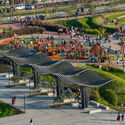
The challenges addressed by the Dumas Sea Face Masterplan mirror broader urbanization patterns unfolding across rapidly industrializing cities throughout India and the Global South. For decades, the priority of urban expansion focused predominantly on industrial output, infrastructure capacity, and residential real estate, frequently treating natural bodies of water—whether rivers, lakes, or coastlines—as secondary utilities or back-of-house service zones. In recent years, an important paradigm shift has gained momentum, driven by a growing recognition that open green and blue infrastructure is vital to urban sustainability. Urban waterfronts are increasingly recognized as primary public assets capable of redefining a city’s image, fostering environmental literacy, and stimulating cultural vitality.
In Surat, where commercial energy has historically outpaced the development of expansive civic landscapes, the revitalization of the Dumas coastline marks a significant milestone in urban design. By turning the city’s gaze back toward the Arabian Sea, the masterplan establishes a new benchmark for coastal development in Gujarat. It illustrates how strategic design interventions can recover marginalized public land and transform it into a resilient public realm where the natural forces of the sea and the collective rituals of civic life peacefully coexist.
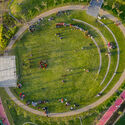
Rather than imposing an artificial, highly commercialized resort aesthetic that might alienate local traditions, the masterplan prioritizes enduring, context-driven architecture. The spatial design relies on resilient materials, durable finishes suited to harsh saline environments, and landscape forms that echo the organic contours of coastal dunes and mudflats. This grounded approach ensures that the waterfront maintains its distinctive local character while providing the modern infrastructure necessary to accommodate future urban growth. The result is a civic threshold that feels simultaneously contemporary and rooted in the authentic cultural geography of Dumas.
Ultimately, the Dumas Sea Face Masterplan by INI Design Studio represents an important step forward in Surat’s urban journey. By viewing the coastline through the complementary lenses of environmental stewardship and democratic placemaking, the project successfully bridges the historic divide between the city and its sea. As the uninterrupted promenade continues to integrate into the daily rhythm of Surat, it transforms an underutilized, fragmented edge into a thriving, resilient landscape where the community, the urban realm, and the natural elements converge in lasting equilibrium.