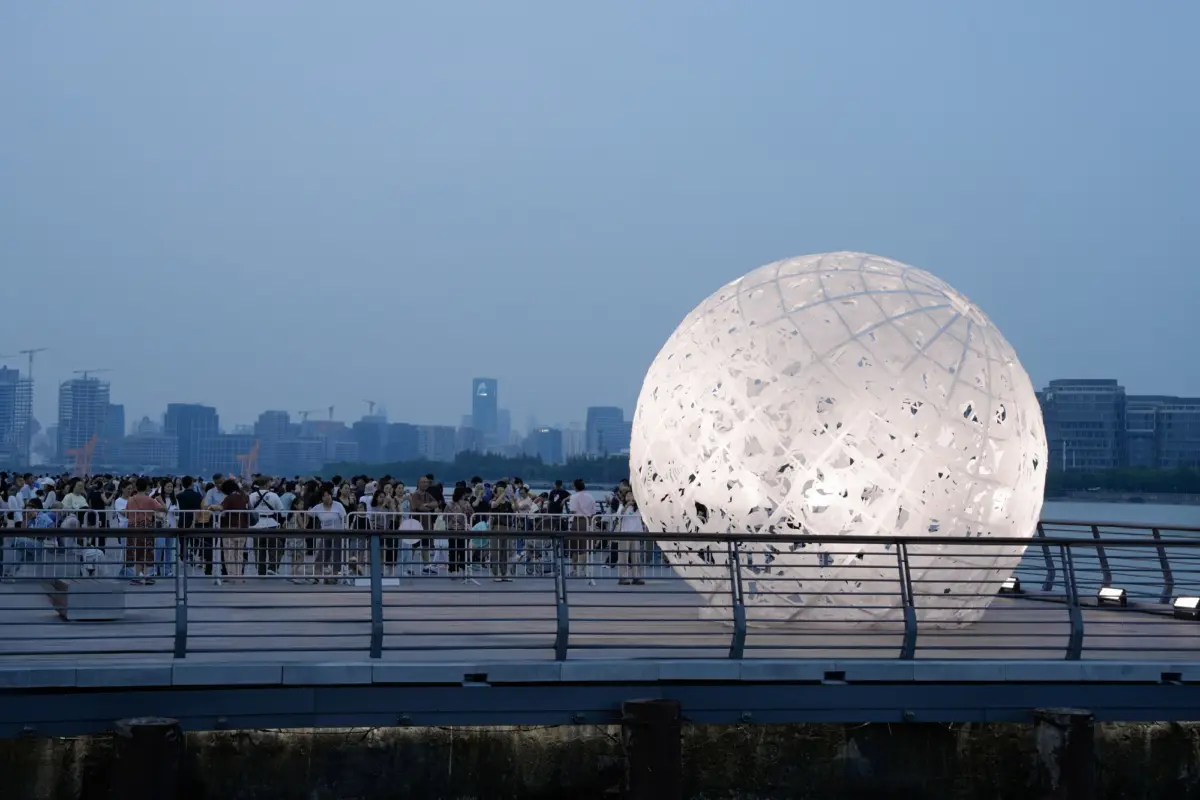
SHANGHAI — In celebration of the Mid-Autumn Festival, architecture and spatial practice SHISUO Design Office has unveiled "The Full Moon," a monumental urban public art installation sited along Shanghai’s vibrant West Bund waterfront. Commissioned through an invitation by the Power Station of Art (PSA), China’s premier state-run contemporary art museum, the project merges ancient intangible cultural heritage with contemporary architectural materiality, offering the public an evocative spatial experience rooted in seasonal folklore.
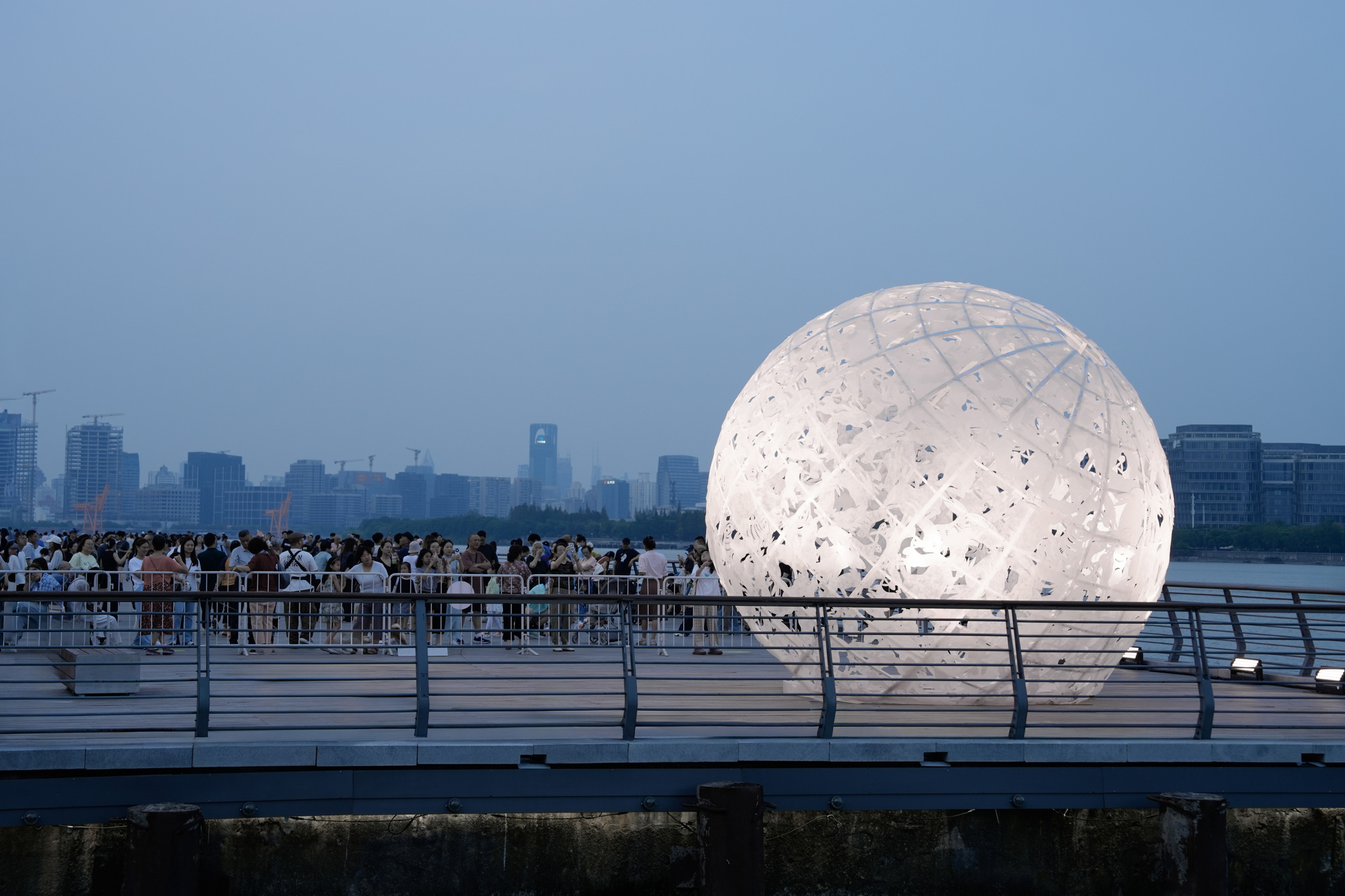
Developed in close collaboration with Shi Qinling, a recognized master inheritor of Shanghai-style paper-cutting, the installation centers around three quintessential motifs: the celestial moon, the mythological rabbit, and the intricate craftsmanship of traditional folk cutouts. Set against the post-industrial backdrop of the Huangpu River and the Power Station of Art, the temporary structure has drawn significant crowds, transforming a familiar urban concourse into an open-air gathering space centered on contemplation, communal reunion, and visual storytelling.
The Mid-Autumn Festival, traditionally observed on the fifteenth day of the eighth lunar month when the moon is believed to be at its fullest and brightest, holds deep cultural significance across East Asia. The festival embodies notions of completeness, family harvest, and seasonal transition. By grounding the installation’s narrative in this festive tradition, the design team sought to re-examine how ancient myths can inhabit dense contemporary metropolises.

Central to the conceptual framework of the piece is the symbolic dialogue between the moon and the rabbit. In traditional Chinese mythology and folklore, the jade rabbit is perceived as the moon’s eternal companion, perpetually pounding the elixir of life under the cassia tree. Within this cultural framework, the celestial orb represents the inevitable cycles of time—the rhythmic waxing and waning that governs existence—while the rabbit metaphorically reflects vital life force, dynamic movement, and the flourishing fecundity of nature. Together, the two elements weave a philosophical commentary on endurance, renewal, and coexistence.
To translate these ancestral themes into a physical intervention, SHISUO Design Office reinterpreted the delicate, two-dimensional art of Shanghai-style paper-cutting into a three-dimensional spatial installation. Rather than relying on ephemeral paper that would quickly succumb to outdoor riverfront conditions, the architectural team employed crackle-textured acrylic panels to capture the translucent, fragile, and silhouette-driven quality of traditional paper craft.

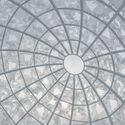
The application of crackle-textured acrylic allows ambient light to diffuse across the installation’s curved surfaces during the daytime, while embedded illumination brings the sculptural volumes alive after dusk. The patterns of rabbits, abstracted and pierced through the panels in homage to Shi Qinling’s paper-cutting techniques, interact dynamically with shifting perspectives. Depending on where a visitor stands along the West Bund promenade, the sculptural panels overlap and align in varying compositions, revealing different lunar phases—from delicate crescents to a luminous, complete sphere.
The internal construction of the installation balances structural economy with poetic light play. Close inspection reveals finely calibrated joint details and layered framework assemblies that allow the installation to remain stable against coastal winds while retaining an open, permeable presence. As visitors move around and through the installation, the translucent screens cast layered shadows, creating an immersive optical environment where visitors effectively walk through the mythological narrative itself.

Public art installations along the West Bund have increasingly served as catalytic agents for public life in Shanghai. The area, anchored by the Power Station of Art—a former thermal power plant converted into a contemporary art destination—has become an expansive cultural corridor frequented by local residents, flâneurs, art patrons, and tourists. During its exhibition run, "The Full Moon" proved to be a popular destination, drawing sustained public interest and functioning as an open community hub where people gathered to photograph the work, watch the sunset over the Huangpu River, and mark the festival.
By engaging an intangible cultural heritage inheritor like Shi Qinling, the Power Station of Art and SHISUO Design Office have also spotlighted the evolving status of traditional crafts in contemporary urbanism. Shanghai-style paper-cutting, characterized by its fine lines, fluid silhouettes, and adaptability to modern urban imagery, finds an atypical scale in the work. The transfer of graphic paper cuts into an architectural-scale acrylic medium underscores how age-old craft techniques can step out of museum vitrines and archival portfolios into active public life.
Curated by Han Shuang, the project demonstrates an approach to seasonal urban placemaking that moves beyond superficial holiday ornamentation. Instead of passive iconography, the installation operates as an instrument of spatial perception, shifting the viewer’s awareness of natural cycles amidst a hyper-modern city skyline. As the installation captures shifting angles of light and presents evolving views of the moon to observers approaching from the riverbank or the museum plazas, it creates an experiential link between urban space and the wider cosmos.
Documented in architectural and urban photography by Ye Jianyuan, the project records the spontaneous interactions between Shanghai’s urban populace and the luminous, layered pavilion. The photographs demonstrate how the installation engaged visitors across different times of day, capturing the quiet geometric clarity of the crackle-surfaced panels against the midday sky, as well as the bustling, warmly lit nocturnal scenes when the forms glowed against the river.

Through its synthesis of paper craft traditions, industrial heritage, and modern synthetic materials, "The Full Moon" stands as a sensitive celebration of lunar myth and festive communion, illustrating how public architectural interventions can honor intangible traditions while fostering dynamic civic gathering spaces.