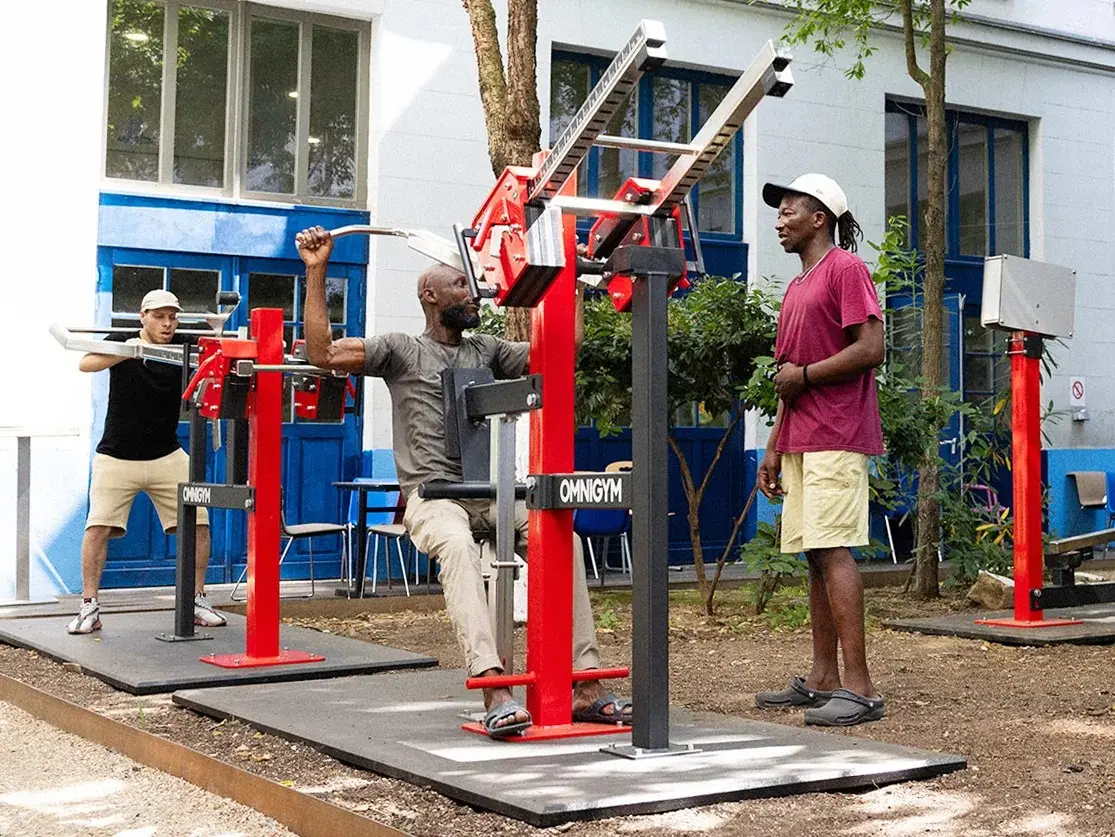
When tasked with compiling a wish list of interventions designed to improve the daily lives of homeless men and women residing in a municipal shelter, it is safe to assume that an outdoor fitness facility would rarely, if ever, make an appearance near the top. Traditional priorities invariably and rightly center on secure housing, nutritional security, comprehensive healthcare access, and vocational training. Yet, in an innovative pilot project launched this past June, Finnish fitness equipment manufacturer Omnigym joined forces with the prominent French non-profit organization Emmaüs Solidarité to introduce a heavy-duty outdoor gym directly into the courtyard of a Paris shelter.
The results of this unconventional partnership have proven surprisingly profound. According to Kirsti Laasio, the chief executive officer of Omnigym, a comprehensive feedback survey conducted after just four weeks of operation revealed striking psychological and social benefits among the shelter’s residents. Fully 90 per cent of the gym’s regular users reported that the presence of the equipment made them feel significantly more valued as individuals, while simultaneously easing social friction and making it notably easier to initiate conversations with fellow residents. Furthermore, 80 per cent of respondents noted tangible improvements in their physical health, directly crediting the courtyard installation with helping them regain a sense of bodily strength and vitality.
Beyond these physical metrics, shelter residents shared deeply personal accounts of how incorporating strength training into their daily routines positively influenced their broader mental well-being. Participants noted noticeable improvements in their sleep patterns, baseline energy levels, and overall mood—vital psychological buffers for individuals navigating the immense stress and instability of homelessness.
While the physiological gains afforded by accessible strength-training equipment are undeniably impressive, industry observers suggest that the broader impact of the Omnigym installation on human dignity and self-worth deserves equal consideration. Navigating the monumental challenge of turning one’s life around, recovering from systemic displacement, and setting constructive new life goals becomes an almost insurmountable task when an individual is continually left feeling stripped of their personal worth and societal value.
Restoring a sense of dignity to vulnerable and marginalized populations—whether through the provision of decent, stable housing, ensuring that public spaces are fully accessible to disabled citizens, or introducing unexpected recreational opportunities into institutional settings—can often serve as a transformative catalyst. Unfortunately, these holistic approaches to human well-being are frequently neglected by policymakers and urban planners, all too often dismissed as overly complicated, secondary priorities, or prohibitively expensive to maintain. What distinguishes Omnigym’s approach within this landscape is the engineering philosophy behind the hardware itself. The equipment is constructed to be exceptionally robust, designed to withstand rigorous daily use and severe weather while rarely breaking down, thereby ensuring a long operational lifespan that helps keep municipal and institutional maintenance costs remarkably low.
The transformative potential of thoughtfully placed outdoor fitness infrastructure extends well beyond emergency shelters, offering valuable lessons for urban planning and community safety in dense European cities. Laasio points to a precedent in Stockholm, where a similar outdoor gym was installed in a public neighborhood park that had long struggled with persistent issues involving antisocial behavior and youth delinquency.
Prior to the intervention, local residents frequently avoided the green space due to lingering safety concerns and a pervasive lack of community oversight. In response, municipal authorities sought to revitalize the area not only by upgrading the park’s architectural lighting to improve natural surveillance, but also by integrating an accessible outdoor fitness zone. Following the installation of the equipment, the demographic profile of the park’s visitors shifted notably, beginning to attract a much more diverse cross-section of the local population. This influx of regular, everyday users contributed to a substantially improved overall sense of neighborhood safety, a positive shift that was subsequently corroborated by local law enforcement observations.
According to representatives from Omnigym, the alfresco, open-air nature of the equipment is a primary driver behind its high adoption rates and success in environments like the Paris shelter. A significant barrier to physical fitness for many marginalized or self-conscious individuals is the psychological hurdle associated with traditional indoor gym culture. Many people feel intensely uncomfortable purchasing specialized athletic apparel, such as Lycra or compression leggings, or stepping into conventional fitness centers where they fear being observed, evaluated, or judged by more experienced members.
Data from the European Union underscores the magnitude of this demographic divide, indicating that roughly 39 per cent of the bloc’s population never engage in sports or physical exercise. Unsurprisingly, these sedentary rates peak dramatically among populations facing the most severe economic and social challenges.
To help local authorities address these disparities, Omnigym routinely deploys temporary outdoor fitness trials to gather precise user feedback, enabling municipalities to make informed, data-driven decisions regarding long-term public health investments. Laasio notes that company data consistently reveals that approximately 20 per cent of individuals who try an Omnigym installation for the very first time go on to initiate regular strength-training habits, with many returning consistently to develop lasting, health-promoting routines in public spaces.
Of course, urban planners and public health advocates emphasize that one must maintain realistic expectations regarding what fitness infrastructure can achieve on its own. While regular physical exercise, an enhanced sense of community belonging, and improved physical conditioning can undoubtedly serve as powerful tonics for individuals navigating difficult life circumstances, they are clearly not sufficient to completely turn a life around in isolation. Vulnerable populations continue to require comprehensive access to professional social services, psychological counseling, stable employment pathways, and robust support networks to address the root causes of displacement.
Ultimately, the initiative in Paris demonstrates that dignity and accessible strength training can be successfully combined into a single, straightforward package when institutions are willing to think creatively about public welfare. As cities across Europe continue to grapple with complex social challenges, projects of this nature highlight the value of ambitious commitments to public health and inclusive urban design.