Black Friday may still be weeks away on the calendar, but Bambu Lab is not waiting for the traditional holiday shopping rush to launch its seasonal promotion. The additive manufacturing company has officially launched its early Black Friday sale, launching a dedicated event page that is scheduled to run through December 1. The promotional campaign offers substantial price cuts across several of the manufacturer’s most advanced multi-material and multicolour 3D printers, providing both enthusiasts and commercial operators an opportunity to upgrade their hardware ahead of the holiday season.
The early promotional push highlights a growing trend within the desktop 3D printing industry, where major manufacturers release end-of-year pricing early to capture demand from makers, engineering labs, and production studios. Bambu Lab’s current lineup of discounted hardware centers around bundled systems featuring the company’s automated material handling technology, offering varying levels of capability tailored to different operational demands and material requirements.
Bambu Lab Black Friday Sale Top Picks
At the center of the current promotional lineup is the Bambu Lab P2S, which has seen its price reduced to $649, down from its standard retail price of $749. This $100 discount positions the P2S as a compelling option for creators seeking an accessible entry point into multi-material FDM (Fused Deposition Modeling) printing without sacrificing structural stability or environment control.
The Bambu Lab P2S is built around a fully enclosed chassis featuring a standard build volume of 256 x 256 x 256 mm. This spatial footprint offers ample room for a wide variety of functional prototypes, functional parts, and detailed multi-part models. The enclosure plays a critical role in stabilizing ambient temperatures during the printing process, allowing the machine to reliably handle more demanding thermoplastic filaments such as ABS (Acrylonitrile Butadiene Styrene) and ASA (Acrylonitrile Styrene Acrylate), which are prone to warping and layer separation when exposed to drafts or fluctuating room temperatures.
A key highlight of the P2S package is the inclusion of the AMS 2 Pro unit. The AMS (Automatic Material System) 2 Pro serves a dual purpose within the printing workflow: it acts as an automated multi-filament feeding system capable of switching between different spools during a single print job, and it functions as an active filament drying unit. Moisture absorption is one of the primary causes of print degradation, stringing, and reduced structural integrity in FDM 3D printing. By actively drying materials while maintaining spool readiness, the AMS 2 Pro ensures that hygroscopic filaments remain in optimal condition throughout extended print cycles.
Despite its impressive capabilities, the P2S represents the entry point of Bambu Lab’s mid-to-high-tier offerings. It utilizes a single-nozzle setup, meaning that every color or material transition requires the printer to retract the active filament, cut it, load the new material, and purge the leftover plastic into a waste container before resuming layer deposition. Additionally, while the P2S features a fully enclosed design to retain internal heat generated by the build plate, it lacks active chamber heating mechanisms found in the manufacturer’s higher-end models.
Stepping up from the baseline model, Bambu Lab has also reduced prices on its more advanced platforms, including the mid-range X2D and the flagship H2C. The X2D sits immediately above the P2S in the product hierarchy, priced $140 higher than the discounted P2S. For users requiring expanded technical capabilities, the price bump introduces two critical features designed for professional applications: active chamber heating and an auxiliary nozzle system.
The X2D retains the familiar 256 x 256 x 256 mm build volume but adds an integrated 65°C active chamber heating system. Unlike passive enclosures that rely solely on radiant heat from the print bed, active chamber heating actively regulates and maintains an elevated internal air temperature throughout the build area. This controlled thermal environment drastically reduces internal stress within printed parts, making it significantly easier to manufacture complex, warp-prone engineering polymers without layer failure.
Furthermore, the X2D introduces a dual-nozzle configuration featuring an auxiliary nozzle alongside the primary hotend. This arrangement is particularly useful for workflows that require dedicated support structures. By designating the auxiliary nozzle specifically for breakaway or soluble support materials, users can prevent cross-contamination between support polymers and primary build filaments. However, operational considerations should be noted: the auxiliary nozzle supports a narrower selection of compatible filament types compared to the primary nozzle assembly, requiring users to carefully match their choice of support media with the secondary toolhead’s material specifications.
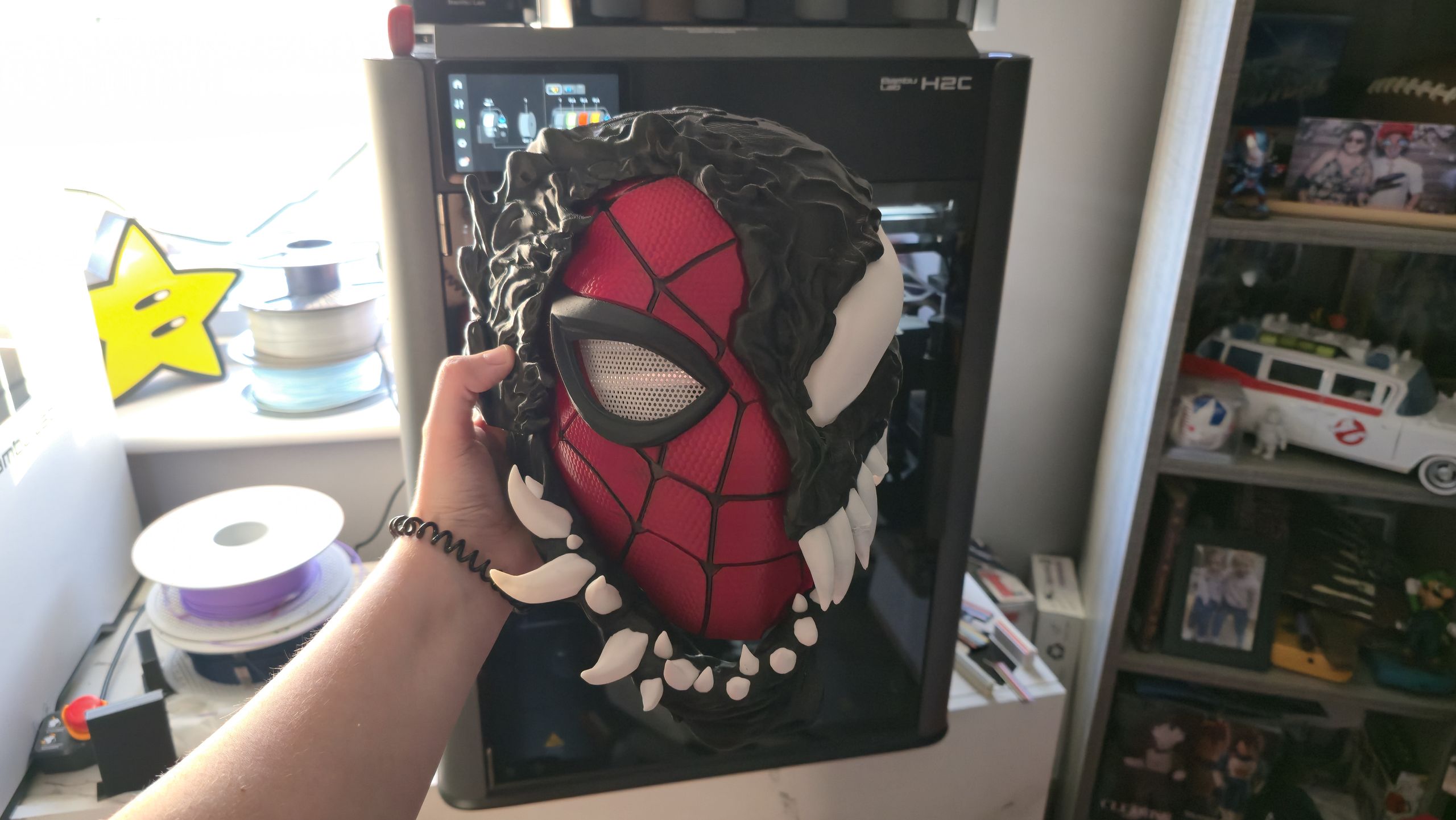
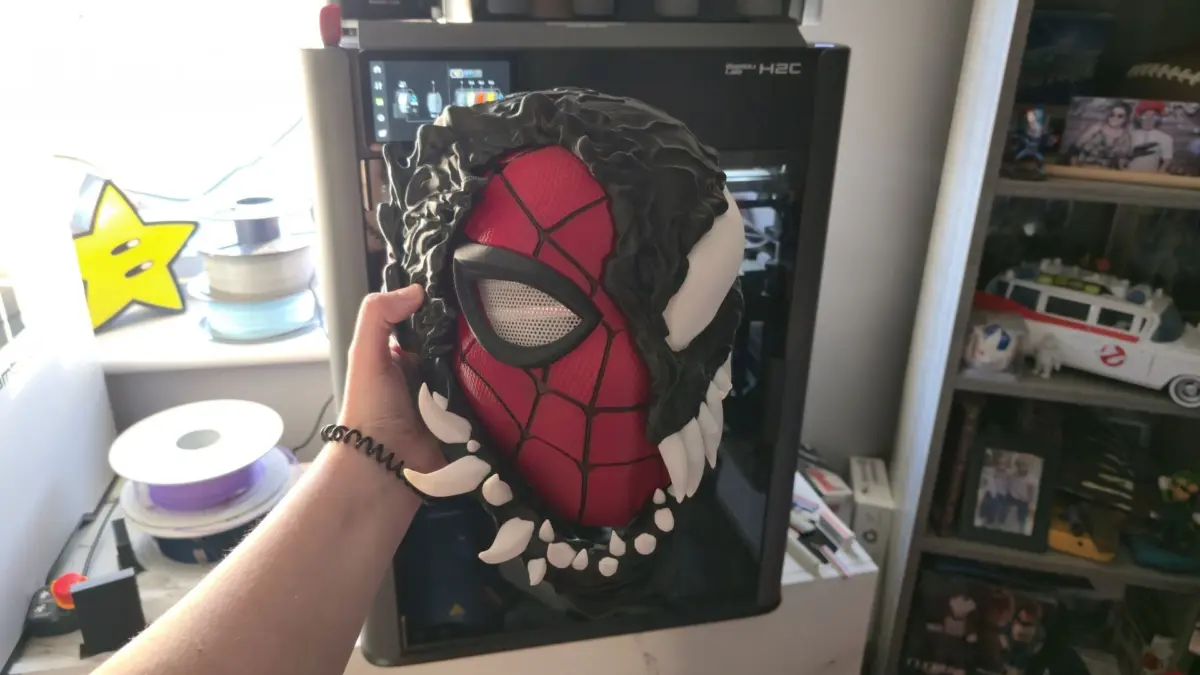
At the apex of Bambu Lab’s discounted offerings is the flagship H2C, a heavy-duty production platform designed for industrial and commercial environments. The H2C is positioned at a substantially higher price point—costing nearly three times as much as the entry-level P2S—and reflects its industrial build quality with an overall physical weight of 32.5 kg. Described by reviewers as virtually limitless in its colour capacity, the H2C is engineered specifically to eliminate the traditional bottlenecks associated with multi-material FDM printing.
The primary technological innovation distinguishing the H2C from its stablemates is its automated hotend-swapping architecture. In standard multi-colour 3D printers, changing filaments requires purging material through a single hotend, which consumes significant time and generates substantial plastic waste over thousands of layer switches. The H2C bypasses this limitation by physically swapping out hotend assemblies during tool changes.
This hotend-swapping mechanism dramatically reduces both material purge volume and overall execution time. In practical testing scenarios, complex multi-colour print jobs that required more than three days (72 hours) to complete on conventional single-nozzle systems like the H2S were completed in just over 24 hours on the H2C. For commercial print farms, design studios, and enterprise rapid-prototyping labs operating under tight schedules, this three-fold increase in operational speed and reduction in material waste offers a clear path toward maximizing production throughput.
How to Choose the Right Model
Selecting the appropriate printer from Bambu Lab’s early Black Friday sale depends primarily on the volume of multi-colour work an operator performs, the specific material profiles required for their projects, and the overall volume of production.
All three bundles featured in the promotion share several core hardware capabilities. Each system comes standard with an enclosed cabinet structure, an integrated AMS 2 Pro unit for automated filament feeding and moisture control, and AI-driven error detection routines designed to pause prints and alert operators if optical sensors detect layer shifts, filament spaghettification, or nozzle obstruction. Because these foundational features are consistent across the lineup, buyers can evaluate their choice based on specific performance differentiators.
For the vast majority of standard users, hobbyists, and digital creators, the Bambu Lab P2S offers the strongest balance of features and value. At its discounted price of $649, it delivers out-of-the-box multi-colour printing capabilities alongside robust support for popular standard and technical plastics like ABS and ASA. For individuals who do not require active thermal chamber management or dedicated dual-nozzle support setups, the P2S delivers commercial-grade reliability at an accessible consumer price point.
For engineering environments, product designers, and functional prototyping specialists, the X2D represents a targeted upgrade. The inclusion of the 65°C active chamber heater expands the printer’s utility when working with high-temperature industrial thermoplastics, while the secondary auxiliary nozzle simplifies the printing of intricate geometries that require dedicated support structures. Although the auxiliary nozzle is subject to specific filament restrictions, the ability to separate support media from the primary model build path makes the X2D a compelling step up for technical workloads.
Finally, for high-volume production studios, commercial makers, and enterprises where multi-colour printing represents a primary business revenue stream, the flagship H2C stands out as the ultimate production tool. While its initial financial investment is significantly higher and its 32.5 kg chassis requires a sturdy, dedicated bench setup, its hotend-swapping architecture addresses the most severe operational drawbacks of multi-material FDM printing. By cutting print times by up to two-thirds and drastically reducing filament purge waste, the H2C provides a heavy-duty solution engineered for continuous, enterprise-level manufacturing.
With Bambu Lab’s Black Friday promotion active through December 1, potential buyers have an extended window to evaluate their workspace requirements, assess their material needs, and choose the platform that best fits their creative or commercial production goals.