In the 2021 satirical film Don’t Look Up, directed by Adam McKay and starring Leonardo DiCaprio, humanity’s stubborn refusal to look up toward an approaching comet served as an allegory for societal denial and political distraction. Yet beyond its immediate commentary, the film struck a deeper chord regarding modern human behavior: the ubiquitous sight of people navigating urban streets with their heads tilted downward, eyes glued firmly to smartphone screens. For well over a decade, the mobile revolution has tethered public attention to handheld glass rectangles, conditioning pedestrians to walk through cities largely detached from their immediate physical surroundings.
As personal technology transitions toward head-worn smart glasses—wearable devices capable of projecting digital information, graphics, and high-definition visual content directly into the wearer’s field of vision—a major cultural and spatial shift is taking shape. While debate continues over whether smart glasses will eventually replace the smartphone entirely, their potential widespread adoption introduces profound implications for the physical world, particularly for the global outdoor advertising industry.
At first glance, it might seem logical to assume that as personal screen technology becomes more tailored, immersive, and digitally immediate, physical advertising would become one of its primary casualties. A common perspective suggests that if lightweight eyewear can project personalized digital feeds directly onto a user’s retina, static outdoor posters, hoardings, and physical billboards would quickly become obsolete relics of a bygone era. After all, why would brands continue investing in costly real-world display boards when consumer attention can be captured entirely in virtual space?
However, a closer analysis of human ergonomics and urban navigation reveals a compelling counter-argument: wearable augmented reality (AR) technology may actually revitalize physical billboards rather than diminish them. Smart glasses are fundamentally designed to allow users to navigate the physical world while maintaining an active line of sight. Pedestrians do not wear head-mounted displays to stare at their feet; the core appeal of smart glasses lies in keeping one’s eyes up, observing the real environment while receiving ambient digital augmentations. Because towns and cities across the globe are already extensively covered in physical advertising surfaces, these structures offer natural, real-world visual anchors for interactive digital layers.
Make billboards great again
For more than a century, outdoor billboards have functioned as an inherently one-way medium. A brand erects a large-scale graphic or message along a street or transit corridor, and passersby consume it visually as they move past. Over the past decade, advertisers attempted to bridge the divide between physical static media and digital interaction through quick response (QR) codes. In theory, QR codes promised to convert passive viewing into active engagement. In practice, however, the technology suffered from significant user friction. Very few pedestrians are willing to interrupt their walk, stop in the middle of a busy sidewalk, pull a smartphone from their pocket, open a camera application, and carefully align the camera frame with a small pixelated square printed on a distant banner. While QR code usage experienced brief surges, it failed to fundamentally transform outdoor advertising into a seamless, interactive experience.
The integration of artificial intelligence assistants directly into smart glasses completely alters this dynamic, eliminating physical friction entirely. Instead of requiring manual camera operation, interaction becomes instantaneous and hands-free. When a wearer glances at a billboard, an AI assistant operating within the eyewear can instantly recognize the target advertisement, process contextual cues, and respond to voice commands or subtle inputs.
Consider how this transformational interaction applies to a movie billboard. Under the traditional model, a poster provides a static image, title, and release date. Through smart glasses, looking at that same poster can trigger an immediate, multi-layered digital experience. A viewer looking at a film poster could simply ask their glasses to play the theatrical trailer, which renders in a floating digital window directly adjacent to the physical frame. Continuing the dialogue, the user could inquire about nearby theaters screening the film, view live showtimes, and immediately receive three-dimensional, turn-by-turn augmented reality navigation arrows overlaid directly onto the sidewalk to guide them to the multiplex.
While such scenarios once sounded like speculative fiction reminiscent of episodes from Black Mirror, many technological concepts originally depicted in sci-fi narratives have swiftly crossed into everyday reality. The outdoor advertising and design industries are actively preparing for this spatial computing future, recognizing that physical locations will increasingly serve as structural frameworks for layered digital experiences.
Evidence of this emerging hybrid strategy is already operational in London’s urban landscape. Located on Shoreditch High Street in East London, an outdoor media site named Electric Garden bills itself explicitly as “the billboard you can walk into.” The venue spans a massive 21,000-square-foot open-air site situated directly behind a high-impact row of giant digital display screens.

The structural model behind Electric Garden bridges traditional out-of-home advertising with physical experiential design. Brands run high-visibility promotional campaigns on the massive street-facing digital screens to catch the attention of passing traffic and pedestrians. However, instead of limiting the campaign to flat screen visual media, the space behind the hoardings allows advertisers to build fully realized, three-dimensional physical worlds that pedestrians can physically enter and explore.
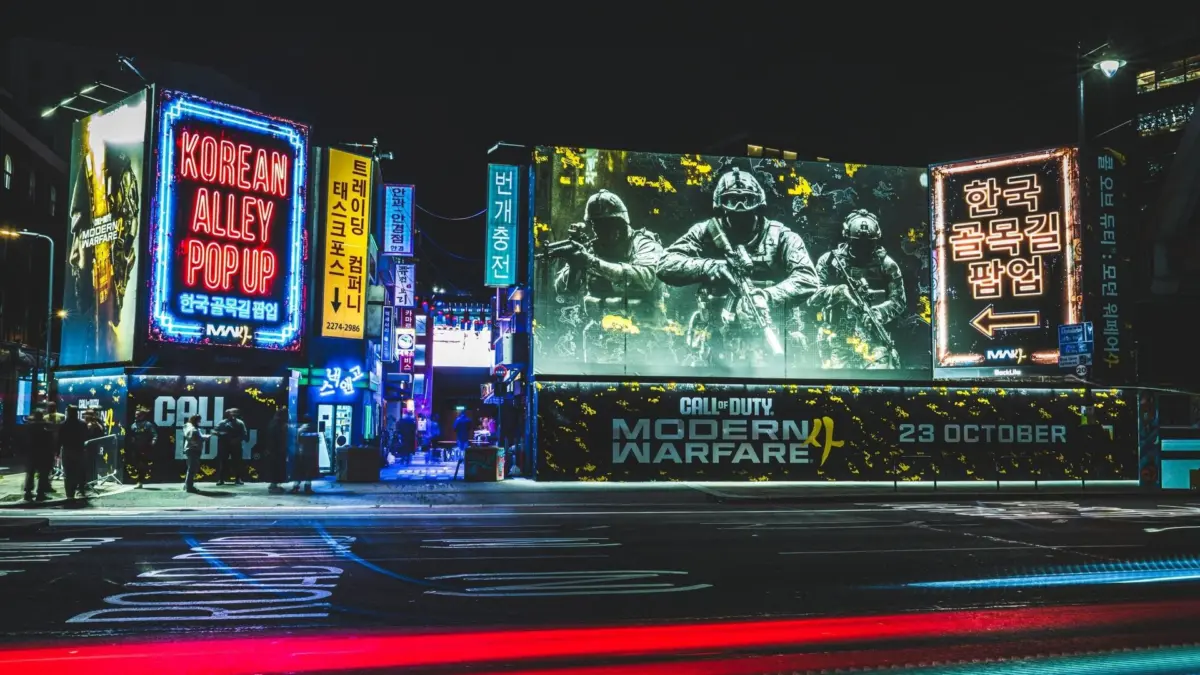
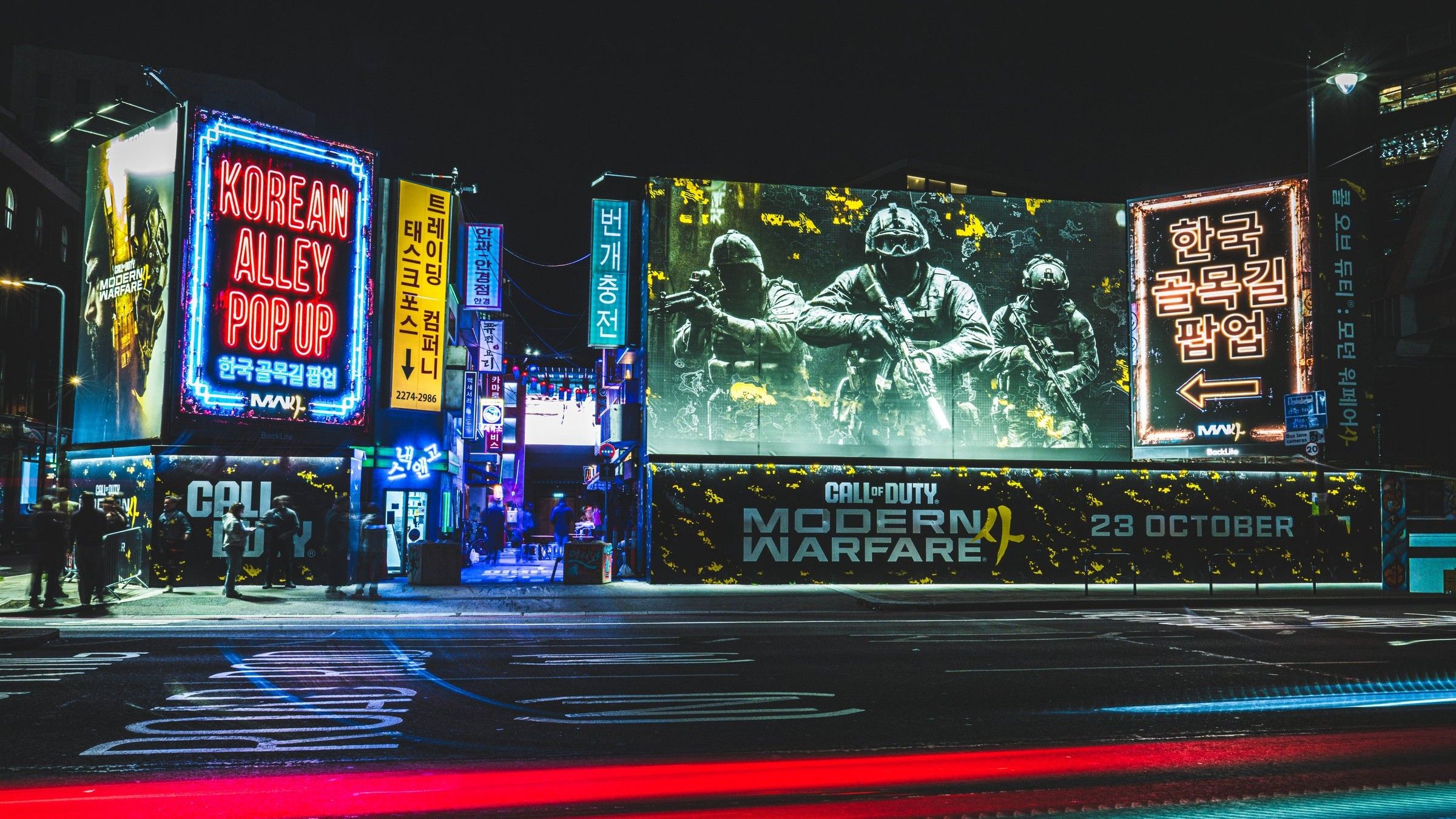
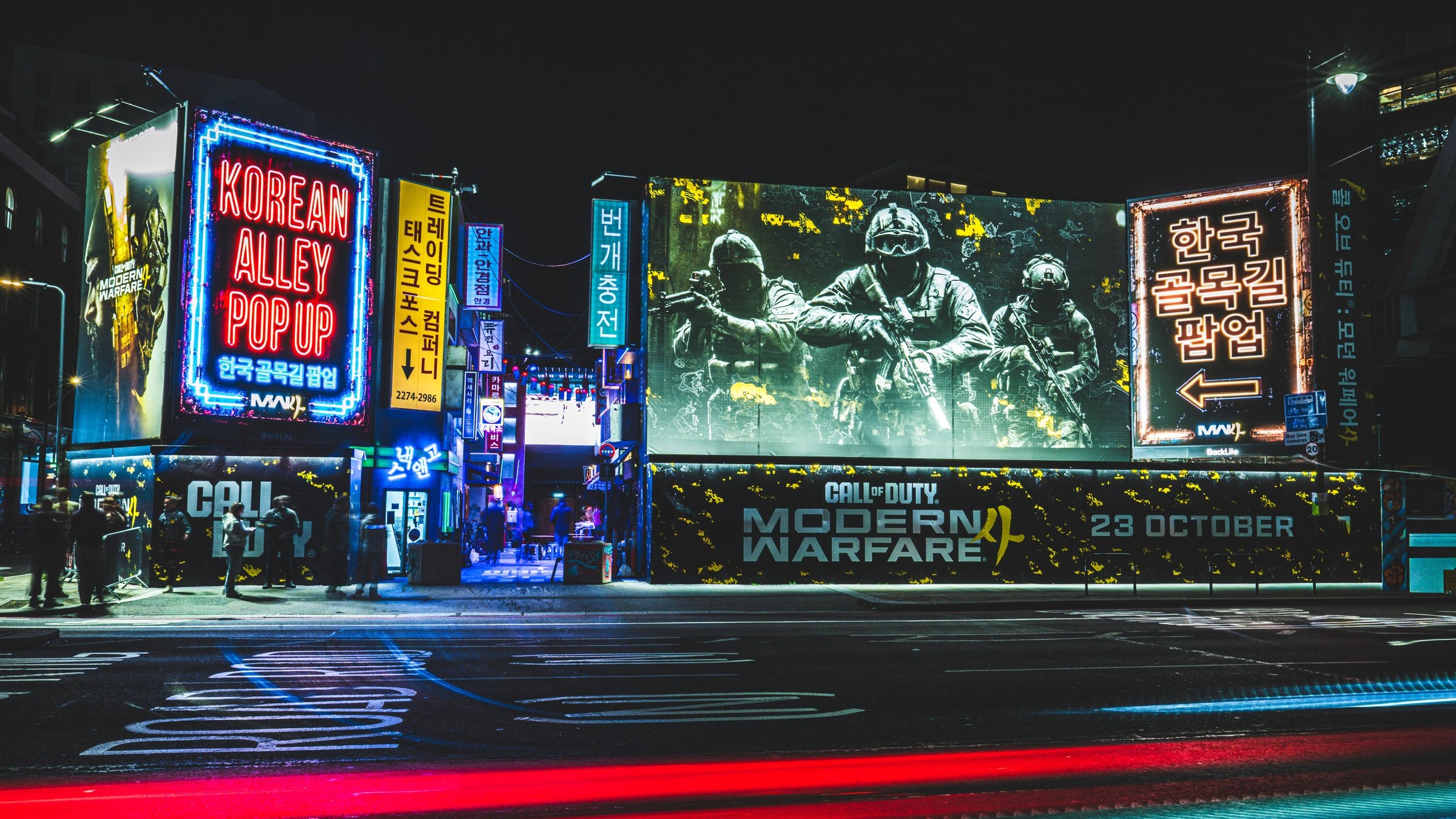
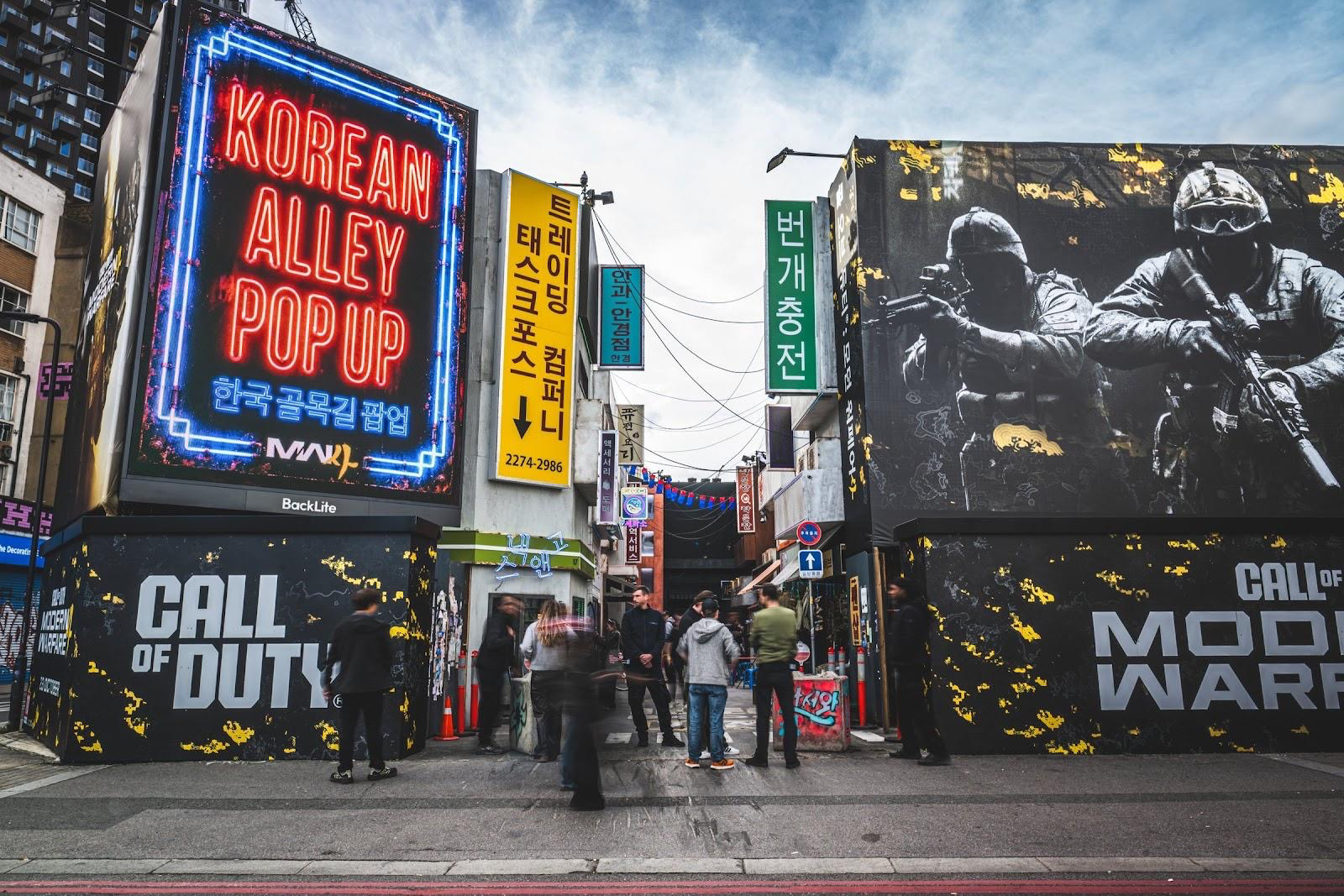
For its launch campaign, Electric Garden partnered with video game publisher Activision to promote Call of Duty: Modern Warfare 4. The site transformed its 21,000-square-foot footprint into a neon-lit, Seoul-inspired urban alleyway. The detailed physical installation featured mock convenience stores outfitted with brightly illuminated Korean-language signage, traditional plastic street stools, atmospheric lighting, and interactive, on-site code-breaking missions designed for visitors to complete.
Reflecting on the philosophy behind the installation, Electric Garden co-founder Alex Ezen highlighted the evolving demands of brand engagement: “A screen can capture attention, but a physical experience gives people a reason to stop, take part and share it.”
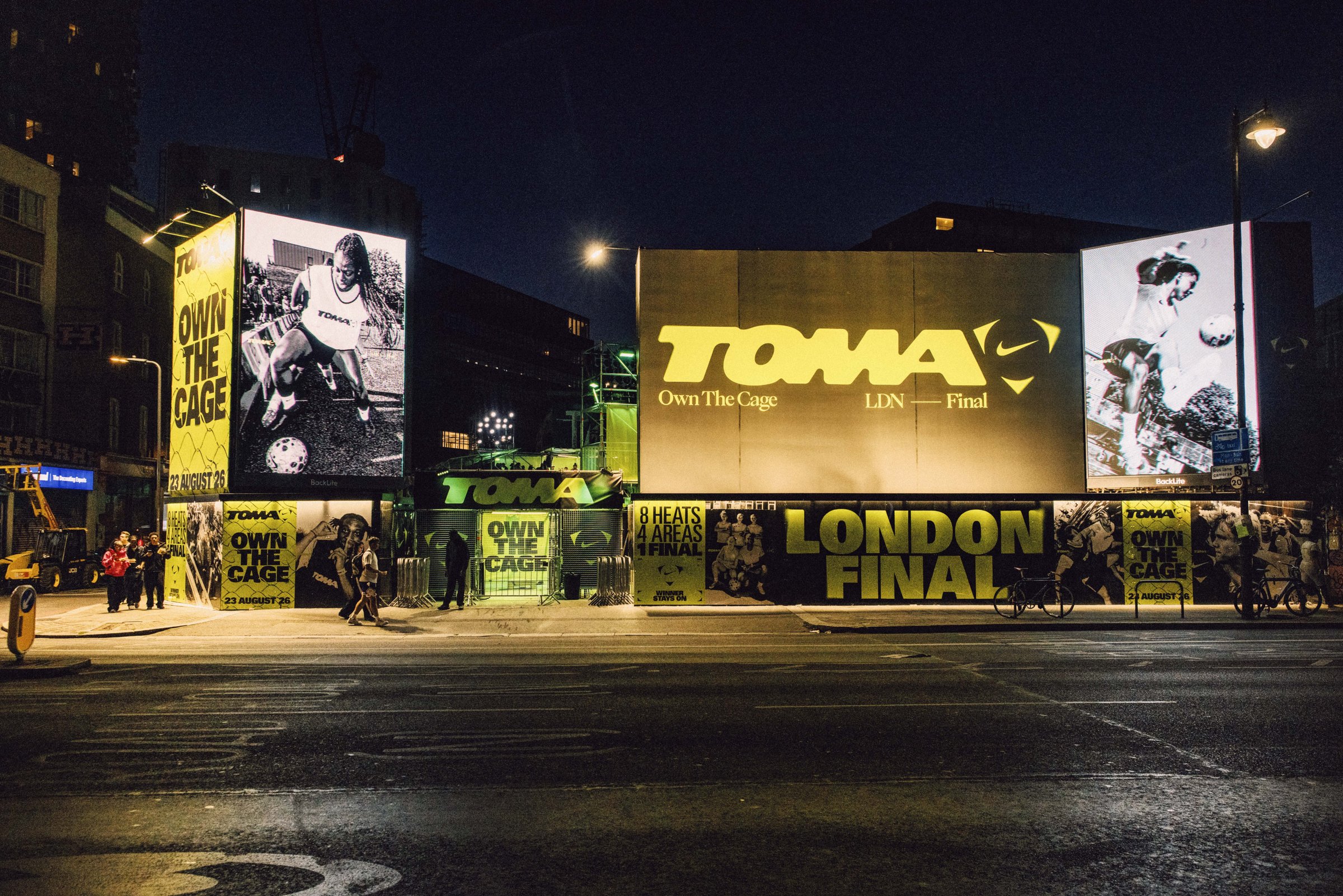
The versatility of combining large-scale physical hoardings with immersive brand narrative space is evident across multiple high-profile activations hosted at the Shoreditch location. Global sportswear brand Nike utilized the space for its TOMA football campaign, surrounding the perimeter with vibrant yellow-and-black hoardings displaying slogans such as “Own the cage” and “London final” alongside striking black-and-white portraits of professional footballers. Similarly, streaming platform Netflix converted the street-facing screen structures to showcase a season of visionary film directors, displaying massive promotional artwork for featured titles including Steve, Frankenstein, and Jay Kelly above bold purple-and-black hoardings.
Electric Garden demonstrates that high-impact physical billboards retain extraordinary value when paired with experiential depth. Smart glasses have the potential to democratize this interactive concept across the entire urban environment. While constructing physical pop-up alleyways like Electric Garden requires substantial real estate, construction material, and logistical overhead, augmented reality powered by smart glasses can project rich, fully interactive digital dimensions over any standard billboard, transit shelter, or building façade anywhere in the world.
This spatial evolution presents both an exciting opportunity and a complex brief for graphic designers, art directors, and advertising agencies. The discipline of outdoor ad design is expanding beyond traditional two-dimensional composition, typography, and visual balance. Creatives will increasingly need to design multidimensional campaigns, considering how static physical graphics will interact with real-time digital overlays, localized spatial data, dynamic audio feeds, and conversational AI interfaces.
Far from rendering physical billboards obsolete, the rise of head-mounted spatial computing promises to restore the outdoor ad to a central position in public life. By transforming static urban surfaces into interactive gateways for story-telling, navigation, and entertainment, smart glasses offer a compelling reason for a smartphone-weary public to finally stop looking down at their handheld screens and start looking up at the world around them.