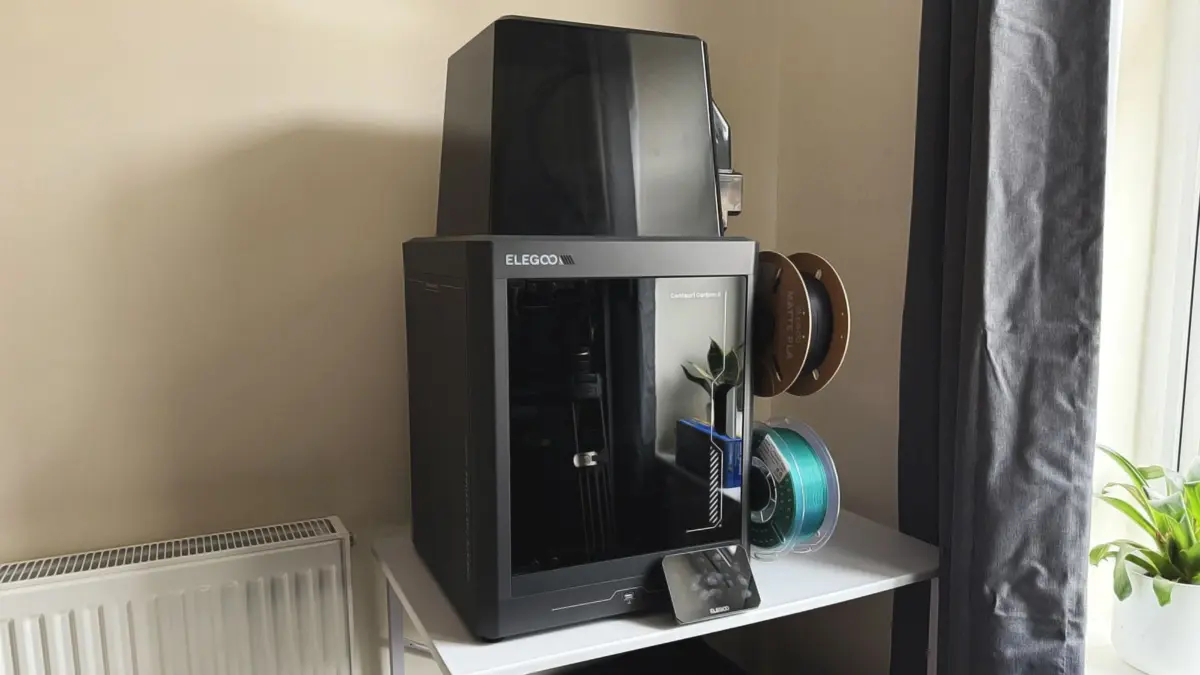
Desktop additive manufacturing is undergoing a rapid evolution as multi-color fused deposition modeling (FDM) technology transitions from an expensive niche to an accessible consumer standard. For years, printing multi-colored or multi-material models required complex aftermarket upgrades, double-nozzle extrusion systems prone to clogging, or investment in enterprise-grade machinery costing thousands of dollars. Today, a new wave of budget-friendly desktop hardware is transforming the maker landscape by integrating automated filament switching systems and high-speed motion control directly into affordable, out-of-the-box machines. Among the most notable recent arrivals in this sector is the Elegoo Centauri Carbon 2, a high-speed desktop 3D printer that has quickly gained attention for combining exceptional FDM print quality, intuitive software integration, and effortless multi-color operation.
Expanding its competitive edge in a crowded market, the Elegoo Centauri Carbon 2 has recently seen a price drop on Amazon. The online retail giant has discounted the unit from its original list price of $424.97 down to $401.28. While a price cut of roughly $23 may seem modest at first glance, it represents a meaningful shift in a market segment where price-to-performance ratios are closely scrutinized by prospective buyers. Even at its full original price, the Centauri Carbon 2 was positioned as a lower-cost alternative to competing high-speed multi-color platforms such as the Creality K2 Pro. At just over $400, the printer further consolidates its standing as one of the most cost-effective entry points into automated multi-filament desktop manufacturing.
Hardware evaluators with over a decade of experience testing 3D printers across various generations of consumer and professional machines have highlighted the Centauri Carbon 2 as a standout release. Reviews emphasize its user-friendly installation process, durable structural construction, and surface layer smoothness that ranks among the best achieved by standard FDM printers. Rather than requiring extensive mechanical tuning or complex calibration routines out of the box, the printer offers a refined experience that appeals to both seasoned additive manufacturing enthusiasts and newcomers attempting multi-color workflows for the first time.
At the heart of the Centauri Carbon 2’s multi-material capability is Elegoo’s Canvas system, an automated filament management unit capable of hosting up to four separate reels of filament at once. Managing multi-color prints has traditionally been one of the most frustrating aspects of FDM printing, often involving tedious manual threading, fine-tuning retraction settings, and manually assigning material profiles within slicing software. The Canvas system streamlines this workflow considerably. Testers found the physical loading process of the multi-spool system to be exceptionally fast and uncomplicated, reducing physical setup time down to a few basic steps.
To further streamline the user experience, the system incorporates automated material recognition via Radio-Frequency Identification (RFID) technology. When users equip the printer with filament spools containing compatible RFID tags, setting up a print job requires almost no manual data entry. Operators simply hold the RFID-equipped spool near the designated reader on the side of the unit, and the printer automatically detects the filament type, color profile, and optimal operating temperatures. The machine then configures its internal parameters accordingly. For prints utilizing non-RFID standard spools, software integration remains similarly streamlined: upon opening a multi-color project file in the slicing software, an intuitive setup window prompts the user to quickly assign each color element of the digital model to its corresponding spool slot on the multi-feed array.
Mechanically, the Elegoo Centauri Carbon 2 relies on a CoreXY kinematic system, a motion architecture favored in modern high-speed 3D printing. Unlike traditional Cartesian printers, where the print bed moves forward and backward along the Y-axis while the print head travels along the X-axis, CoreXY designs keep the print bed moving only vertically along the Z-axis. The print head itself is driven by a system of intersecting timing belts powered by stationary stepper motors mounted directly to the rigid outer frame. By eliminating the weight of moving stepper motors from the X and Y axes, the print head mass is significantly reduced, allowing for rapid acceleration and deceleration without generating excessive mechanical inertia or frame wobble.
This CoreXY architecture allows the Centauri Carbon 2 to reach maximum print speeds of up to 500 millimeters per second while maintaining high structural stability throughout operating cycles. Combined with a respectable build volume of 256 by 256 by 256 millimeters, the machine provides ample capacity for producing medium-to-large functional parts, artistic sculptures, or multi-component assemblies. Crucially, high operational speed on the Centauri Carbon 2 does not come at the expense of print quality. During hands-on evaluation, reviewers tested the printer’s motion precision and tolerance management by printing a single-piece fidget toy containing interconnected moving parts designed to articulate immediately upon completion. The print emerged from the build chamber with exceptionally smooth surface finishes and effortless mechanical movement, demonstrating that the machine can execute precise tolerances without fusing adjacent moving components during high-speed multi-color passes.
Despite its impressive performance capabilities, the Centauri Carbon 2 does present a few practical hardware trade-offs that prospective buyers must account for before setting up the machine in their workspace. The primary drawback of the unit stems from its physical footprint and clearance requirements. Because the four-spool filament management system is designed to mount alongside the chassis, and an automated waste chute is positioned at the rear of the machine to purge excess filament during color transitions, the printer demands a significant amount of open space around its perimeter.
The rear waste chute is an essential physical component of single-nozzle multi-color FDM printing. Whenever the machine transitions from one filament color to another, it must retract the active filament, feed the new color into the hotend, and purge the leftover melted filament from the nozzle to prevent color bleeding. This purged material is deposited out of the rear chute as small waste fragments. Consequently, users cannot push the printer flush against a wall or tuck it into a tight enclosure; adequate rear clearance must be maintained to allow waste material to fall freely into a collection container. Combined with the lateral width added by the side-mounted spool assemblies, the Centauri Carbon 2 requires a generous workbench area, making spatial planning a key consideration for home workshops, offices, or crowded classrooms.
Nevertheless, the printer’s physical space requirements are easily outweighed by its construction quality, performance metrics, and current price point. The market for desktop 3D printers has become increasingly competitive, with manufacturers racing to provide faster speeds, better material management, and smarter automation features at lower consumer price tiers. For years, competing brands held a dominant share of the budget desktop market, but manufacturers like Elegoo have rapidly closed the gap by introducing hardware platforms that deliver advanced multi-color capabilities at lower cost thresholds. The Creality K2 Pro, while powerful, carries a higher baseline price point, giving the Centauri Carbon 2 a clear financial advantage for budget-conscious buyers seeking similar functional features.
The ongoing reduction in pricing for multi-color FDM hardware reflects a broader democratization of additive manufacturing tools. What was once limited to dedicated industrial rapid-prototyping labs is now easily deployable on a standard desktop. The ability to automatically switch between four different filaments allows makers to produce multi-colored logos, complex visual prototypes, support-material assisted overhangs, and multi-property functional components within a single uninterrupted print job.
By combining a reliable 500mm/s CoreXY frame, intelligent RFID filament detection, an accessible four-spool Canvas system, and exceptional out-of-the-box surface finish quality, the Elegoo Centauri Carbon 2 stands as one of the most compelling options in the modern desktop 3D printing segment. With Amazon lowering the price to $401.28 from its original $424.97 baseline, the barriers to adopting fast, high-quality, multi-color 3D printing have dropped even lower, offering exceptional value for hobbyists, educators, and design professionals alike.