For modern digital teams, launch day represents a rare moment of complete perfection. The final branch is merged into the code repository, every design component aligns seamlessly with brand guidelines, and the site goes live exactly as envisioned. For a brief instant, the digital presence of a company is flawless.
Yet, as industry veterans know, that moment is fleeting. A website is almost never as good as it is on the day it ships.
This decline is rarely caused by technical failure or catastrophic bugs. Instead, it is driven by the relentless pace of the broader market. Messaging shifts over time, competitors launch aggressive new campaigns, design systems evolve, and minor maintenance tasks slip through the cracks. As a business grows and adapts, the carefully constructed website built just twelve months prior slowly ceases to mirror the company it represents. Without constant, deliberate intervention, a site becomes a period piece—not explicitly broken, but fundamentally left behind.
For decades, digital product teams have treated this steady post-launch decay as an inescapable law of web development. However, the emergence of autonomous software agents promises to challenge this assumption, offering a vision of websites that continuously refine, repair, and optimize themselves long after launch.
Yet, as platform builders attempt to turn full web autonomy into reality, they are uncovering a paradox that has little to do with raw technology: virtually no organization actually wants a website that changes entirely on its own.
Pierre Burgy, building on experience from developing the autonomous website platform Fimo, has spent significant time studying how teams interact with automated site maintenance. The lessons learned reveal that solving post-launch decay requires moving past the simplistic idea of total automation, focusing instead on the complex intersection of human judgment, organizational dynamics, and customizable agent control.
Why “Just Make It Autonomous” Is The Wrong Goal
When powerful AI agents first became capable of reading codebases, interpreting design rules, and writing copy, the obvious product direction appeared straightforward: hand the entire website over to the technology. The concept of letting autonomous agents continuously draft content, edit layouts, optimize performance, and deploy changes directly to production seemed like the logical destination for web engineering.
When put into practice, however, complete autonomy quickly ran into cultural and operational walls.
During the development of Fimo, an autonomous website platform designed to maintain sites after launch, the initial hypothesis was that teams would eagerly embrace a hands-off, fully automated system. Instead, early users consistently hesitated.
This friction did not stem from a lack of technical confidence in the capabilities of the underlying models. Rather, it emerged because a corporate website is rarely owned by a single individual or department. A typical digital presence is a shared asset claimed by product managers, brand strategists, front-end engineers, compliance officers, and copywriters. Each stakeholder possesses a distinct tolerance for automation and a different threshold for what constitutes an acceptable modification.
The core challenge of automated web upkeep was never simply a matter of trusting the agents to perform tasks correctly. Instead, the central problem was determining precisely where to draw the boundary of control—and recognizing that this boundary shifts depending on who is using the platform.
When analyzing website maintenance through this lens, the work required to keep a site healthy splits into three distinct categories.
Most Of It Is A No-brainer
The vast majority of ongoing website maintenance consists of routine, rule-bound, and repetitive tasks. This layer represents the hidden administrative burden that drains developer hours and leads to eventual site degradation when neglected.
Consider the baseline requirements of modern web health: maintaining accessibility compliance across dozens of dynamic templates; propagating global design system updates whenever a color token or spacing variable changes; identifying and compressing high-resolution images uploaded during rushed marketing pushes; and fixing broken meta tags or dead hyperlinks caused by URL restructures from previous development sprints.
None of these tasks require creative breakthrough or artistic taste. No designer or engineer was hired specifically for their passion for auditing image alt text or updating legacy CSS tokens. Because these responsibilities are strictly defined by clear rules rather than subjective preference, they represent the ideal workload for autonomous agents.
An automated system that quietly monitors and corrects these compliance, performance, and structural issues in the background presents no threat to creative autonomy. Instead, it eliminates the tedious 80 percent of site maintenance that human teams actively dread. When viewed this way, assigning this operational layer to background agents is not a surrender of control, but a practical offloading of repetitive chores.
Some Of It You’d Never Hand Over
At the opposite end of the spectrum sits a category of work that teams will not delegate to software under any circumstances. While this constitutes a much smaller portion of total site maintenance, it represents the foundational identity of the brand.
An advanced AI agent can rapidly evaluate a newly drafted page against every programmatic rule provided to it. It can verify that text contrast meets legal standards, confirm heading structures follow proper document hierarchy, check design system tokens, and ensure written copy aligns with basic style guides. What an agent cannot do, however, is determine how a page should fundamentally feel, or whether a creative direction achieves genuine artistic and emotional resonance.
Subjective taste and strategic vision remain strictly human domains. Creative direction is precisely what human designers and brand strategists are employed to deliver, and no degree of algorithmic sophistication changes that reality.
When critics express skepticism toward autonomous websites, they typically point to this high-level creative judgment as something machine intelligence should not touch. Their instinct to protect human creative authority is entirely correct; the error lies in assuming that an entire website consists of these sacred design choices. In reality, while artistic taste governs only a small fraction of day-to-day web updates, its importance guarantees that fully unmonitored site creation will remain undesirable for serious brands.
And A Lot Of It Depends On Who You Are
Between purely mechanical chores and high-level creative direction lies a vast gray area of website decisions. In this middle zone, software platforms cannot provide universal, pre-set rules because the definition of an acceptable automated change depends entirely on the role of the person managing the system.
Consider a practical example: altering a website’s code to make dark mode the default visual theme for all incoming visitors. Technically, an autonomous agent can execute this configuration shift in a matter of seconds. However, organizational friction arises over who holds the authority to mandate that change.
For a lead brand designer, the default visual theme is far more than a technical setting; it is a fundamental statement about brand identity, visual tone, and how the company presents itself to the world. A designer will naturally demand direct control over this decision. Conversely, for a systems developer focused on site performance and user experience metrics, setting dark mode to default may appear to be a straightforward configuration tweak supported by user preference data—a task that could easily be automated and deployed without administrative review.
This dynamic demonstrates that different team members interpret identical site modifications in completely opposite ways. The divergence is not driven by one party being overly cautious and the other overly permissive. Rather, the exact same action carries vastly different degrees of subjective risk depending on an individual’s responsibilities within the organization.
Because the perception of risk is fundamentally tied to job role and personal oversight rather than the technical action itself, no software platform can ship with a single, permanent autonomy threshold that satisfies every user. Effective control must be configurable per task and per individual.
You Don’t Just Set The Autonomy: You Build The Agent
Recognizing that control must be tailored to individual roles shifts the problem away from global settings menus. A basic master switch that toggles between "require manual approval" and "fully delegate" is insufficient for real-world development workflows. Because boundaries depend entirely on context, control must be applied at the level of individual agents.
This realization shaped the architecture of the Fimo platform. Instead of forcing teams to select from a rigid set of pre-configured behaviors, the system allows users to compose specialized, modular agents mapped to specific operational boundaries.
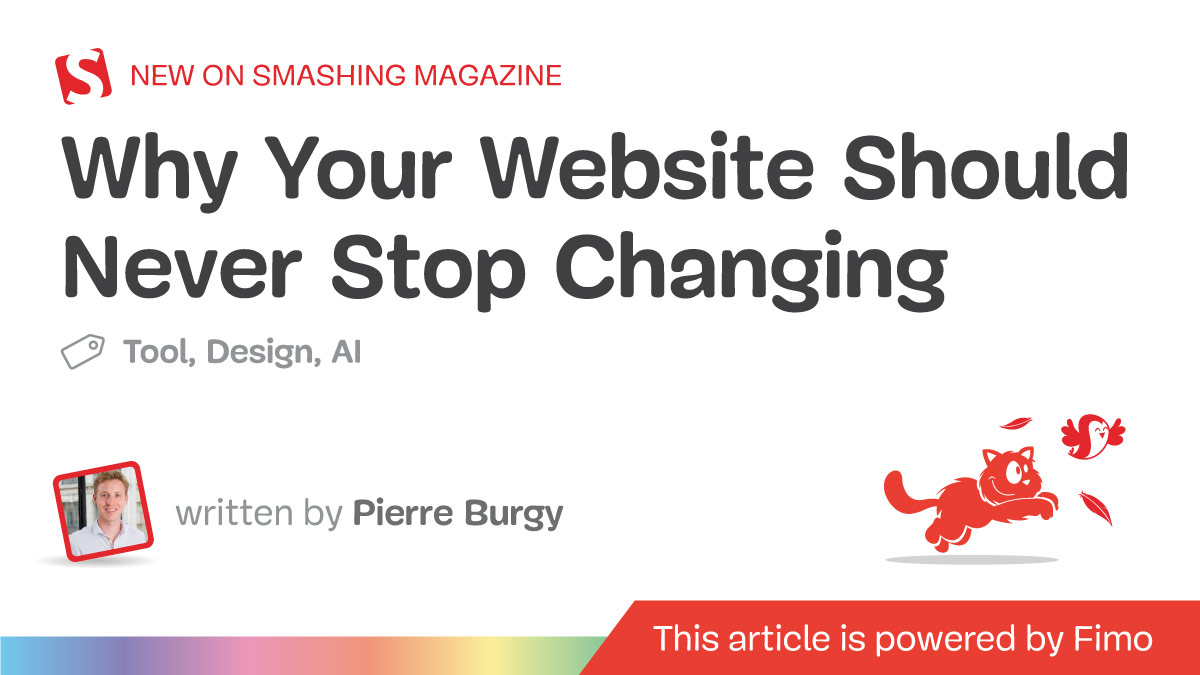
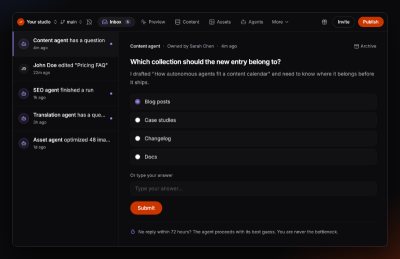
Organizations can construct tailored agents or adapt existing frameworks to match their internal risk tolerance. For instance, a team might deploy a specialized accessibility agent authorized to repair code compliance issues entirely unattended, while simultaneously running a dedicated content agent programmed to submit all brand-facing copy edits to a human editor for review before publishing.
Crucially, these boundaries are not static. As specialized agents execute tasks over time, they gather context from team feedback and historical approvals. A task that initially required explicit human sign-off can gradually be transitioned toward higher levels of autonomy as the agent demonstrates consistent adherence to corporate standards. Trust is earned incrementally, allowing the line of automation to shift naturally toward reduced manual oversight without compromising site integrity.
Start Narrow, and Widen As You Trust It
In practical deployments, adopting autonomous web maintenance rarely involves granting sweeping permissions on day one. Instead, implementation follows a progressive model where teams delegate narrow, low-risk responsibilities, observe system performance, and gradually expand operational scope.
Transparency is essential to building this confidence. To facilitate trust, agent platforms provide comprehensive execution logs, operational histories, and detailed visual diffs displaying exact before-and-after states for every proposed or executed modification. Trust grows not from abstract faith in artificial intelligence, but from clear, auditable visibility into real-world changes.
To ensure automated processes do not stall due to busy human reviewers, platforms can incorporate time-bound approval windows. If a human reviewer does not intervene within a designated timeframe for low-risk tasks, the agent proceeds with deployment based on predetermined rules. This structure prevents human team members from becoming operational bottlenecks while preserving explicit fallback mechanisms.
The Frozen Site Is The Real Risk
The primary anxiety voiced by digital teams approaching website autonomy is the fear that an automated agent might publish an unapproved or incorrect change. While risk management is essential, this perspective overlooks a far more pervasive operational threat: the danger of a completely static website.
A site frozen in time does not remain secure or relevant. Instead, it slowly decays, falling behind shifting market demands, evolving browser standards, and updated corporate priorities. Over time, an unmaintained web presence gradually degrades until it represents an organization that no longer exists in that form.
The ultimate goal of targeted web autonomy is not to remove human creators from their websites, but to eliminate post-launch decay. By delegating rule-bound maintenance to specialized background agents, organizations can prevent their launch-day version from being their best version. This approach allows human designers, developers, and strategists to focus their time and creative energy on high-value decisions, leaving routine upkeep to continuous, automated oversight.