The new headquarters Apple is building in Cupertino features what might be the absolute finest door handles in existence. As WIRED’s Steven Levy has noted, they are precision-milled aluminum rails attached to glass doors—both sliding and swinging—completely devoid of any visible bolts.
Virtually everything in this gargantuan structure represents the pinnacle of high-end design. The toroid glass roofing curves scientifically to shed rainwater efficiently. In the event that California’s notoriously dry climate persists, an arborist carefully selected thousands of drought-tolerant trees for the 175-acre campus. Not every Apple employee will secure a desk inside the new crown jewel, but roughly 12,000 workers will call it home. Naturally, the campus provides only 9,000 parking spaces, a deliberate design choice meant to encourage personnel to utilize Apple’s shuttle network. Once they arrive, the amenities are designed to make leaving entirely unappealing: a fitness center boasting a climbing wall with pre-distressed stone, rounded concrete edges on parking lot walls, yacht-grade fire suppression systems, and wood paneling harvested precisely at the mid-winter window demanded by the late Steve Jobs to ensure the sap content remained minimal.
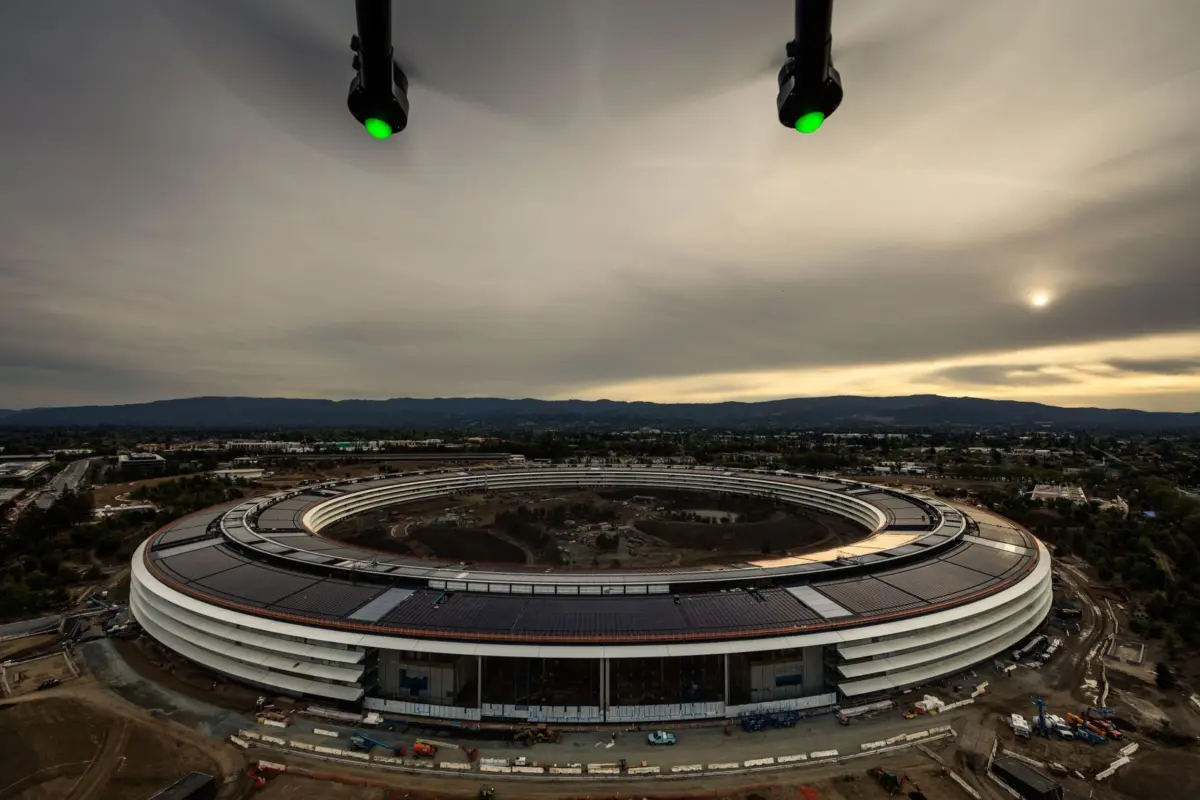
Whether observers call it the Ring, the Death Star, or the Spaceship, an unmistakable colossus has touched down in Cupertino. It is impossible to question the sheer elegance of its architecture. This $5 billion, 2.8 million-square-foot facility is a monument to the genius of Steve Jobs, Jony Ive, and Norman Foster.
Yet, understanding a building requires examining its surroundings—its site, as architects say. From that broader perspective, Apple’s new headquarters emerges as a retrograde, inward-looking structure that displays a fundamental disconnect from the city that hosts it and from urban environments at large. While Apple rightly receives credit for defining the look and feel of the future through science-fiction-grade devices, this mega-headquarters borrows straight from the middle of the last century. In doing so, it exacerbates the chronic, endemic problems facing 21st-century suburbs like Cupertino, including transportation, housing shortages, and economic imbalances. Apple Park is an anachronism wrapped in glass, tucked neatly into a residential neighborhood.
The Architecture
Apple Park is far from the first high-end, suburban corporate headquarters. In fact, such layouts were once the standard. Looking back at the 1950s and 1960s reveals iconic structures like the Connecticut General Life Insurance headquarters in Hartford or John Deere’s campus in Moline, Illinois.
"They were stunningly beautiful, high modernist buildings by quality architects using cutting-edge technology to create buildings sheathed in glass with a seamless relationship between inside and outside, dependent on the automobile to move employees to the site," explains Louise Mozingo, a landscape architect at UC Berkeley and author of Pastoral Capitalism: A History of Suburban Corporate Landscapes. "There was a kind of splendid isolation that was seen as productive, capturing the employees for an entire day and in the process reinforcing an insular corporate culture."
By abandoning downtown skyscrapers in favor of expansive suburban plots, corporations mirrored mid-century anxieties about cities, which were frequently viewed as dirty, crowded, and unpleasantly diverse. The suburbs offered exclusive, aspirational, and architectural blank slates alongside enhanced security and isolation from outside job markets where workers might be tempted to explore alternative employment. It was, in essence, corporatized white flight.
Silicon Valley, however, historically operated under different rules. While IBM established a few research facilities modeled on East Coast redoubts, Silicon Valley generally thrived on interchangeable office spaces, according to Mozingo. Companies typically start in a garage, expand into half a floor of an unglamorous office park, take over an entire floor, secure venture capital, and eventually transition to a superior business park. Eventually, a firm grows into a massive corporate empire spanning an entire highway corridor.
During economic downturns or periods of shifting product demand, companies could simply let leases lapse or sell off real estate. More than half of the land utilized for Apple’s new campus previously belonged to Hewlett Packard, just as the Googleplex once belonged to Silicon Graphics. It is the natural economic circle of life.
However, when a company constructs a definitive statement building like the Spaceship, that economic circuit breaks. Should Apple ever face an existential crisis, the fate of the building mirrors that of Union Carbide’s former headquarters—abandonment and uncertainty. Successful buildings engage directly with their surrounding environment. Apple is not situated in some remote suburban arcadia; it occupies a living city, situated across the street from homes and retail developments, immediately adjacent to two freeway onramps.
Despite this urban proximity, the Ring is largely concealed behind artificial berms, evoking Space Mountain at Disneyland. "They’re all these white elephants. Nobody knows what the hell to do with them. They’re iconic, high-end buildings, and who cares?" Mozingo notes. "You have a $5 billion office building, incredibly idiosyncratic, impossible to purpose for somebody else. Nobody’s going to move into Steve Jobs’ old building."
The Landscape
That future-oriented predicament belongs to tomorrow’s Apple. Today’s Apple must grapple with how the campus integrates into Cupertino and the broader, congested Silicon Valley landscape.
Between 2010 and 2015, the San Francisco Bay Area added 640,000 jobs, with more than a third of that growth concentrated in the technology sector. Yet the region failed to construct a commensurate amount of housing. With the exception of a temporary spike during the boom preceding the 2008 financial crisis, new housing unit construction in San Francisco and neighboring Bay Area municipalities has trended steadily downward. When supply drastically fails to meet soaring demand, the predictable result is staggering inflation: the median home price in the Bay Area has climbed to $800,000, with Silicon Valley figures sitting even higher.
Gradually, certain urban centers are attempting to course-correct. San Francisco maintains tens of thousands of housing units in its development pipeline, and San Jose adds thousands annually. However, the smaller towns flanking highways 101 and 280—the home turf of Apple, Google, and Facebook—have remained largely resistant to building new houses or apartment complexes, despite hosting massive tech workforces.
Addressing how this dynamic implicates Apple, Cupertino assistant city manager Aarti Shrivastava explains that the city understood the project’s unique scale. "Apple’s obviously very important to the city, and when they came in with that plan, we understood this wasn’t going to be just any development. They had certain needs." Heightened security concerns were paramount, resulting in restricted public access and the closure of a major thoroughfare.
Early in the planning process, reports indicated that Apple showed little initial willingness to engage in financial "community benefits," while Cupertino’s city council hesitated to pressure one of its largest employers and taxpayers. Although the mayor at the time proposed instituting a business tax on the company, the city council declined to advance the measure. Over time, however, Apple agreed to provide funding earmarked for traffic and parking mitigation. "We had to bring them into our world. They don’t do urban design. They don’t do planning. We Needed to talk to each other," Shrivastava notes.
During its iteration under Hewlett Packard, the site accommodated roughly 5,000 workers; the new Apple complex more than doubles that capacity. Although only 10 percent of those employees reside within Cupertino, an Environmental Impact Report submitted by Apple indicates that local housing demand will surge by 284 percent. Apple agreed to pay a "Housing Mitigation Fee" calculated on overall square footage. Because the new campus adds only about 800,000 square feet over the previous footprint, the company agreed to double the standard fee rate. However, because the city had previously halved the base fee, the resulting payment totals approximately $5 million.
Simple mathematics reveals that with only 10 percent of the campus workforce living in Cupertino, 90 percent must commute from elsewhere, predominantly San Jose and San Francisco. The absence of a cohesive regional transit network prioritizes automobiles, a dynamic that previously prompted tech firms to deploy private shuttle fleets.
Apple’s shuttles traverse the entire peninsula and extend into the East Bay, with corporate targets aiming to raise non-single-occupancy vehicle commutes to 34 percent. According to the environmental impact report, only 1.5 percent of commutes to existing Apple facilities utilize public transit. Based on this metric, the company maintains that the existing public bus system is adequately robust—a circular logic implying that public transit will not expand if demand is artificially suppressed by private corporate fleets.
Beyond transportation, Apple negotiated other community provisions. To offset public space absorbed by the campus, the company contributed $8.2 million for park development elsewhere in Cupertino. Apple also funded local active transportation improvements, covering a $250,000 feasibility study for a nearby intersection and an additional $1 million for another. Recognizing that overflow parking would inevitably spill into residential areas, Apple allocated $250,000 to Santa Clara and $500,000 to Sunnyvale for parking restitution.
Furthermore, Apple agreed to structural tax adjustments. The city previously forgave all business-to-business sales taxes generated by Apple, but under the updated arrangement, the municipality retains 65 percent. The company also financed a $5 million pipeline system to transport recycled water from Sunnyvale to irrigate the campus landscaping, a resource that future developments like the Vallco Mall project may eventually utilize.
Critics note that against Apple’s vast cash reserves of roughly $250 billion, these community contributions appear modest. The tech giant could have easily underwritten expanded CalTrain commuter rail frequency or financed a dedicated transit center in Cupertino.
"Apple could have done anything. Money was no object," says Allison Arieff, editorial director for the San Francisco Bay Area Planning and Urban Research Association. "They want to be innovative in everything, and they’re not innovative in this thing." Instead of addressing regional housing and congestion crises directly through transformative infrastructure investments, Arieff argues, the company focused primarily on local road and highway adjustments.
The systemic challenges facing the Bay Area extend far beyond any single corporate campus. Local governments continually balance the economic benefits of job creation against the costly public services required by residential growth, such as schools and transit. California’s 1978 Proposition 13 drastically restricts annual property tax increases, gutting foundational state services like public education while transforming real estate into the primary vehicle for personal wealth accumulation. Consequently, long-term homeowners have strong financial disincentives against approving nearby multi-family housing developments that might alter property values.
Simultaneously, municipal budgets are increasingly strained by public employee pension obligations. With limitations on residential property taxation and new housing construction, commercial real estate and technology booms offer vital municipal revenue streams.
Some contemporary technology firms have adopted alternative models. Cloud storage provider Box situated its primary building directly across the street from the Redwood City CalTrain station, opening its parking lots to downtown visitors on weekends. Such approaches prioritize regional connectivity over inward-facing isolation.
Transnational technology corporations face unique structural hurdles in local engagement. "Tech tends to be remarkably detached from local conditions, primarily because they’re selling globally," explains Harvard urban economist Ed Glaeser. "They’re not particularly tied to local suppliers or local customers." Consequently, corporate incentives to resolve localized municipal planning problems remain limited.
As cities evolve, contemporary commercial architecture increasingly favors verticality over expansive sprawl. San Francisco’s 60-story Salesforce Tower, for instance, houses 1.5 million square feet across roughly an acre of land, connects directly to the regional Transbay Terminal, and cost a fraction of Apple’s ring.
Cupertino itself is undergoing gradual transitions. Municipal officials point to developments like Main Street Cupertino, which pairs multi-story residential housing with retail shops and public gathering spaces, contrasting sharply with older strip malls along Stevens Creek Boulevard. Directly across the street, the former Vallco Mall site represents the city’s next major development debate.
Historically, industrial capitalists recognized the mutual value of partnering with municipal governments to build public infrastructure like water systems, public transit, and schools to support regional growth. While contemporary tech companies are taking incremental steps—such as Google’s inclusion of nearly 10,000 apartments in its North Bayshore plans and Facebook’s community-accessible campus designs—Apple chose a different path.
Steven Levy observed that Apple’s headquarters was Steve Jobs’ final great project, physicalizing his worldview. Yet beneath its circular geometry, the monument ultimately reflects the insular ambitions of a vanished era rather than the interconnected realities of a complex future.