The cast of the highly anticipated sequel “Godzilla Minus Zero” brought the radiant glow of a Hollywood standing ovation straight to the 39th Tokyo International Film Festival on Sunday, arriving just two days before director Takashi Yamazaki’s follow-up to his Oscar-winning masterpiece “Godzilla Minus One” opens in theaters across Japan. The cast’s triumphant return to home soil added a palpable sense of excitement to the festival, reflecting the massive global wave of enthusiasm that has surrounded the franchise following its historic international milestones.
Leading stars Kamiki Ryunosuke and Hamabe Minami had flown back to Japan only two days prior, following a high-profile premiere at Los Angeles’s iconic TCL Chinese Theatre that set a thrilling tone for the film’s rollout. Reflecting on the reception in the United States, Kamiki shared his awe during the Tokyo festival appearance. The energy in Los Angeles, he noted, was simply extraordinary. Feeling that raw, unadulterated enthusiasm firsthand made him realize all over again just how deeply Godzilla is loved and cherished around the world, describing the Hollywood premiere as an invaluable and unforgettable experience.
Reports from the TCL Chinese Theatre indicated that applause inside the 900-seat auditorium ran on continuously without a single break, captivating the cast and crew. Hamabe added that the actors later mingled with premiere-goers at an exclusive after-party, where attendees approached them with beaming smiles to share their immediate emotional reactions to the film. Many fans had gone out of their way to show their dedication, dressing in elaborate Godzilla-themed outfits or proudly wearing specialized Godzilla badges to celebrate the occasion.
The fervor extended far beyond the formal screenings. Kamiki recalled that the red carpet in Los Angeles was open to ordinary passersby, creating a remarkably vibrant and organic atmosphere. Some enthusiastic fans held up large posters and clamored for autographs, while spontaneous chants of the director’s first name erupted from the massive crowd. Instead of a polite or reserved utterance of his name, the crowd roared with a casual, high-energy familiarity. Kamiki humorously imitated the unforgettable shouts of “TAKASHI! HEY, TAKASHI!” noting that it sounded less like a standard red carpet greeting and more like a thunderous roar. When Yamazaki graciously walked over to sign autographs for the gathered admirers, the crowd erupted into cheers yet again, leaving Kamiki fully convinced that a filmmaker of Yamazaki’s caliber representing Japan on the global stage is truly amazing.
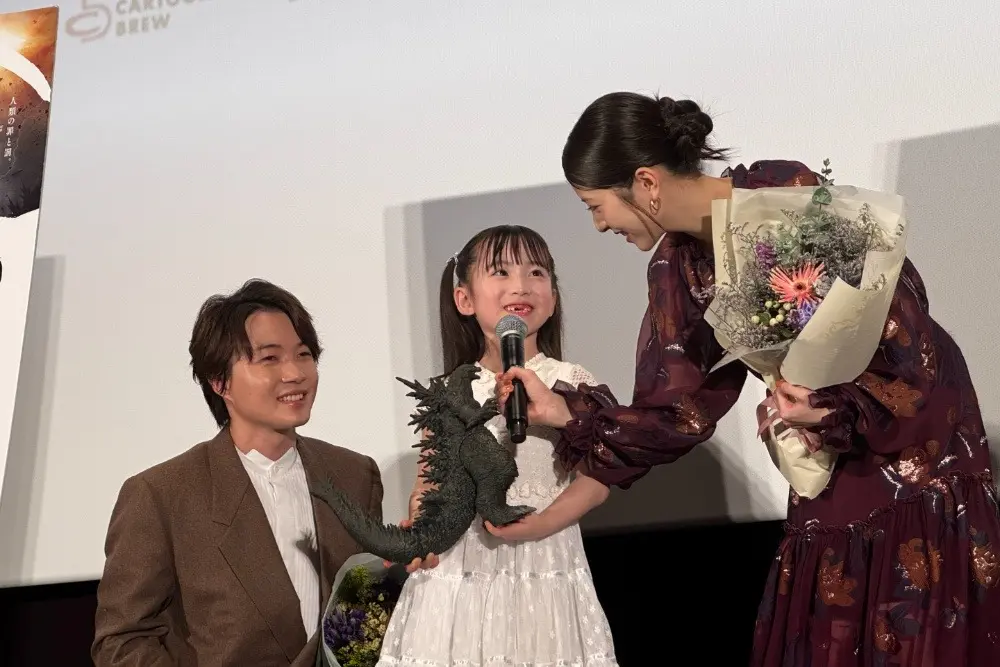
The Tokyo event also served as a major milestone for young child actor Nagatani Sae, who reprises her role as Shikishima Akiko. Marking her very first stage appearance, Nagatani was escorted onstage by Kamiki, drawing warm affection from both her co-stars and the audience in attendance.
In “Godzilla Minus One,” which notably aired on Japanese television’s “Friday Roadshow” just days prior on Friday, Nagatani’s character had a minimal speaking role consisting mostly of crying or uttering single words such as “Where?” For the new sequel, however, the script vastly expanded her role by giving her full, substantive dialogue. Kamiki admitted that the cast initially shared a sense of nervous disbelief, wondering among themselves if a child of her age could truly pull it off. Yet, any lingering doubts vanished the moment they stepped onto the set. Nagatani had memorized all of her lines with absolute perfection and delivered every single piece of dialogue flawlessly, earning the deep professional respect of her older co-stars.
Hamabe expressed a similar sense of astonishment regarding the young actor’s rapid development. She noted that Nagatani had barely left toddlerhood during the production of the first film, at which point she was easily startled and intimidated by the large number of adults operating on a professional movie set. Reuniting with her for “Godzilla Minus Zero,” Hamabe was deeply amazed by how much she had grown into a wonderful, articulate young girl. Nagatani chatted animatedly with the cast throughout the production, offered helpful insights on various things, and proved herself to be entirely dependable in her acting performances.
For her part, Nagatani maintained that she felt remarkably calm and unburdened by nervousness during filming. She fondly recalled moments behind the scenes, such as Kamiki continuing to gently rub her back to comfort her even after the director called cut on an emotionally heavy scene where Akiko cries. Demonstrating a precocious dedication to her craft, Nagatani even asked her seasoned co-stars how she could continue to develop into a fine actor while still navigating elementary school. Kamiki responded by telling her that she already outshone both of them, emphasizing that starring in two major feature films like “Minus One” and “Minus Zero” at such a tender age is an extraordinary achievement in its own right.
Providing narrative context for the upcoming film, Kamiki explained that “Minus Zero” picks up its story thread approximately two years after the tumultuous events depicted in “Minus One.” He expressed his heartfelt hope that viewers will take the time to imagine what those intervening two years were like for the surviving characters, and witness firsthand how the family unit stands together to face whatever new nightmare comes next. Hamabe placed the timeline gap at roughly two to three years, noting that the family had finally settled into a semblance of everyday life together before the terrifying shadow of Godzilla resurfaces to threaten their hard-won peace once again.
When discussing the enduring legacy and remarkable longevity of the franchise, Kamiki echoed sentiments shared by director Yamazaki and his fellow cast members, suggesting that each successive Godzilla film serves as a faithful mirror to the specific era in which it is produced. However, on a deeply personal level, Kamiki reflected on his lifelong relationship with the monster’s cultural footprint. Pointing to Godzilla’s very existence and its iconic, instantly recognizable theme music, he confessed that he cannot even pinpoint the exact moment in his childhood when he first heard the melody or realized it belonged to Godzilla. The music and the monster have simply always been present alongside everyday life in Japan, which he believes is the primary reason the character has remained beloved for generations.
Hamabe approached the franchise’s enduring appeal from a profoundly human perspective, observing that Godzilla represents an overwhelming, cataclysmic force that is fundamentally impossible for humanity to defeat on conventional terms. Yet, she noted, the true emotional core of the narrative emerges precisely when Godzilla appears, because it forces fragmented humans to unite, cooperate, and stand shoulder-to-shoulder to face the existential threat. Witnessing that resilient human resolve, she believes, is the primary element that profoundly moves audiences’ hearts across cultures.
The phenomenal groundwork laid by “Minus One”—which stands as the 30th Japanese live-action entry in the historic Godzilla franchise—cannot be overstated. The film grossed an impressive sum of more than JPY7.65 billion, translating to roughly $50 million at the local Japanese box office. Furthermore, it etched its name into cinematic history by becoming the first Asian production ever to take home the prestigious visual effects prize at the 96th Academy Awards, subsequently going on to collect more than 50 major honors both at home in Japan and around the world.
Building directly upon that unprecedented wave of critical and commercial success, “Minus Zero” arrives with its own historic distinction, standing as the first Japanese motion picture in history to be officially certified as Filmed for IMAX.