In the thick of a heated midterm electoral season, the Cheesecake Factory, of all things, became the latest brand to get sucked into a political food fight against its will. This week, Democrats and Republicans converted the familiar restaurant into a symbol for who is and isn’t out of touch with mainstream America. But largely because the chain has remained stoically above the fray, the incident has worked out rather sweetly for the restaurant, transforming a casual punchline into a nationwide cultural conversation about class, design, and the vanishing sacred spaces of American life.
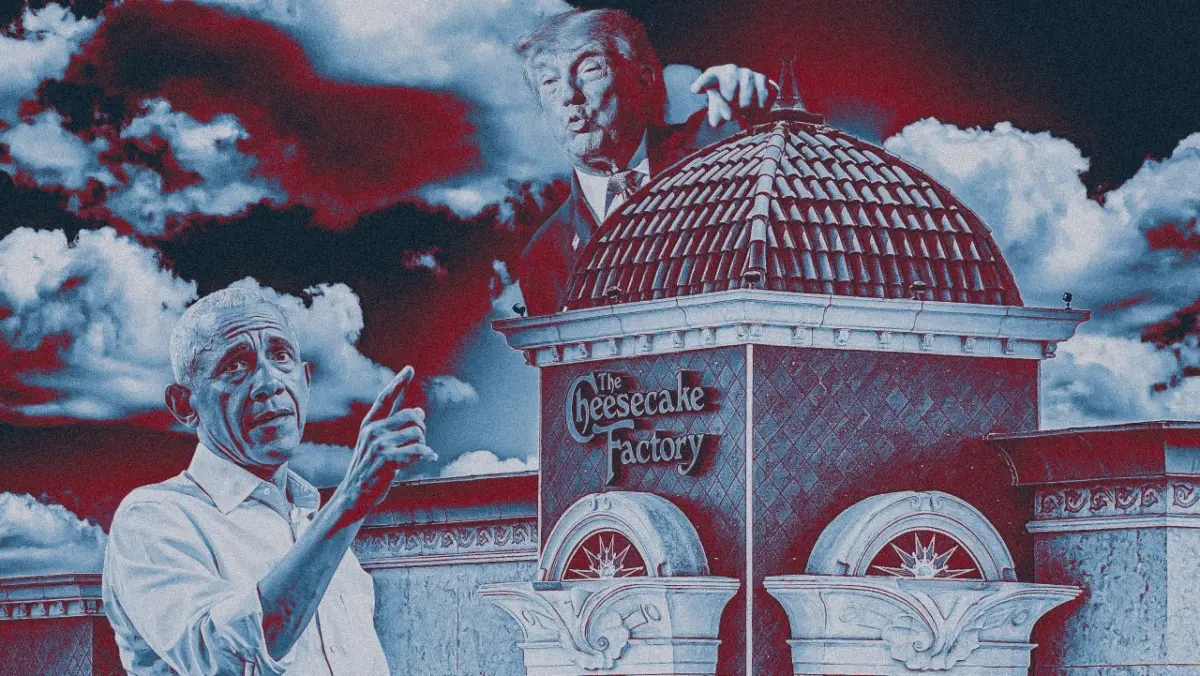
The fracas started with a remark last weekend from former President Barack Obama, who was on the campaign trail poking fun at current President Donald Trump’s focus on high-profile renovation projects and his well-documented penchant for maximum aesthetic opulence.
“He’s got the White House looking like Saddam Hussein opened a Cheesecake Factory,” Obama joked to the crowd.
For anyone who has never stepped inside one of the chain’s sprawling dining rooms, the comparison hinges on a very specific visual vocabulary. The restaurant is known partly for a maximalist decor that mixes opulent elements from Egyptian columns to Victorian beadboard paneling, European café details, decorative ceilings, and deep booths in a mash-up that might strike some critics as, let’s say, tacky. It is an unapologetic sensory overload that has defined the brand’s physical identity for decades.
Of course, the GOP pounced almost immediately on the former president’s off-the-cuff remark, seizing it as an emblem of coastal elitism. The Wall Street Journal editorial board found it necessary to weigh in, slamming Obama as “condescending” for “making fun” of the popular chain. Pundits and conservative strategists quickly framed the casual jab as yet another example of why Democrats have lost touch with the middle class and everyday voters who frequent such establishments on Friday nights.
The political fallout quickly spilled out of the traditional media ecosystem and onto the campaign trail. Treasury Secretary Scott Bessent, in a move that underscored how quickly the administration sought to capitalize on the gaffe, was interviewed by reporters outside a Cheesecake Factory location, where he sniped back at the opposition: “I would tell the Martha’s Vineyard set to give it a try.”
President Donald Trump also weighed in on the cultural controversy, defending the casual dining giant. Trump called the Cheesecake Factory “a very successful company” and claimed that Obama “doesn’t like successful companies.” To cement the administration’s playful yet pointed exploitation of the moment, the White House official channels even dropped an AI-generated clip of a cartoonish, animated Trump waving cheerfully outside a Cheesecake Factory location, leaning heavily into the internet-driven nature of modern political skirmishes.
Yet, what made the food fight particularly unique was that the defense of the restaurant crossed traditional partisan lines. It wasn’t just Republicans rallying around the massive menus and massive portions of the beloved chain. The Atlantic, a publication not exactly known for defending Donald Trump or mainstream conservative talking points, published a bemused but remarkably warm defense of the Cheesecake Factory.
The publication’s writer argued that “like any number of kitschy, charming American chain restaurants . . . the Factory can obviously be mocked. But it must be mocked from a place of love. It should exist above partisan politics as a sacred third space, one of the few we Americans have left.”
The cultural reckoning prompted by Obama’s joke even reached deep into the architectural history of the company. A writer for Washingtonian decided to track down and interview the person ultimately responsible for the very aesthetic that sparked the debate, speaking with the former Cheesecake Factory in-house design director. Rick McCormack, who served as the vice president of design at the chain for 13 years, passionately defended the unique visual philosophy. McCormack praised the ambitious design vision of founder David Overton and tsk-tsked at Obama for what he considered “disparag[ing] such a great American success story.”
Despite being dragged directly into the crosshairs of a polarized political battleground weeks before a critical election, the Cheesecake Factory itself maintained its corporate composure, refusing to be baited into the partisan theater. By staying entirely out of the fray, the ubiquitous chain managed to capture days of free, wall-to-wall media coverage, reminding millions of Americans why they continue to fill its massive booths across suburban shopping centers and bustling city centers nationwide.