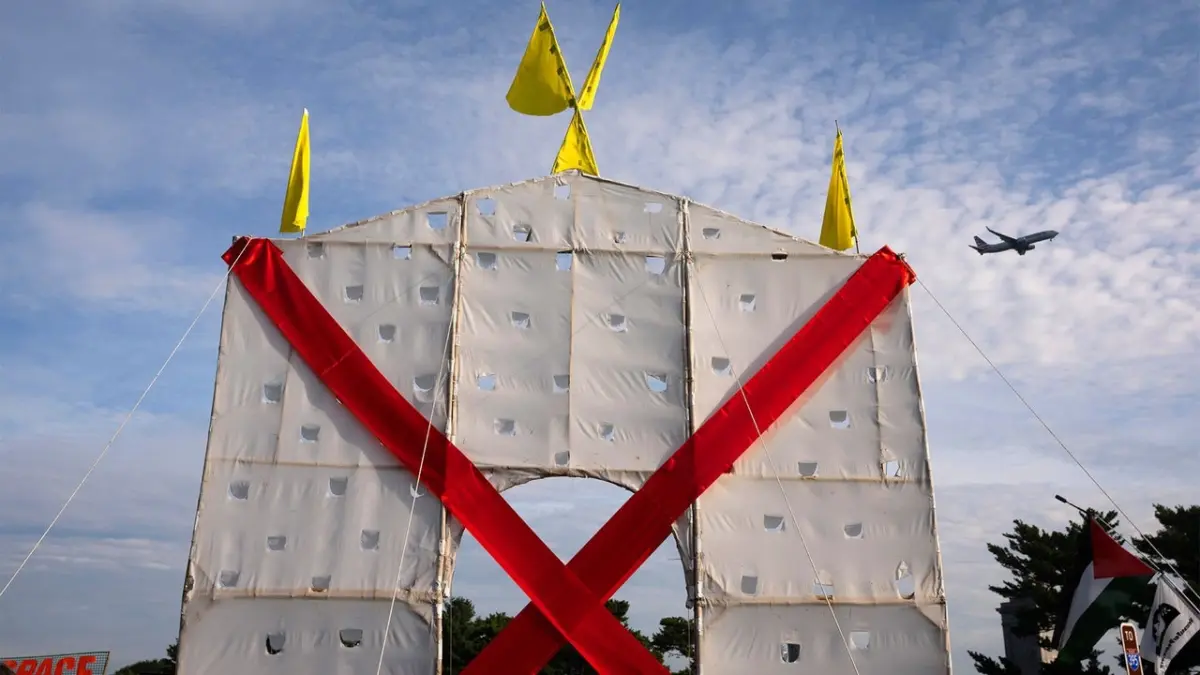
The Arlington County Board in Virginia filed a lawsuit on Thursday to formally oppose the construction of the Triumphal Arch, marking a historic turning point as the first governmental body to take direct legal action against President Donald Trump’s controversial planned monument.
The legal challenge, filed in the U.S. District Court for the Eastern District of Virginia with the backing of the legal advocacy group Democracy Forward, sharply criticizes the unprecedented speed at which the project has advanced. Specifically, the lawsuit targets the administration’s push to break ground at Memorial Circle without adhering to the comprehensive, mandated review processes typically required for major federal undertakings on public land.
According to the complaint, the National Park Service—the federal agency responsible for overseeing projects on national park land such as Memorial Circle—is proceeding at a breakneck pace toward ground-disturbing construction. The lawsuit alleges that while the agency has publicly claimed a final decision to construct the arch has not yet been formally made and has attempted to portray its actions as part of a routine decisional process, this rushed timeline is merely a pretext. The filing contends that the accelerated steps are designed specifically to manufacture justifications for building the arch in accordance with the president’s repeated marching orders.
In light of these concerns, the lawsuit urgently asks the court to halt the agency’s feverish pace toward the construction of the arch. The legal action aims to ensure that the stringent requirements of the National Environmental Policy Act are strictly followed, allowing for proper environmental analysis, community impact testing, and bureaucratic oversight before any permanent changes are made to the landscape.
Arlington County officials argue that their community stands to bear the heaviest burden from the development. Arlington County Board Chair Matt de Ferranti emphasized this sentiment in a public statement released shortly after the filing. He noted that the county has consistently acted in good faith throughout the preliminary review process, only to see the severe, unique, and wide-ranging negative impacts the project will have on the county and its residents completely ignored by federal planners.
Memorial Circle occupies a strategic and sensitive geographic location on federal parkland situated immediately west of the Potomac River. The site lies directly across the Memorial Bridge and immediately adjacent to the borders of Arlington County, placing local residents in the immediate vicinity of any heavy construction, altered traffic patterns, and permanent structural modifications. Despite the close proximity and the obvious localized consequences, local officials maintain they have been shut out of meaningful consultations.
Representatives for the White House and the Department of the Interior did not immediately respond to requests for comment regarding the federal court filing.
The filing of the Arlington County lawsuit compounds an already contentious debate surrounding the massive monument, arriving just a day after prominent labor leader Sara Nelson raised severe safety and logistical concerns. Nelson, who serves as the president of the Association of Flight Attendants-CWA, publicly expressed alarm that the proposed 250-foot, or 76-meter, arch would significantly exacerbate multiple safety hazards. She pointed out that these critical safety issues have remained unaddressed since a deadly January 2025 aircraft crash over the Potomac River that tragically claimed the lives of 67 people. Furthermore, Nelson sharply criticized President Trump’s stated plans to transform the interior and upper sections of the monument into a top-grade military complex capable of hosting active drones, accommodating military snipers, and storing munitions.
The Arlington lawsuit is not the only legal roadblock the administration faces over the controversial monument. Although the arch has managed to secure early approval from the U.S. Commission of Fine Arts—whose members were entirely appointed by President Trump—the project is facing separate legal challenges in Washington, D.C. A separate lawsuit filed in federal court by a coalition consisting of three military veterans and an architectural historian argues that the monumental construction project exceeds executive authority and legally requires explicit approval from Congress before any physical work can begin. A federal judge presiding over that case has previously ordered that the administration must provide the court with at least 48 hours of advance notice before undertaking any activities related to or in preparation for the construction of the arch.
The battle over the Triumphal Arch unfolds as part of a broader, sweeping effort by President Trump to physically redesign and reshape the architectural landscape of Washington, D.C., and its surrounding areas under the banner of national commemoration and modernization. Over recent months, the administration has pursued several high-profile civic transformations across the capital region. These initiatives range from extensive renovations of storied public golf courses to aggressive policy moves and financial pressures, including recent threats directed at the John F. Kennedy Center for the Performing Arts, which faced dire bankruptcy warnings and potential closures. As federal authorities press forward with these ambitious urban design campaigns, the legal confrontation initiated by Arlington County sets the stage for a high-stakes judicial battle over the limits of executive power, federal land management, and the rights of neighboring local communities.