Our Verdict: A little uneven, but Penguin Colony is too weird, wonderful, and surprising to miss.
Need to Know
- What is it? Lovecraftian horror through the eyes of a penguin.
- Release date: October 16, 2026
- Expect to pay: $15 / £13
- Developer: Origame Digital
- Publisher: Fellow Traveller
- Reviewed on: RX 9070 XT, Core i5 12600K, 32 GB RAM, Steam Deck
- Multiplayer: No
- Steam Deck: Verified
Penguin Colony is a work of cosmic horror that I would recommend to anyone with even a passing interest in scares from the beyond, even though its unique penguin platforming can be frustrating to wrangle. It is a radical recontextualization of an H.P. Lovecraft classic that displays a clear affection for the legendary writer’s atmospheric storytelling, alongside a scathing contempt for his well-documented racism.
For my money, it just isn’t October without a weird-ass new indie horror game leaving a lasting impression on me, and Penguin Colony has thoroughly satisfied my annual craving. In this game, you play as a penguin witnessing the chaotic and terrifying events of Lovecraft’s At the Mountains of Madness. Your primary suite of powers consists of four distinct actions: honking, sliding, swimming, and hopping.

Rather than being locked to a single specific bird throughout the entire journey, you possess the unique ability to jump into and control any penguin you come across. Theoretically, this allows you to utilize different species’ specific physical attributes to tackle various environmental movement challenges. Aside from utilizing tiny baby penguins to squeeze into tight spaces, however, I found myself almost exclusively playing as a Rockhopper. Their impressive vertical jump proved to be an absolute boon across many tricky areas. Honestly, those particular birds probably should have spent their time hooping instead of investigating The Strange.
The legendary PC Gamer "Tales from The Hard Drive" host Lenval Brown narrates the adventure from the perspective of a customarily neurotic and verbose Lovecraftian protagonist. Brown’s delivery lends everything a heavy emotional weight reminiscent of his iconic performance in Disco Elysium, creating a comforting, familiar presence even as the narrative descends into absolute madness.
Waddle On
I remain somewhat conflicted over Penguin Colony‘s movement mechanics. I didn’t find them especially fun to execute, and they frequently felt like they were getting in the way of smooth progression, but that friction also felt weirdly appropriate for the premise. As a real-life penguin, waddling around is kind of clumsy and sluggish, particularly as the level design shifts away from the creatures’ native snowy habitats into stranger, more alien environments.
Most charitably, there is a distinctly "Foddian" quality to the mechanical exploration, bringing to mind titles like Getting Over It and Baby Steps. It forced me to really lean in and concentrate during tricky traversal sequences, especially as the atmosphere reached its most suffocating and intense points deep within the caves and structures buried under the arctic ice. I often felt frustrated and restless as the game’s coolest levels opened up before me, held back as I was by the limitations of a little penguin body. Yet, that exact friction dovetails quite well with the core premise: you are an inhuman observer trapped inside a human—and something else—story.
A more clear-cut negative, however, was an inconsistency with the mantling feature. It felt more like a clipping glitch than a deliberate design choice, allowing me to clear certain ledges while inexplicably failing on others. Furthermore, Penguin Colony‘s appropriately minimalist user interface features one glaring exception: a Shadow of the Colossus-style circular stamina meter that pops up only when your stamina is actively depleting. It is distractingly massive and neon-colored, and it usually remained entirely unclear what relationship existed between my actions and the sudden drop of the stamina bar. It operated with a mind of its own and was never a welcome sight during my playthrough.
At its best, though, the penguin parkour contributed heavily to the sensation that I was a small, insignificant creature skirting the terrifying edges of a grand drama I could only partially understand. We as humankind effectively act as unknowable elder gods to the rest of the animal kingdom, and Penguin Colony largely succeeds in evoking a one-of-a-kind sense of dual-layer cosmic horror through its mechanics.
Side Stories
This is definitely a game that thrives on surprise, mystery, and personal interpretation. Penguin Colony is not a strict one-to-one retelling of At the Mountains of Madness. Lenval Brown voices a brand-new character named Howard Blakely—as opposed to the original story’s William Dyer—and the passages he narrates are a pitch-perfect imitation of Lovecraft’s distinctive prose style.
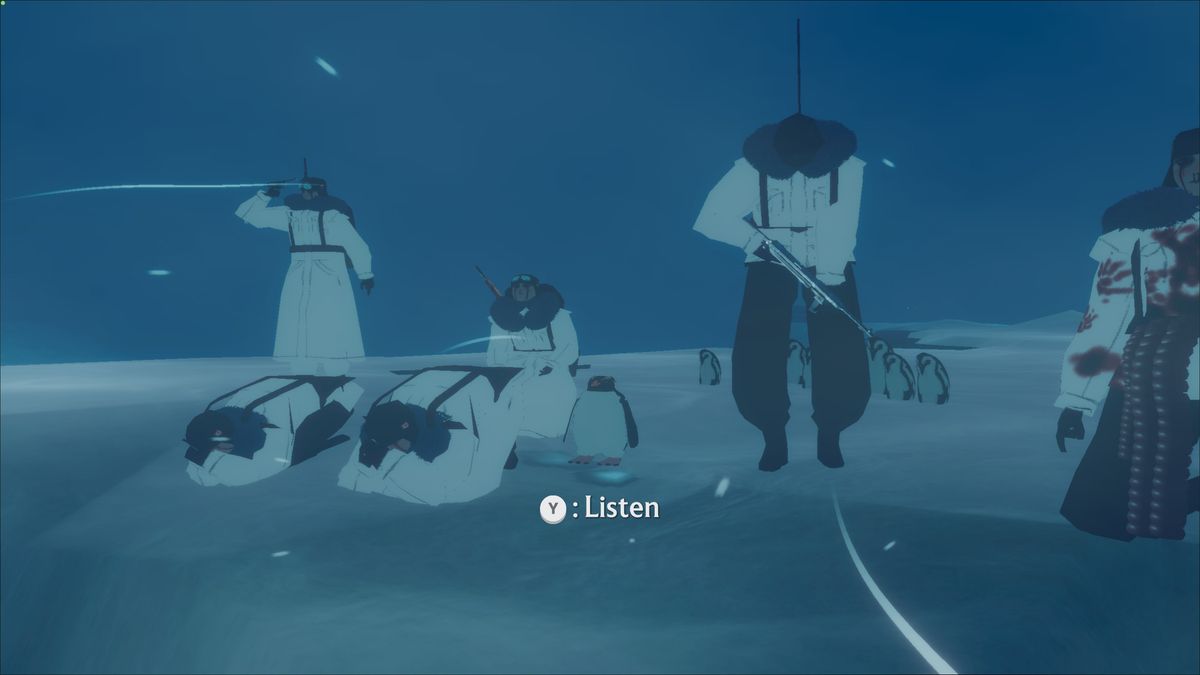
Each level concludes with a brief interlude where you briefly control members of a party of Māori warriors who have inherited a long-standing tradition of fighting and containing the ancient evil resting at the bottom of the world. Blakely is framed as a sympathetic American working closely with an expedition of Nazis, specifically focusing on their famous historical division devoted to hunting down artifacts like the Ark of the Covenant, Thor’s Hammer, and other mystical objects. Meanwhile, the Māori warriors are on a dedicated quest to stop the Nazi expedition and suppress the outer evil they have inadvertently awakened.

These war party interludes gradually built up the distinct feeling that I was receiving dispatches from another, vastly superior game happening simultaneously just out of sight. I love that narrative choice; I don’t think I’ve ever played a game quite like Penguin Colony, where it feels like the full, sprawling story is happening in another room entirely, and you are only granted a narrow keyhole view of what is truly going on.
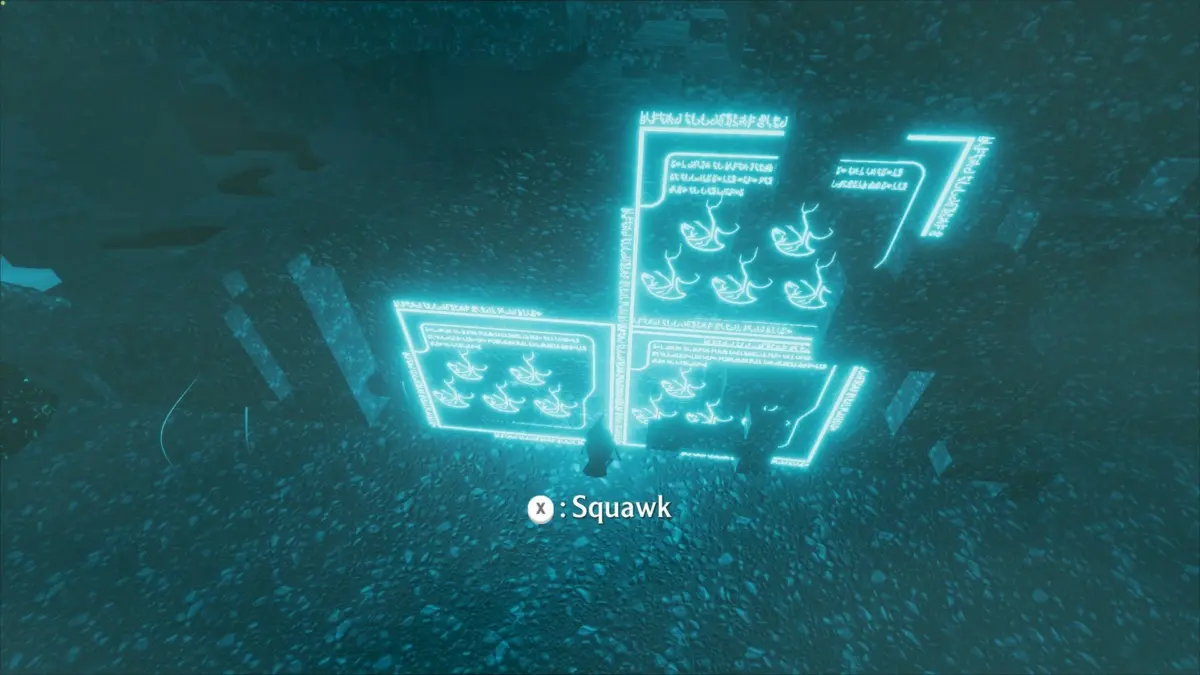
You truly get out of this cryptic mystery what you put into it. The world is suffused with unique, cursive hieroglyphs, and I eventually realized they function as a direct replacement cipher for the standard alphabet. It genuinely pays to play with a notebook and pen nearby, as cracking this hidden code proved to be a rewarding side activity that significantly deepened my understanding of the overarching plot.
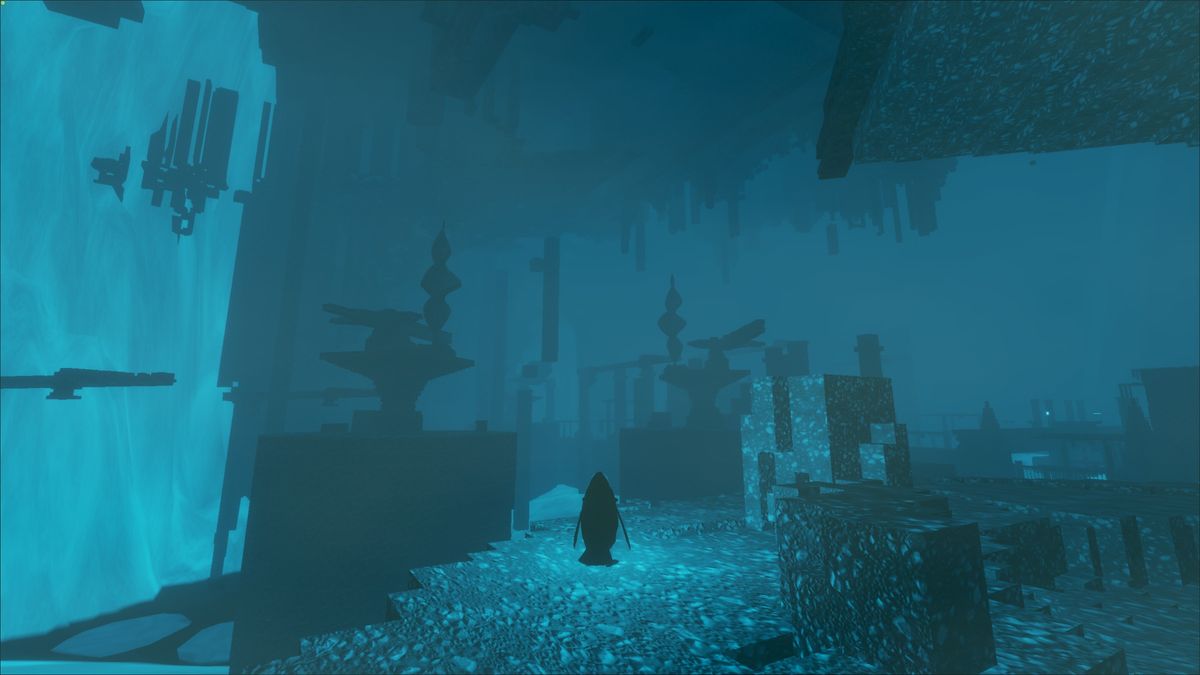
The back half of Penguin Colony takes place among the twisting megastructures of a massive alien city buried deep beneath the ice. Origame Digital manages to evoke an incredible sense of scale and ancient, terrible purpose with these levels. They reminded me strongly of 2022’s criminally underrated Scorn, as well as the stunning Ash Lake found in the deepest depths of the original Dark Souls. You do not fully understand what you are looking at, but you immediately grasp that it possesses a staggering, terrifying profundity.
Case of the Vapours
I have often noticed a frustrating tendency in modern cosmic horror writing to shy away from the more unseemly aspects of H.P. Lovecraft’s legacy—an instinct to say, "Thank you for the outer horrors and cyclopean ruins, H.P., but I am going to tactfully gloss over what you named your cat, as well as your assorted sociopolitical views, as though you are my least favorite uncle cornering me at a family gathering."
Penguin Colony, by contrast, proverbially says that we must confront these flaws head-on, making Lovecraft’s racial fixations a very real, highly impactful component of the horror. Blakely is an "enlightened" man of modernity who gets along swimmingly with his expedition partners from the Third Reich. He embodies the neurotic, asylum-bound Lovecraft protagonist at his most cowardly, self-indulgent, and contemptible, easily serving as a direct stand-in for old Howard Phillips himself.
The Māori warriors represent everything Blakely is not, utilizing minimal dialogue in stark contrast to Blakely’s voluminous, self-absorbed narration. Their laconic characterization is instead conveyed entirely through their decisive actions and deep mutual fellowship. Their camaraderie stands in direct opposition to Blakely’s solipsistic navel-gazing. They are proactive, actively working to oppose the influence of outer beings rather than waiting passively to be driven mad by them. They are motivated by a fierce desire to protect others, even to the point of self-sacrifice, which contrasts sharply with Blakely’s vulgar, clinical curiosity and the brutal nationalism of his Nazi companions.
It is brilliant that all of these thematic undercurrents are roiling just beneath the surface of Penguin Colony. The game invites you to draw your own conclusions about what you are witnessing, rather than didactically explaining a heavy-handed point of view. The only times it indulges in explicit messaging are via a land acknowledgment and content warning at the very start of the experience, followed by a blistering indictment of the video game industry’s inaction regarding the ongoing crisis in Palestine displayed after the credits roll. I found these direct addresses to the player to be all the more impactful precisely because they were paired with the game’s otherwise deeply cryptic storytelling.
Even with its rough edges and frustrating mechanical quirks, I love Penguin Colony. It is a rich, multilayered piece of interactive storytelling delivered in an impressively compact package. It offers a truly unique exploration of cosmic horror—one that actively rebels against genre granddaddy H.P. Lovecraft’s signature nineteenth-century bigotry by telling a sweeping tale of indigenous resilience and resistance, all observed quietly through the eyes of a bewildered penguin.