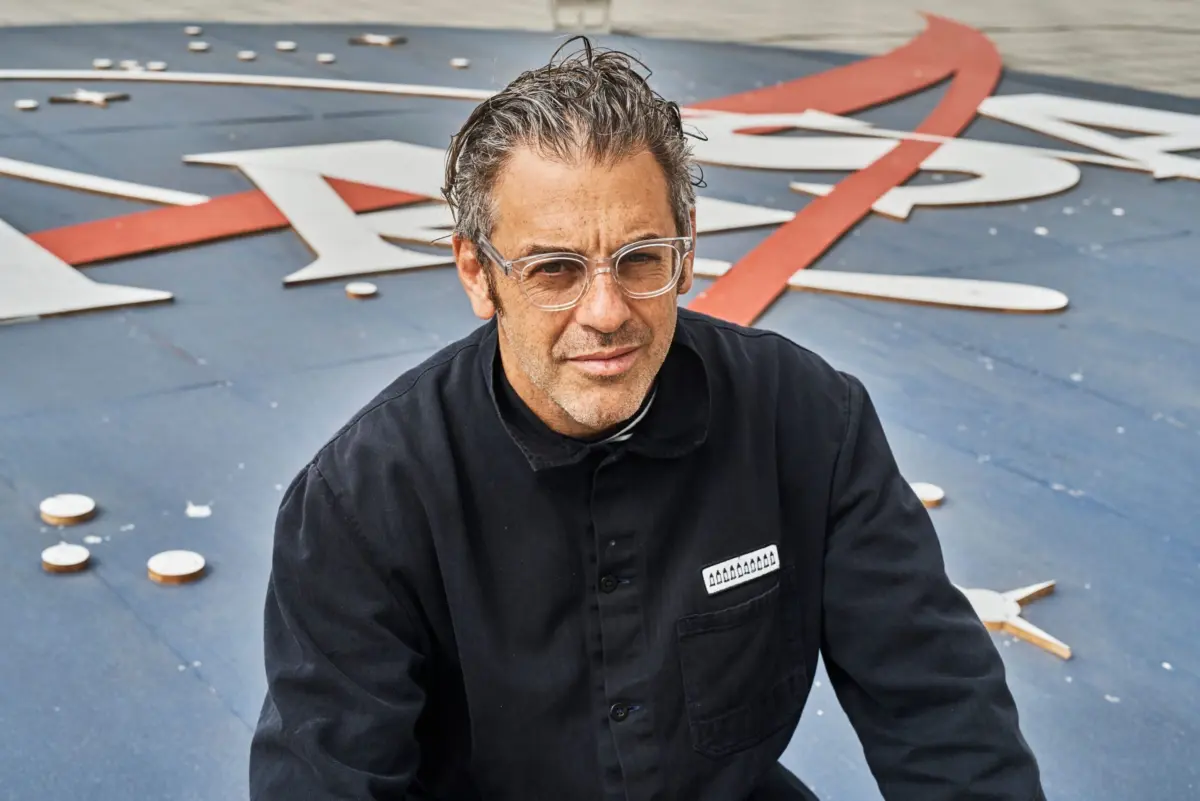
Deep in the labyrinth of a lower Manhattan workshop, contemporary sculptor and self-described bricoleur Tom Sachs presides over a chaotic ecosystem of customized cabinets, heavy-duty shelving units, and meticulously organized tool systems. In Sachs’ world, even standard workshop equipment undergoes a radical transformation. A mundane drill press is heavily remade, featuring twin machine lamps spidering off its top, a retractable brush to instantly sweep away debris, and a chuck key and center punch held securely to its face by powerful magnets.
To Sachs, these idiosyncratic rituals and modifications are not merely aesthetic eccentricities; they represent a complete philosophy of work. Sachs identifies as a bricoleur—someone who cobbles together functional contraptions out of collected, repurposed, or discarded materials. Over the past two decades, this hands-on, rough-edged approach has propelled him from the fringes of the art world to international renown. Today, alongside a dedicated team of twelve studio assistants, he mounts large-scale museum exhibitions across the globe, capturing the attention of major art collectors and institutions alike.

On a typical studio day, the atmosphere hums with intense preparation. Sachs and his team are finalizing details for a massive, immersive installation at San Francisco’s Yerba Buena Center for the Arts. The upcoming project, part of his acclaimed Space Program series, will send two "astronauts"—played by studio assistants—on a simulated mission to Europa, the icy Jovian moon that astrobiologists believe might harbor extraterrestrial life. Amid the studio tour, studio assistant Sam Ratanarat works carefully to stabilize a rolling cart designed for the astronauts to wheel out onto the alien terrain, welding the titanium rods that hold its structural framework together.
Inspecting the work, Sachs praises the initial weld as a stunning feat of craftsmanship. "Talk about material bragging rights," he remarks. "Titanium is up there!" However, when turning his attention to an older, battered MIG welder in the corner, Sachs makes his feelings clear. "Can we get rid of this?" he asks. Ratanarat pushes back protectively, insisting, "We use it."

While the team handles the heavy infrastructure of the lunar and planetary modules, Sachs focuses on smaller, more provocative narrative details. Reflecting on past missions, he recalls how the folding knife manufacturer Spyderco once produced white Delicas engraved with a nostalgic 1970s NASA logo for his team. But Europa presents an entirely different conceptual challenge. "Europa is a mission about imperialism," Sachs explains. "We go to another planet, find some Europans, and abduct them. So what’s the knife of colonialism? A machete!" True to form, he is currently milling his own version directly from a discarded Japanese lawn-mower blade.
Sachs’ trajectory into the upper echelons of the contemporary art world was unconventional from the start. As a youth, he was a self-described peculiar kid who bought his clothes at Goodwill and had them tailored, struggled academically with a D-minus average, faltered at sports, and was forced to repeat the ninth grade. Eventually, he gained admission to Bennington College, a pivotal turning point where he met Babs, a senior who taught him the fundamentals of welding and introduced him to the avant-garde works of Brancusi and Richard Serra.

Although that early romance ended abruptly when she left him for another student, the encounter fundamentally reshaped Sachs’ artistic vision. She introduced him to a more complex methodology of creation—teaching him how to construct physical objects while engaging in political and social dialogues about how everyday items function within human rituals. He channeled his heartbreak directly into his work, using an angle grinder to shape his future.
That distinctive artistic philosophy eventually caught the attention of fellow makers and pop-culture icons. Adam Savage, former co-host of MythBusters and host of Tested.com, first encountered Sachs’ work in 2012 through a video documenting a replica Lunar Excursion Module on a simulated Mars mission. Savage forwarded the link to acclaimed actor and space enthusiast Tom Hanks, who revealed he not only knew the work intimately but was also a personal friend of the artist. Hanks subsequently connected Savage and Sachs, sparking a creative friendship rooted in shared obsessions.

Savage, whose own hobby involves meticulously building cinematic replicas like the pistol from Blade Runner, the space suits from Alien, and the mechanical glove from Hellboy, found an immediate kindred spirit in Sachs. "We’re both obsessive organizers. We both make replicas," Savage notes. " And when we can’t think of what to work on, we build infrastructure—stands, shelves, benches." Their bond runs deep enough that their respective spouses jokingly describe their relationship status as "dating," with Savage utilizing Sachs’ East Coast studio and Sachs working out of Savage’s West Coast workshop when traveling.
Looking across Sachs’ studio, Savage recognizes that the underlying rituals of making are just as important as the finished pieces. While Savage builds cinematic props to converse with his ten-year-old self and enter beloved fictional narratives, Sachs uses his gallery exhibitions to gift that same inner child an endless supply of high-end art supplies and materials. Sachs builds narratives directly into the physical construction of his pieces. Observers can easily spot exposed plywood edges, visible screws, greasy handprints, or stray tool marks. Nothing is hidden behind a slick, commercial finish; Sachs’ pieces are unequivocally made, and their rough textures tell the story of the artist’s labor.

This philosophy extends far beyond the traditional gallery space into immersive performance art, such as Sachs’ modern reinterpretations of the Japanese tea ceremony. At the Noguchi Museum in Long Island City, Sachs constructed a teahouse out of plywood and resin to host exclusive ceremonies for museum donors. Breaking completely with classical tradition—where guests shed coats and keys to don traditional tabi footwear—Sachs’ guests have their sneakers cut into makeshift sandals, while their smartphones and wristwatches are locked inside a Faraday cage.
The ceremony itself is a blend of earnest craftsmanship and subverted tradition. Sachs whisks matcha powder and pours water with absolute seriousness, but guests smoke from a handcrafted pipe, drink sake out of stacked plywood cups coated in resin, and snack on Oreos and Ritz crackers smeared with peanut butter. Explaining the appeal, Sachs notes that people are drawn to tea through spirituality, sensuality, or architecture. "Obviously, I’m into it for that," he says, gesturing to the bespoke teahouse and custom utensils.

This tension between utilitarian hardware and elaborate ritual mirrors Sachs’ lifelong fascination with NASA. While some are drawn to space exploration for navigation, science, or philosophical questions about human origins, Sachs admits his primary attraction lies in the hardware. "I think if I were to be honest with myself, I’m more about the hardware," he reflects. "But it doesn’t mean anything without the ritual."
That synthesis of hardware and ritual drives the meticulous mechanics of Sachs’ Space Program exhibitions. Much like NASA operates as a massive, institutionalized failure-analysis organization—studying structural, personal, and organizational breakdowns to prevent future disasters—Sachs builds elaborate safety and failure protocols into his simulated missions. For the Europa exhibition, the performance involves a rigorous sequence: astronauts begin in a quarantine trailer, transfer via scissor lift to a landing module, and launch a model rocket captured by a miniature camera to mimic authentic NASA footage.

The climax of the performance hinges on success or failure. One astronaut must successfully pilot the classic Atari game Lunar Lander. A failure results in a television screen broadcasting the real speech Richard Nixon had prepared in the event that the Apollo 11 astronauts perished on the moon, abruptly ending the show. A successful landing allows the astronauts—their custom spacesuits cooled by internal tanks of ice water—to shuffle toward an ice-covered koi pond, drill through the surface under the guidance of mission control, and capture live "alien" marine life to be consumed on-site.
Despite the irreverent details—including tequila bars, drug paraphernalia, and playful subversions—actual NASA scientists and engineers have embraced Sachs’ work. Dave Lavery, a prominent NASA roboticist, notes that despite the exposed plywood edges and worn paint, every mechanical detail of Sachs’ equipment traces accurately back to the operational realities of actual spaceflight hardware.

The immense logistical effort required to transport and assemble these intricate installations across the country for just a few days of live performance underscores Sachs’ fundamental motivation. He seeks out the tactile reality of physical creation. "I love getting my hands dirty. I only feel good if I have a cut somewhere," Sachs says. "If I have a little burn, it means that I’m probably doing something right."
That shared dedication to physical making recently culminated in a direct collaboration between Sachs and Savage: constructing physical replicas of the iconic lunch box carried by character Heywood Floyd in Stanley Kubrick’s 2001: A Space Odyssey. While Savage built his version with refined precision using styrene, aluminum, and genuine NASA-issue Mylar bubble wrap, Sachs opted for an edgy, exposed approach utilizing raw plywood, visible screws, and white paint bleeding over rough wood grain.

Exchanging their completed pieces, the two makers debated the fine line between prop replication and high art. Reflecting on the difficulty of parting with a finished creation, Sachs offered a definitive measure for artistic authenticity. "It feels like that every single time," Sachs tells Savage. "That’s when you know it’s good."