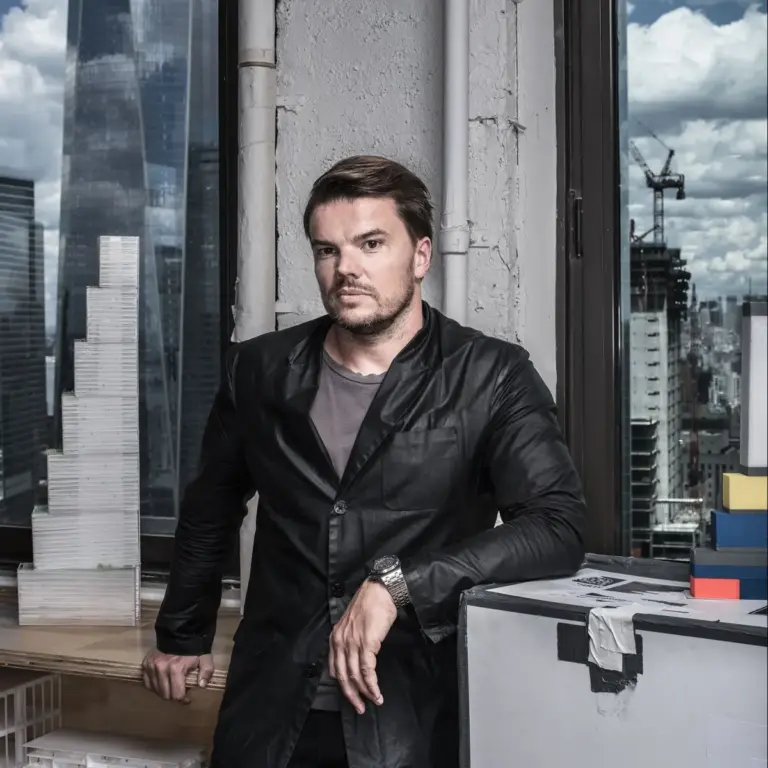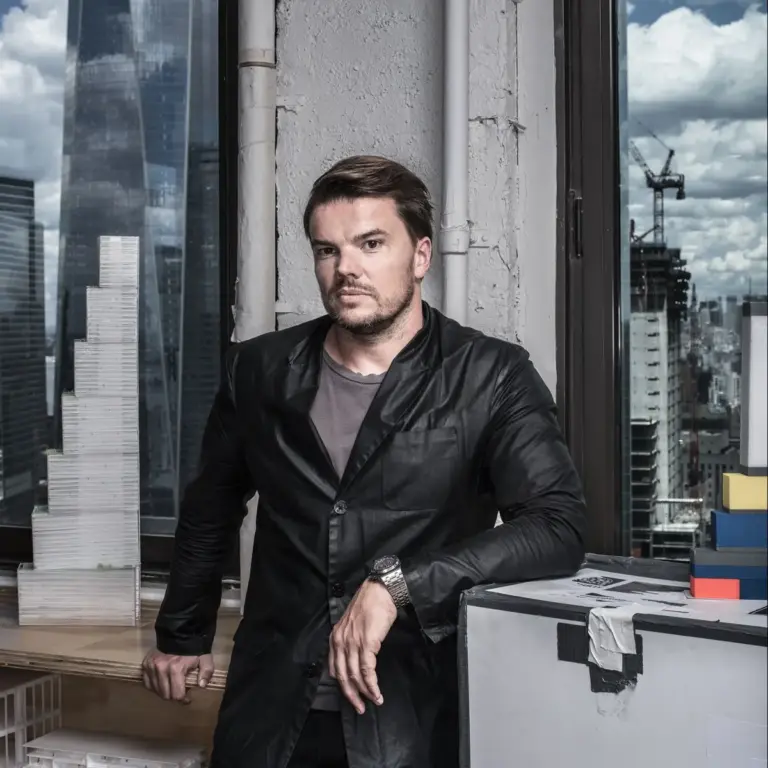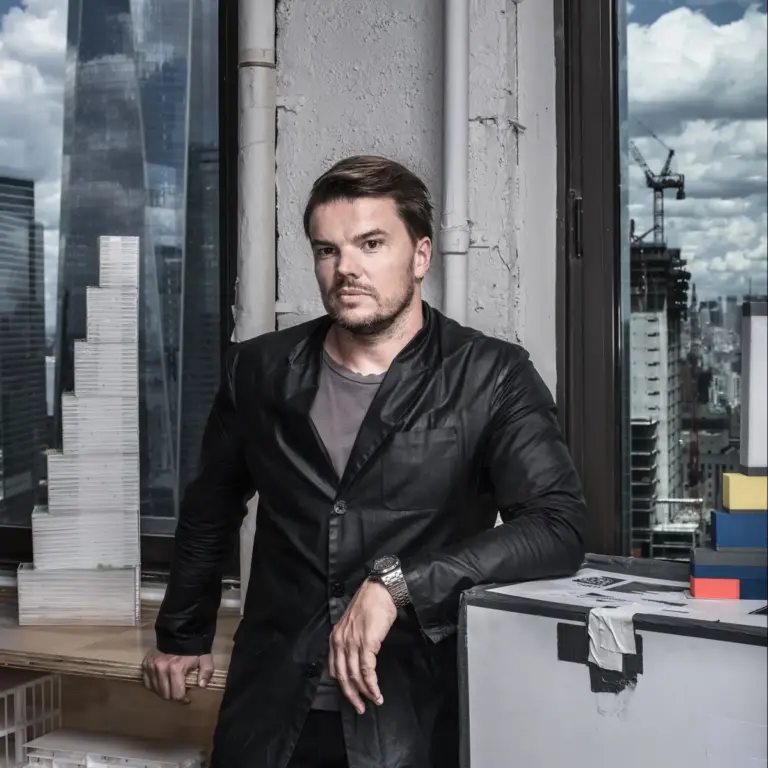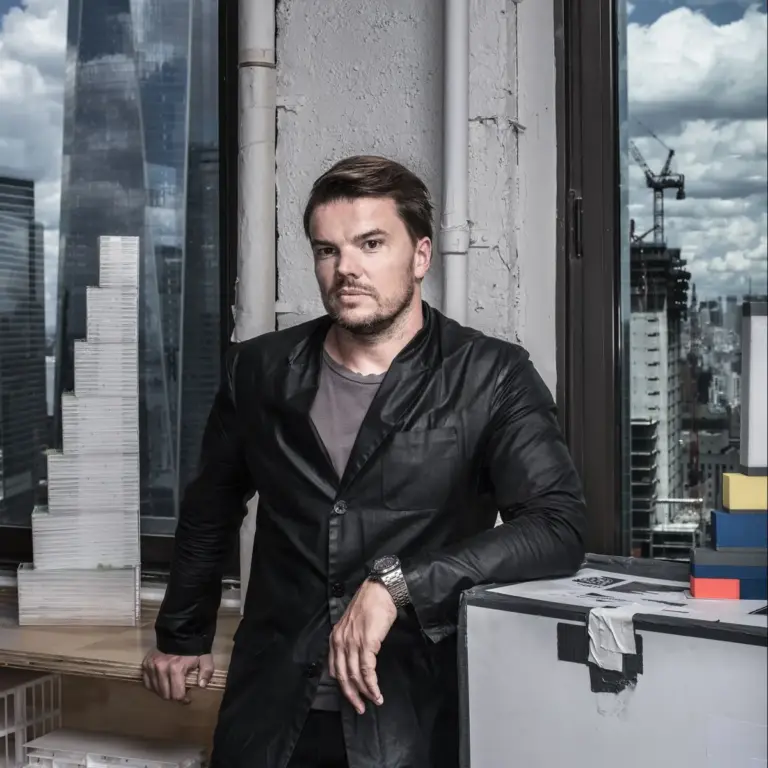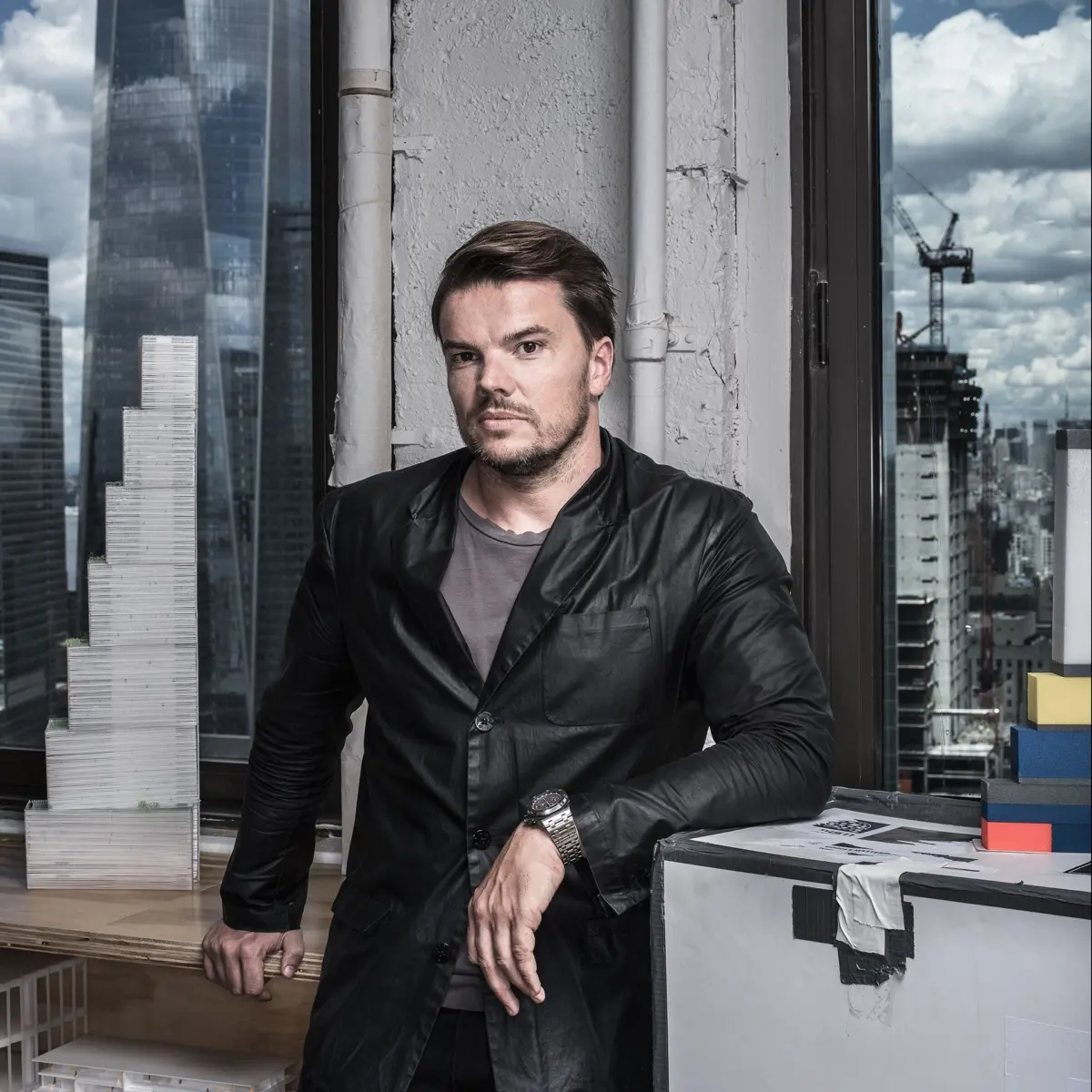
On a misty April morning in Lower Manhattan, Danish architect Bjarke Ingels stood atop an old brick building with his coat collar popped, shooting a promotional film for the defining commission of his career. At 40 years old, the hyper-eloquent founder of the Bjarke Ingels Group (BIG) was working on a design for the skyscraper known as Two World Trade Center. It was still very much a work in progress, and his primary client—media magnate Rupert Murdoch—had not yet officially signed off. Yet, Ingels did not let doubt stall his vision. He obsessed over every frame and detail, telling his director that he wanted viewers to swoon over the concept.
At the time, Murdoch’s plan to relocate his media empire was one of the worst-kept secrets in New York real estate, but Ingels was eager to broadcast the vision from the rooftops. Between takes, he pointed toward a void in the dense Manhattan skyline, tracing the profile of a skyscraper that existed for now only in his mind and blueprints. From this perspective, his design resembled a stack of seven distinct blocks, ascending like a monumental staircase toward One World Trade Center, its monolithic neighbor.
"In a way, it is almost like a physical manifestation of the spirit of America," Ingels remarked, invoking the nation’s motto. "Out of many, one."

If completed, the tower would stand among the tallest buildings in New York City and mark the final piece of the master plan for the redeveloped World Trade Center site. The ensemble was designed to ring two cascading reflection pools honoring the roughly 3,000 people who died in the terrorist attacks of September 11, 2001. But Ingels was not overly preoccupied with the solemnity of the footprint; he wanted to forge his own contemporary history. "The memorial is about the memorial," he explained. "The tower should be about the living city."
Eclecticism on Demand
Ingels is fond of describing architecture as "the art of turning fiction into fact." He possesses a rare mix of talents as a draftsman, a master salesman, and a charismatic cultivator of his own professional image. However, his greatest asset is a remarkable gift for storytelling: an uncanny ability to construct a compelling narrative around the most practical engineering necessities. Often, his designs veer in wonderfully fantastical directions.
For instance, he designed a waste-to-energy plant in Copenhagen featuring a slanted roof that doubles as a public ski slope, complete with a smokestack engineered to puff a symbolic ring of steam every time a ton of carbon dioxide is emitted. For a proposed expansion of Google’s campus in Mountain View, California—created in collaboration with designer Thomas Heatherwick—Ingels envisioned a wild, membrane-like complex of geodesic domes, where employees could bike, hike, and code inside a sunlit glass terrarium.

Such imaginative flights have made Ingels internationally famous and highly sought-after at an age considered precocious by the conservative standards of architecture. Yet, fame can be a deceptive indicator in the building profession, where an architect’s work often only materializes after years of arduous planning and construction. Ingels’ largest completed project in New York at the time, a striking pyramidal apartment building along the West Side Highway known as Via 57 West, was roughly one-third the size of Two World Trade Center.
"At the moment we are working seriously on one of the most daunting buildings in downtown New York," Ingels acknowledged, noting that his firm had yet to complete a full-scale skyscraper. With Two World Trade Center, he believed he had discovered a way to reinvent the high-rise work environment, transforming a form that is inherently vertical and hierarchical into a space for horizontal interaction. But first came the laborious task of proving he could turn that captivating narrative into hard facts on the ground.
Navigating the Realities of Urban Development
To realize his design, Ingels had to continually prove its value to two hard-nosed octogenarians: Rupert Murdoch and Larry Silverstein, the veteran developer who has controlled much of the World Trade Center rebuilding process. Murdoch and Silverstein still needed to finalize a long-term lease agreement that would allow the $4 billion skyscraper to secure financing.

"There’s a lot of drama with the deal right now," Ingels admitted during his promotional film shoot. "I don’t know how worried I should be."
Even if the key players reached an agreement, other formidable hurdles loomed: a volatile real estate market, the political sensitivities surrounding construction on a site of mass tragedy, and the bureaucratic friction of the Port Authority of New York and New Jersey, the agency that owns the underlying land. For 14 years, these combined factors had kept the redevelopment lurching along unpredictably, dashing the ambitions of other notable architects.
Ingels’ design had actually displaced an earlier proposal by renowned architect Lord Norman Foster—though turnabout was fair play, as Foster had previously pushed aside Ingels on a national library project in Kazakhstan. To avoid his predecessor’s fate, Ingels had to balance the competing demands of Murdoch and Silverstein while juggling a growing roster of international clients who had recently flooded BIG with commissions.

The first major force Ingels had to overcome at the World Trade Center site was sheer inertia. Silverstein was initially satisfied with Foster’s existing design and harbored serious concerns about Ingels’ early drawings, fearing the stacked, asymmetrical structure would look precarious from certain angles. He questioned whether it truly fit the context of the site. Silverstein nearly walked away from the deal entirely until endorsements from the architects of other World Trade Center buildings convinced him to reconsider.
The following Monday, the principals gathered in a conference room overlooking the site. Unflappable by nature, Ingels was momentarily caught off guard by Murdoch’s rapid-fire questioning. Murdoch’s primary anxiety centered around a fundamental question: Why doesn’t it fall over? With assistance from David Childs, the architect behind One World Trade Center, Ingels explained that the leaning effect was an optical illusion. The unorthodox stepped form resulted from placing the structural core off-center, creating expansive interior spaces for newsrooms, outdoor terraces, and sweeping views of the plaza for Fox News studios. Murdoch was ultimately convinced.
Ingels also found a vital ally in James Murdoch, Rupert’s son and corporate heir apparent. As the driving force behind the relocation of 21st Century Fox and News Corp. from an aging building near Rockefeller Center, the younger Murdoch initially toyed with the idea of avoiding a traditional "starchitect" or a massive tower in favor of an open, creative loft space. But after exploring multiple sites, they landed at the World Trade Center with Ingels, drawn by his ability to translate strict constraints into surprising, effective solutions.

Engineering Challenges and Structural Compromises
The most significant physical constraint involved the remnants of Foster’s original foundation, which had already been partially constructed to support a $4 billion underground transportation hub. Piggybacking a brand-new skyscraper onto a pre-existing foundation presented complex engineering puzzles, particularly at the lobby and lower levels, where the new tower’s immense weight had to transfer onto old supports.
Shortly after winning over the developers, Ingels faced a harsh reality check from his engineering team. His initial concept for retrofitting the underground foundation—altering walls and columns within the Port Authority’s domain—was rejected as structurally unsafe, carrying the risk of destabilizing the entire base like a game of Jenga. Furthermore, a facade consultant informed him that New York Police Department security standards required all exterior glass at the World Trade Center to be heavy, laminated safety glass to withstand potential explosions, rendering his initial cost-saving measures impossible and adding millions to the budget.
"I was like, fuck!" Ingels recalled. "Because that’s a piece of information that hadn’t reached me. I just thought I had an ace up my sleeve, which I didn’t, because the building has to be safe."

As negotiations between Silverstein and Murdoch grew tense, any departure from standard formulas incurred severe cost penalties, leaving the architecture temporarily in limbo. Yet, through careful structural adjustments and compromises, Ingels managed to preserve the core identity of the design. Prominent executives, including Silverstein’s second-in-command Janno Lieber, eventually praised the rapid turnaround and collaborative spirit that kept the project alive.
By early June, a tentative deal between Silverstein and Murdoch was finally in place, allowing the team to publicly unveil the design for Two World Trade Center. Before the public reveal, Ingels sought a final blessing from architect Daniel Libeskind, whose master plan laid the groundwork for the entire World Trade Center complex. Gathered in BIG’s conference room, Libeskind inspected a glowing model of the tower and offered his approval with a firm slap on the table.
"Congratulations, that is a super building," Libeskind said, while acknowledging the long road ahead. "Between that first smile and the last stone is the challenge of architecture… this complex space filled with what the city really is: economics, society, power brokers, politicians."

Despite the public unveiling, elements of the design remained fluid. The building’s height shrank slightly during ongoing negotiations, and even Douglas Durst—operator of the neighboring One World Trade Center—expressed personal reservations about the orientation of the stepped gardens, noting that it turned its back on his building. Nevertheless, Durst praised Ingels’ overarching genius, highlighting the delicate tightrope walk of high-profile urban development where not every stakeholder can be entirely satisfied.
Expanding Horizons
As BIG continued to expand, opening a spacious new office on Broadway near Wall Street to house its growing staff of over 250 employees across New York and Copenhagen, Ingels leaned further into his role as a global architectural ambassador. Alongside Two World Trade Center, his firm managed a massive portfolio of ambitious projects, including a master plan for the Smithsonian’s South Mall campus in Washington, D.C., and the Dryline, a $335 million hybrid park and flood defense system designed to protect Lower Manhattan from future climate disasters.
Reflecting on his rapid ascent, Ingels remained philosophical about the inherent frustrations and compromises of his profession. While architectural theory and grand visions often collide with rigid financial and political realities, he maintained that the true eureka moments in design frequently arrive when an architect is forced to adapt, pivot, and find unexpected solutions within strict boundaries.

Standing by the window of his new Broadway office, looking out toward the northern skyline and the monumental footprint of the World Trade Center, Ingels reflected on the sheer scale of his firm’s trajectory in America.
"Coming here to America five years ago, we were given the opportunity to try to reimagine the skyscraper, which is one of the great inventions of American architecture," Ingels said. "Imagine, that’s where it’s going to sit. I think it’s going to be pretty epic."