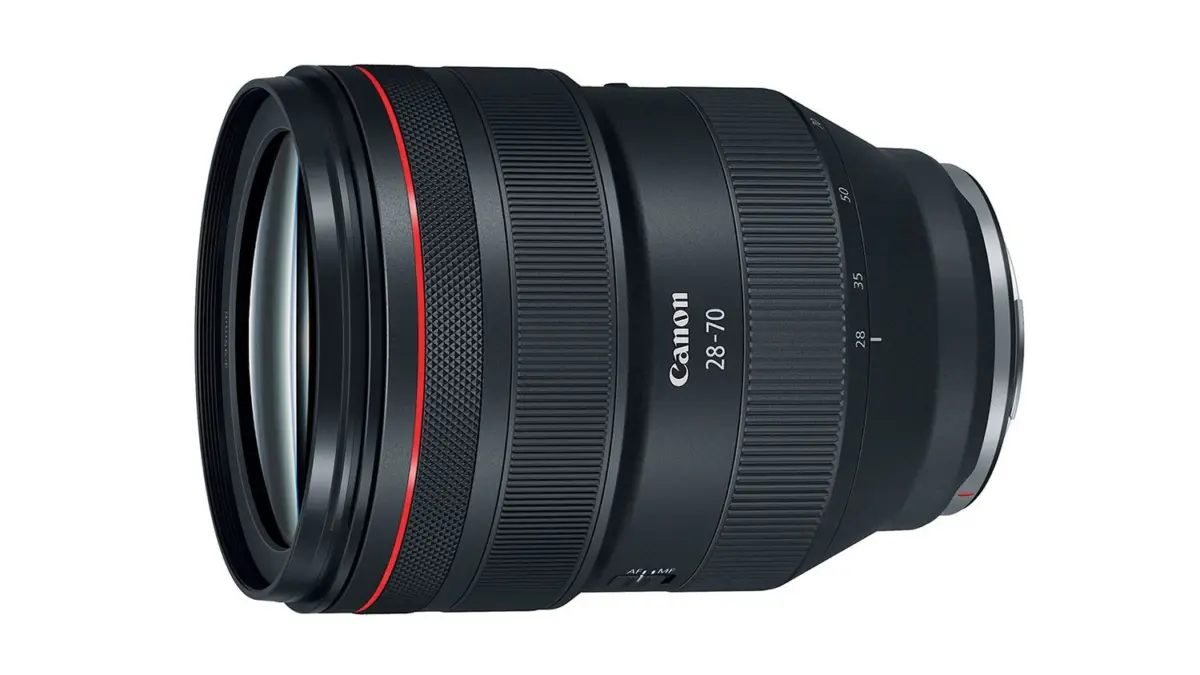
The Canon RF 28-70mm f/2L USM has carved out a unique and celebrated space in the modern professional photography market, largely thanks to its remarkably bright maximum aperture across a versatile focal length. However, recent documentation suggests that Canon’s optical engineers are not resting on their laurels and are actively exploring the engineering boundaries of what is possible with ultra-fast zoom lenses. A newly published patent indicates that the manufacturer is investigating designs that could eventually pave the way for an even more ambitious telephoto zoom with a constant f/2 aperture.
The patent, which was published in Japan and first brought to broader industry attention by the specialized tracking site Canon Rumors, outlines an innovative optical design intended to deliver compact, high-performance zoom lenses. Rather than relying on the more traditional two-focusing-group configuration seen in many current RF-series lenses, the newly detailed optical schematics utilize three or more distinct focusing groups. Tucked away among the technical drawings for various potential focal length combinations are blueprints that reference a prospective 70-200mm f/2 lens, sparking immediate excitement and speculation within the global photography community.
Engineering the Impossible: Overcoming Size and Weight Challenges
For optical engineers, the fundamental challenge of designing a bright zoom lens has always been managing physical size and weight while maintaining uncompromising image quality. Achieving a wide, constant aperture like f/2 requires large glass elements to capture and bend light effectively across the entire zoom range. Traditionally, reducing the overall physical length of a zoom lens means bringing the internal optical groups closer together.
However, as the patent points out, compressing these optical groups leaves virtually no physical room within the lens barrel to house the complex autofocus mechanism groups necessary for fast and accurate subject tracking. This spatial limitation is precisely why ultra-fast zooms have historically been massive, heavy, and exceptionally difficult to manufacture for mirrorless camera systems.

The solution detailed in Canon’s recent patent involves the strategic implementation of three or more separate focus units. By dividing the workload among a greater number of internal moving elements, the design can effectively shorten the operational distances required during focusing. This sophisticated internal architecture theoretically makes it possible to construct a remarkably bright zoom lens without triggering an exponential increase in the physical size of the lens body, striking a delicate balance between optical speed and everyday usability.
A History of Innovation in Focus Groups and Motor Technology
While the concept of utilizing three or more focus groups in a high-speed zoom represents a fascinating step forward, it is not entirely unprecedented within Canon’s broader research and development pipeline. Earlier this year, another patent from the manufacturer surfaced, exploring a similar three-group focus configuration designed specifically to maximize focusing speed and precision across complex optical assemblies.
Furthermore, Canon is already well-versed in dividing autofocus responsibilities among multiple internal components. The company’s established Dual Nano USM lenses successfully leverage two distinct autofocus motors to drive different lens groups simultaneously. More recently, cutting-edge lenses utilizing Voice Coil Motor (VCM) technology—such as the acclaimed Canon RF 35mm f/1.4L VCM—frequently pair a magnetic VCM system with a secondary, smaller Nano USM autofocus motor to enhance both speed and positioning accuracy.
The newly published patent expands upon these multi-motor and multi-group concepts, applying them to the daunting task of supporting a wider aperture without creating an unmanageable physical footprint. Among the various theoretical designs included in the documentation, the notion of a 70-200mm f/2 zoom has captured the imagination of professionals and enthusiasts alike, especially given the immense popularity of its wider sibling, the RF 28-70mm f/2L USM.

Weighing the Realities of Ultra-Fast Optics
To understand why a potential 70-200mm f/2 lens generates such intense industry interest, one only has to look at the physical realities of Canon’s existing line-up. The Canon RF 28-70mm f/2L USM utilizes an ultrasonic autofocus motor and deliberately foregoes the wider 24mm starting point found on standard professional zooms, yet it remains a substantial piece of glass. Tipping the scales at roughly 3.1 pounds or 1,430 grams, the 28-70mm f/2L is notably heavier than even the dedicated Canon RF 70-200mm f/2.8L IS USM.
That stark comparison serves as a masterclass in the engineering hurdles associated with maintaining an f/2 aperture over a telephoto zoom range. Scaling up such a concept to cover a 70-200mm focal length while keeping the system portable enough for handheld field use would require revolutionary optical breakthroughs.
At the same time, industry observers frequently urge caution when interpreting manufacturer patents. Canon routinely files and publishes a staggering volume of intellectual property documentation each year, consistently leading global corporate patent rankings for decades. The mere existence of a patent drawing or a theoretical design specification is never a guarantee that the concept will eventually transition from the research laboratory into a commercial product available on retail shelves.
For the time being, the prospect of a native Canon RF 70-200mm f/2 zoom remains firmly in the realm of optical theory and speculation. Until Canon makes an official product announcement, photographers will have to content themselves with marveling at the company’s continuous R&D efforts to push the absolute limits of lens design.