A hooded man wielding a sharp knife walks purposefully toward a woman sitting quietly in her backyard. Before he can close the distance and reach his target, a humanoid robot steps directly between them, squaring up in a defensive posture to block the threat. That dramatic encounter serves as the central money shot in a striking one-minute promotional video released by Chinese robotics company Unitree on October 21. The footage was published to introduce the world to the H2-X, a newly unveiled machine that the manufacturer has affectionately and boldly nicknamed the "Kung Fu Legend Guardian."
According to the company’s official promotional materials, the machine offers powerful performance designed to serve and protect its human users. For many technology enthusiasts, it represents a compelling fantasy—the ultimate household protector, functioning much like the fictional T-800 guarding John Connor against threats in the Terminator franchise. However, industry analysts and robotics experts warn that if a machine of this nature actually exists and functions in the physical world precisely as the Chinese robot maker imagines it, the societal and safety implications could quickly spiral into a complex mess.
Deploying a combat-trained, metal-smashing, and bone-breaking humanoid robot into residential neighborhoods drags one of the most persistent and notoriously difficult unsolved problems of modern artificial intelligence and military battlefield research straight into the suburban living room. The fundamental question hanging over the technology is deceptively simple yet profoundly difficult to solve: Can autonomous robots genuinely tell the difference between a friend and a foe?
The short answer from computer scientists and robotics engineers is a definitive no, at least not yet. Some researchers even suggest that achieving flawless discernment may never truly happen, noting that even human beings frequently struggle to accurately distinguish between allies and threats in high-stress, real-world environments.
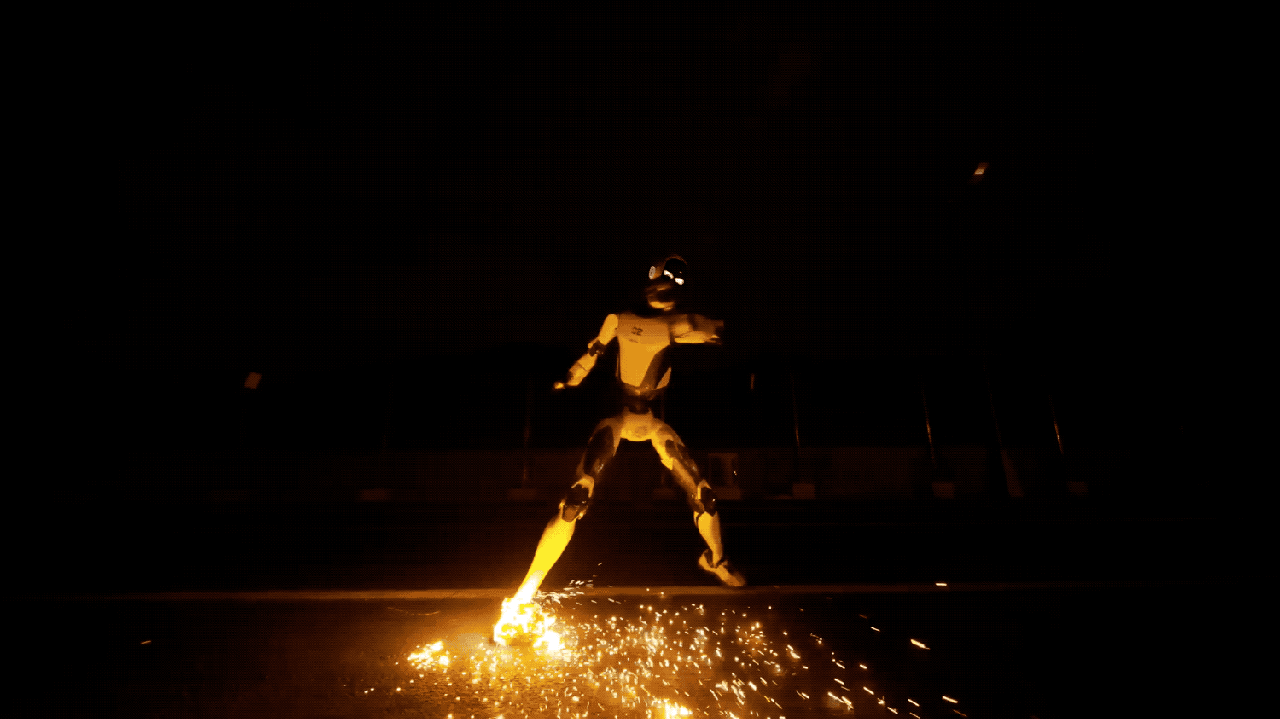
The promotional video itself, which Unitree firmly insists was captured with real physical hardware and was not digitally sped up in post-production, opens dramatically in a dark junkyard at night. In the sequence, the robot springs agilely onto the roof of a parked sedan, executes a smooth somersault off the vehicle, kicks and knees a car door until the metal visibly buckles, and then delivers a powerful flying kick directly onto the hood. Following this display of kinetic force, the machine drops deliberately from an elevated platform marked as thirteen feet high, rolls smoothly across the ground to absorb the heavy impact of the fall, stands back up fluidly, and launches immediately into a rapid string of side kicks and backflips.
The second half of the promotional showcase shifts focus toward the domestic protection capabilities that earn the machine its "guardian" moniker, highlighted by the aforementioned knife confrontation. Following the backyard defense scene, the video demonstrates the H2-X holding up the front end of a heavy automobile with its upper body strength while a human handler pulls a crash test dummy out from underneath the chassis. In another dramatic sequence, the robot forcefully shoves a child mannequin clear of the path of an oncoming vehicle, intentionally taking the physical impact of the moving car itself to protect the simulated child.
It is undeniably a wonderful and captivating concept, resembling the fantasy of having a personal superhero dedicated to safeguarding the health and well-being of loved ones, while presumably also possessing the dexterity to serve tea and cookies. Yet, despite the cinematic appeal of these demonstrations, there are several critical questions that must be answered before a machine of this caliber could ever safely land inside a residential home.
Crucially, Unitree has not yet clarified who, or what, was actually in control of the robot during the filming of the promotional video. The company notably declined to confirm to the South China Morning Post whether the machine was acting entirely autonomously during the stunts. This leaves open several distinct possibilities regarding how the robot operated: it could have been running its own onboard artificial intelligence algorithms, it could have been actively steered by a human operator sitting off-camera with a remote control unit, or it could have simply been executing a strictly choreographed, pre-rehearsed physical script designed solely for the camera.