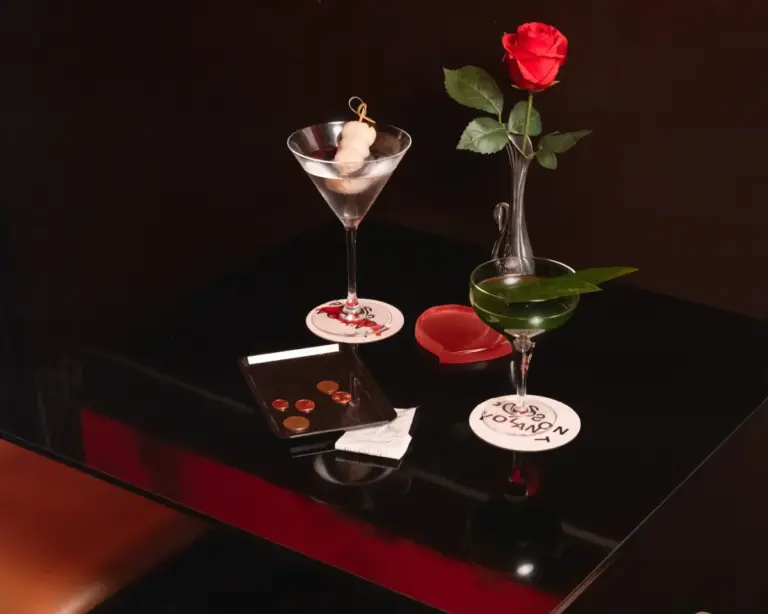
Warm, moody colors dominated the bustling aisles of Cersaie 2026 and the windows of almost every storefront in Bologna, notes Danielle McWilliams, principal at Novità, the communications agency for Ceramics of Italy. Just like in fashion, Italian tile manufacturers debuted collections in deep burgundy, luxurious browns, earthy terracottas, and vibrant reds and yellows.
Beyond color, large-format tiles, intricate textures, dimensional surfaces, advanced digital printing, and natural material effects stood out as top trends at the 43rd edition of Cersaie. Held for five days at the end of September in Bologna, Italy, the annual trade show brings together manufacturers, architects, and designers to explore the latest innovations in ceramic tile, architectural surfaces, and bathroom furnishings. This year’s exhibition drew more than 90,000 visitors to view ceramic and porcelain surfacing materials presented by 600 exhibitors hailing from 24 countries.
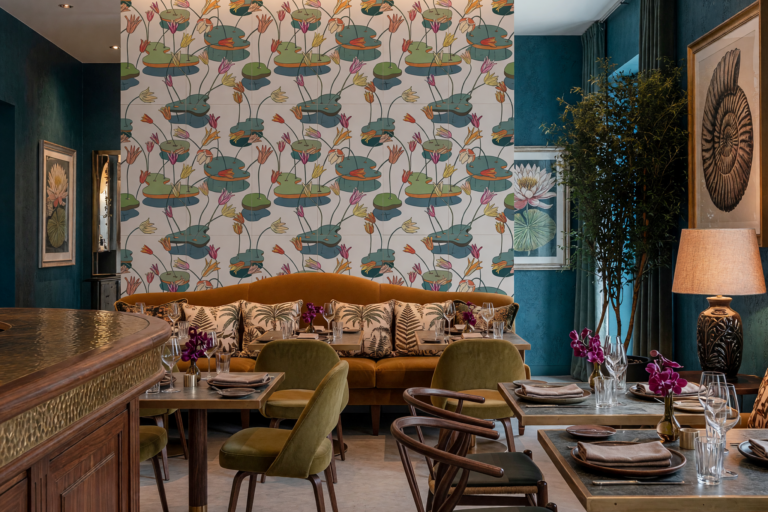
There was a palpable energy to this year’s fair, driven by more than just the massive crowds. That unmistakable buzz resonated directly through the temporary showrooms, which displayed bold, dynamic products that pushed the boundaries of traditional surface design.
Color Makes a Comeback
While stark white and neutral tiles will always maintain a foundational place in fashion and design, ceramic makers did not shy away from richer, more saturated hues this year. Industry leaders note a distinct shift in how designers approach architectural palettes. Benedetta Borghi of external affairs at Atlas Concorde points out a renewed confidence in color, accompanied by a much greater willingness to incorporate stronger tones into overarching architectural schemes.

Combining bright hues with neutral and warm white tiles offers a refreshed aesthetic for modern interiors. Atlas Concorde’s Boost Hux pairs warm natural tones with striking accents of green, red, blue, and ember, while its Vivia collection features vivid glazed colors directly inspired by traditional Italian ceramics. For manufacturers like Atlas Concorde, color is increasingly becoming a core design tool rather than simply serving as a decorative accent.
Cristina Faedi, a renowned tile trend expert, consultant to Confindustria Ceramica, and founder and art director of Infinite Possibilità, echoes this sentiment. She observes that Italian companies have significantly expanded their color ranges, with some firms doubling their color offerings and others introducing multiple densities of the same shade to provide nuanced design options.

Green Takes Root
The sudden explosion of rich-colored tiles could be interpreted as the design pendulum swinging back after years of muted tones and neutrals dominating the market. However, Faedi also points to broader global influences, such as the chaotic state of the contemporary world, subtly steering tile palettes toward emotional resonance. She references the concept of the seven chakras, which correspond to the colors of the rainbow, noting that green represents empathy and emotional healing.
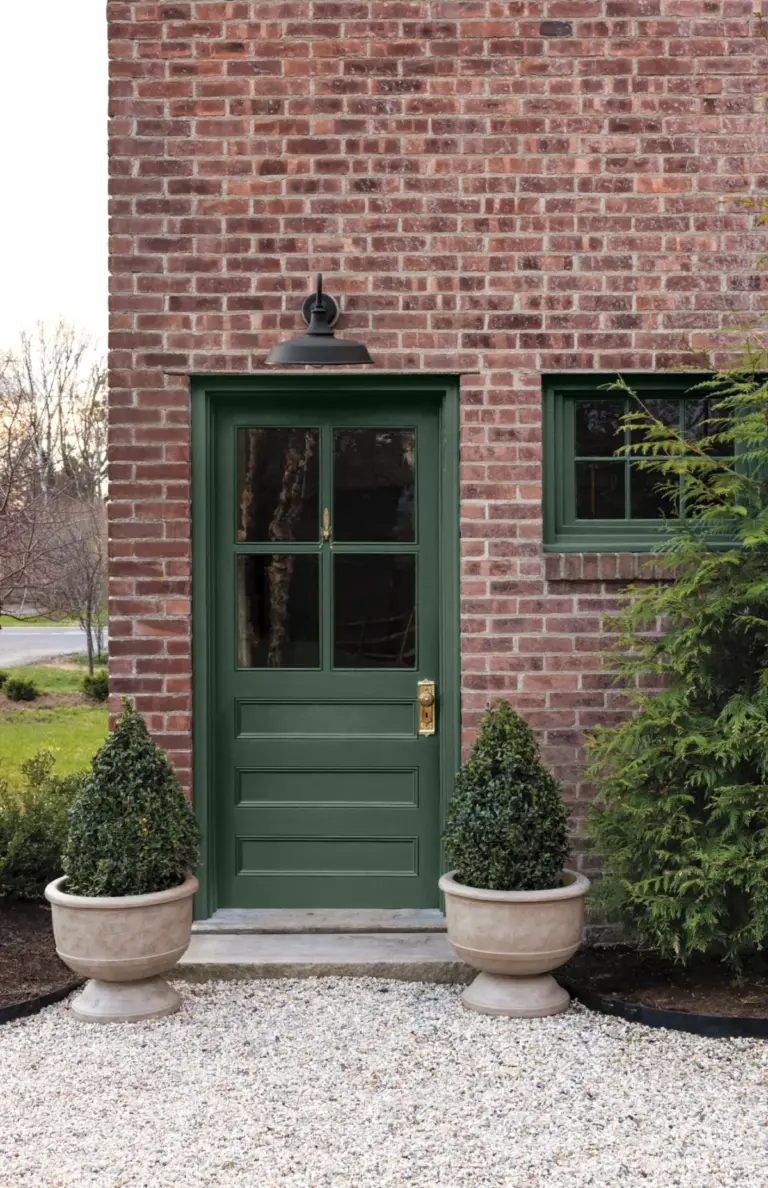
This connection to emotional well-being helps explain why green is having such a prominent moment in contemporary tile design. Faedi explains that green is a color that provides a deep sense of calm while remaining intrinsically tied to nature. It serves as a narrative of landscapes, wild herbs, thermal waters, and vast oceans. Alongside shades ranging from deep forest green to pale sage, grounded earthy palettes of terracotta and other natural tones also captured significant attention at the exhibition.

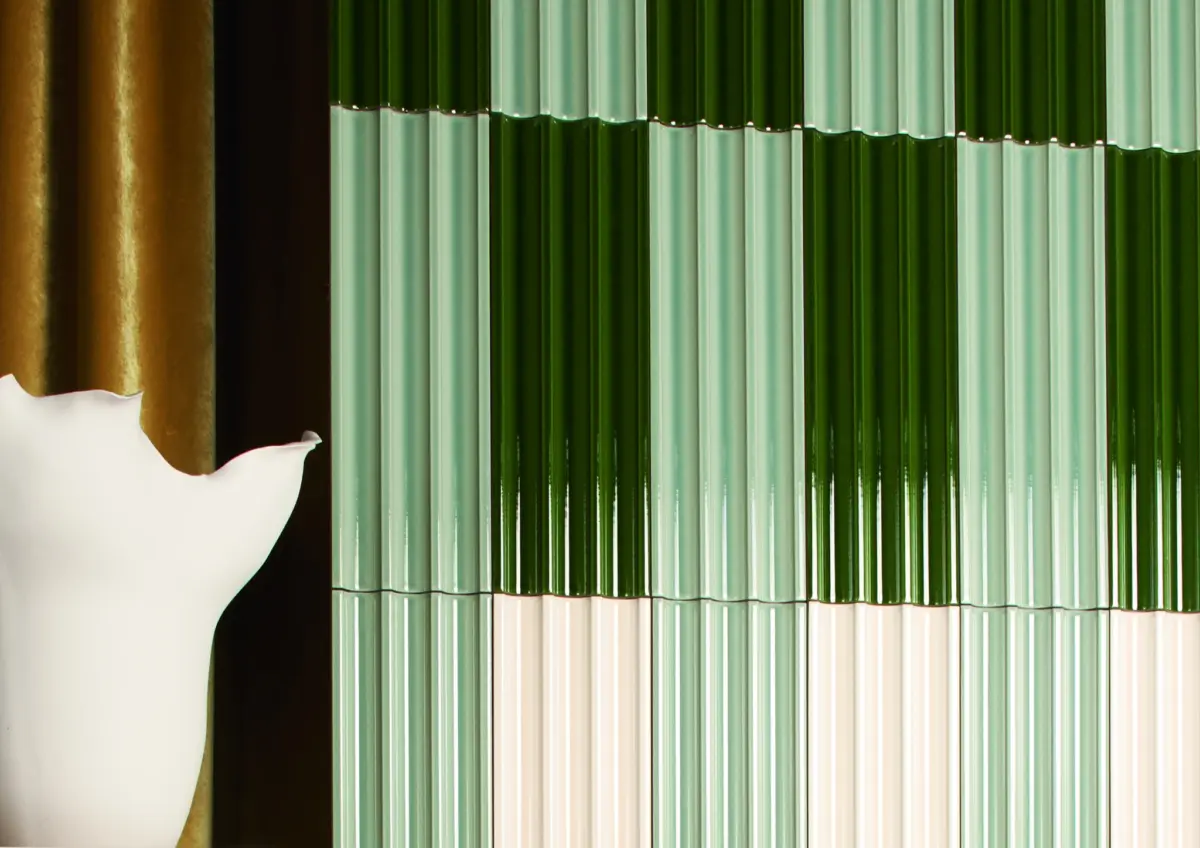
Glossy finishes further amplify these saturated colors, allowing them to pop within residential and commercial spaces. For instance, the Plinth collection from Sartoria—a brand under the Terratinta Group—is available in two distinct shades of green, Moss and Stone Green, and features a three-dimensional surface that adds tactile texture and dimension to walls.
Playing with Perception
As manufacturing technology continues to advance, the role of ceramics within interior architecture is undergoing a fundamental transformation. Ceramic is no longer simply reproducing a natural material; the surface itself is rapidly becoming an independent architectural element.

Marca Corona’s Multiforme Mira wall tiles beautifully complement the brand’s concrete-effect porcelain floor tiles. Its Tassello decorative variant features small, three-dimensional tesserae meticulously arranged to create the appearance of a continuous mosaic, contrasting glossy and luster-glazed details against a matte background.
As part of The Nesting Room collection, Moooi Ceramic Surfaces, in collaboration with ABK, designed Hypnotic Owl. This innovative floor and wall tile features a tactile 3D-relief surface realized through ABK’s proprietary 3DTECH technology, a process that digitally applies glazes and textures directly onto porcelain stoneware.

Similarly, Appiani—a brand under Gruppo Bardelli—introduced Lamiere as part of its Pastelli Strutture collection. Inspired by industrial sheet metal, these through-body ceramic tiles utilize a chiaroscuro effect to create the optical illusion of a three-dimensional surface while remaining entirely flat to the touch. The interplay of light and reflectivity creates a striking visual depth that challenges traditional perceptions of flat tile surfaces.
Nature, Reimagined
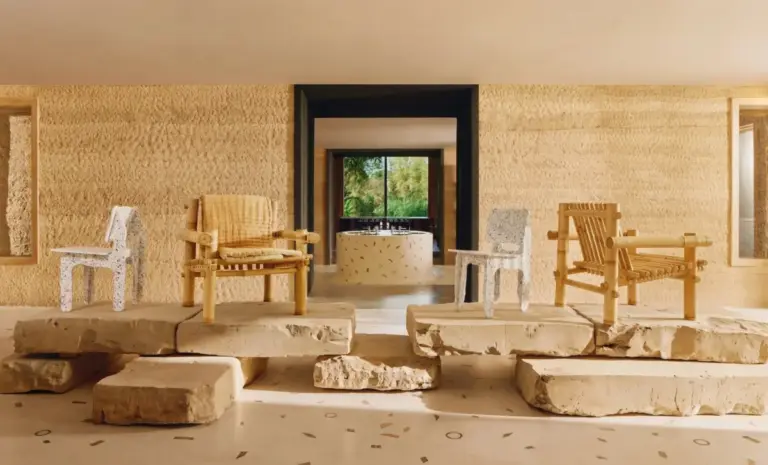
When real stone or marble proves insufficiently durable for a demanding project, or exceeds budgetary constraints, ceramic offers an effective solution by pairing the aesthetics of natural materials with the high performance of porcelain. Although ceramic simulation of natural materials is a well-established trend, continuous technological advancements have rendered these effects increasingly indistinguishable from the real thing.

Faedi describes these sophisticated simulations as controlled chaos. Modern technology enables manufacturers to replicate the complex, chaotic mix of colors, hues, and natural shapes found in stone, delivering high visual impact through precise digital techniques.
Gruppo Romani brand Verde introduced Essenziale, a glazed porcelain stoneware that faithfully mimics the materiality of limestone. Its Contour Tech 3D printing process colors the ceramic body at varying depths to accurately reflect the irregularities characteristic of sedimentary stone. Meanwhile, the Marble Boutique collection from Del Conca successfully captures the look of genuine marble and onyx through three distinct finishes—Shine, Natural, and Structured—alongside six material options featuring enhanced coloration and intricate veining displayed across large-format slabs measuring 48 by 110 inches.

Sizing Up
Large-format tile remained a major focal point at Cersaie, even though oversized formats have steadily gained traction over the years. Large slabs allow architects and designers to establish greater visual continuity across different elements of a space, extending seamlessly from floors and walls to kitchen countertops, islands, and custom furniture.
European manufacturers, particularly in Italy and Spain, pioneered oversized formats back in 2001 by utilizing advanced pressing techniques that superseded traditional 12-by-12-inch tiles. In the United States, the American National Standards Institute officially defined large-format tile as any tile featuring a facial dimension of 23 inches or larger. Many exhibitors at Cersaie showcased even more dramatic, extra-large dimensions, such as the Solaris collection by Cotto D’Este, which offers formats reaching up to 24 by 128 inches.

From Paint to Pixels
Another compelling trend at the exhibition was the presence of colorful, intricate decorative tiles produced through a combination of high-tech digital processes and traditional hand-painting techniques. The juxtaposition of cutting-edge technology and time-honored artisanal methods highlighted the diverse capabilities of modern ceramic producers.
Ceramica Bardelli showcased Tulipani, designed by Ronald van der Hilst, which features floral decorations executed in three distinct patterns created through technologies ranging from cold digital printing to laser engraving. The brand also debuted Searcus, designed by Riccardo Capuzzo, featuring whimsical patterns inspired by the sea and the circus, realized via cold digital printing techniques.

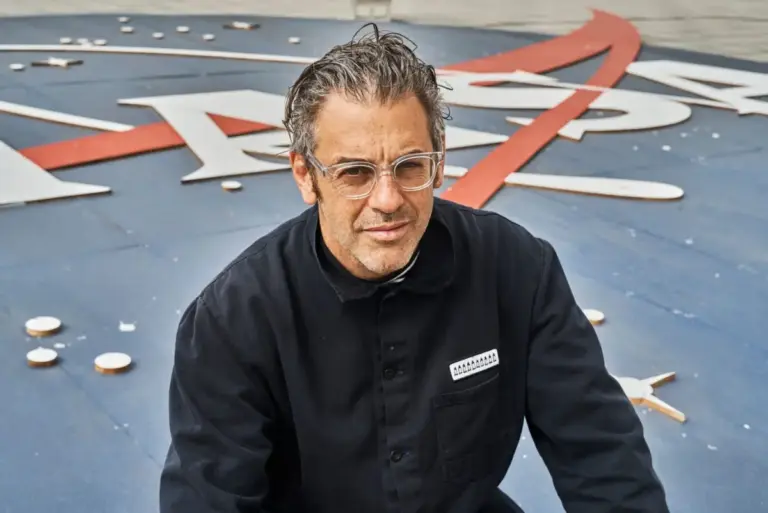
In direct contrast to digital methods, Ceramica Francesco De Maio presented its Three Elements, One Matter collection, designed and hand-painted by renowned architect Kengo Kuma. Explaining his artistic vision, Kuma noted that he sought to let nature emerge through the human hand, ensuring that each tile carries a continuous human gesture that feels as light as rain, as soft as mist, or as grounded as earth, ultimately uniting material, movement, and landscape.
Danine Alati is a 25-plus-year veteran of the interior design industry. She began her career at the commercial design publication Contract, where she spent 11 years before transitioning into luxury lifestyle media, working with titles including Hamptons and Art Basel. Based in Brooklyn with her family, she has contributed to AD PRO, DuJour, Galerie, and aspire, among other prominent design and lifestyle publications.