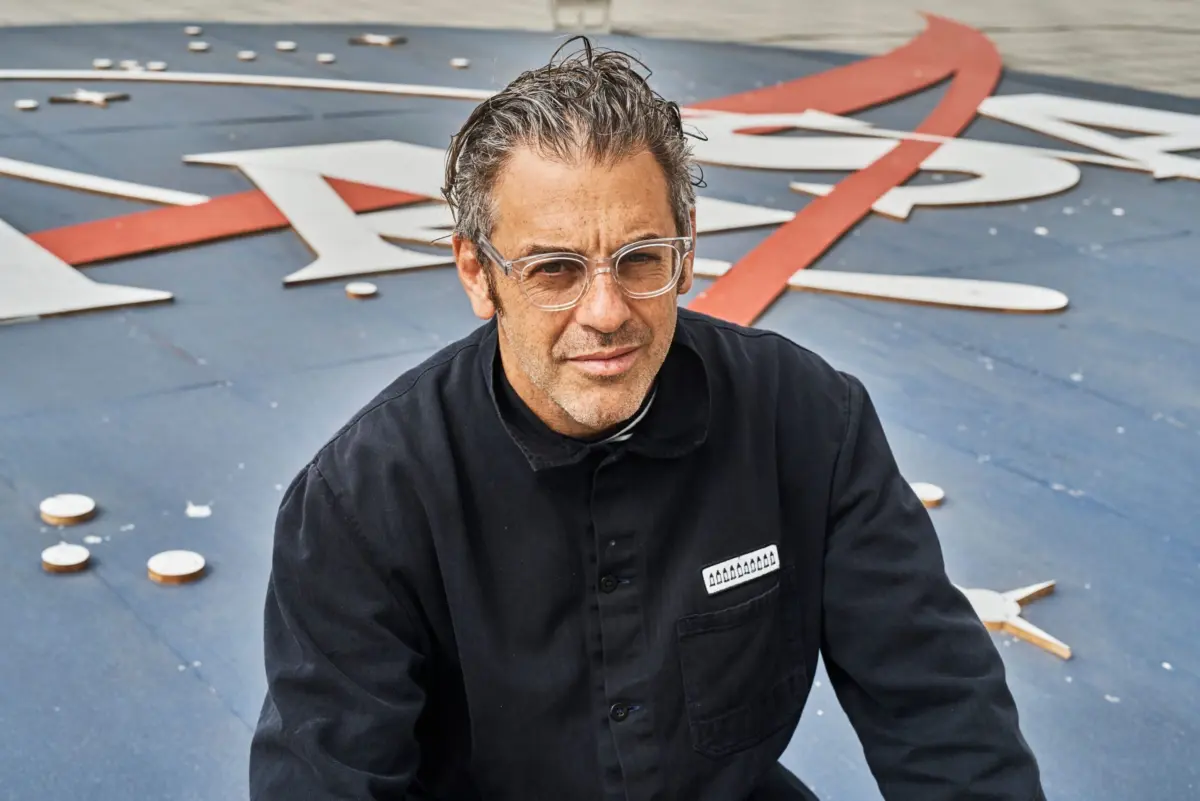
Deep within a labyrinth of customized rooms in lower Manhattan, sculptor and bricoleur Tom Sachs presides over a chaotic ecosystem of cabinets, shelves, work tables, and meticulous sorting systems. Every square inch of the workshop reflects an obsessive philosophy of work and making. Even a standard drill press has been radically overhauled, featuring two machine lamps spidering from its crown, a retractable brush to sweep away debris on command, and a chuck key and center punch firmly anchored to magnets on the machine’s face. It is a space where utility meets ritual, shaped by a 12-person team that helps mount high-profile museum exhibitions across the globe.

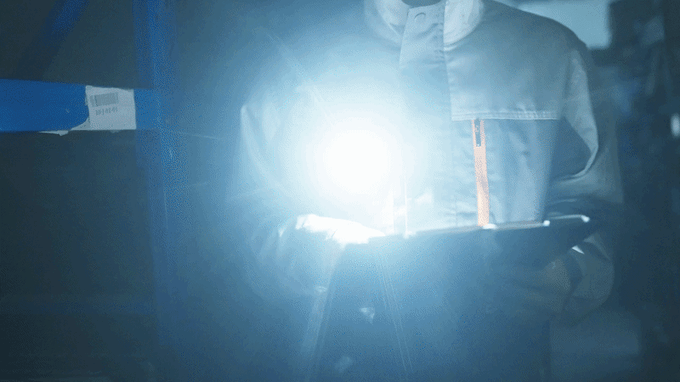
On the day of the visit, Sachs and his team are in the final, frantic stages of preparation for a massive, large-scale installation at San Francisco’s Yerba Buena Center for the Arts. Opening in September, the exhibit is the third installment in Sachs’ celebrated Space Program series. It will send two "astronauts"—portrayed by studio assistants—in a plywood mock-spaceship on a simulated mission to Europa, the icy Jovian moon that scientists believe might harbor alien life. Nearby, studio assistant Sam Ratanarat is carefully welding the titanium rods of a supply cart the astronauts will wheel onto the simulated planetary surface.

Sachs examines the work, praising Ratanarat’s first weld as a gorgeous display of "material bragging rights." Yet, true to his perfectionist nature, he immediately scrutinizes their aging MIG welder, questioning whether it is time to retire the battered machine. Ratanarat defends its utility, capturing the practical push-and-pull of a bustling studio environment.

While his team handles the heavy engineering, Sachs focuses on outfitting the mission with a distinct thematic edge. Past space efforts utilized modified, white Spyderco folding knives engraved with NASA’s iconic 1970s logo. But Europa requires a different tool. Conceptualizing the mission as an exercise in interplanetary colonialism, Sachs decides that the ultimate weapon of the explorer-conqueror is a machete, which he is currently milling straight from a Japanese lawn-mower blade.

With multiple concurrent exhibitions in New York and the impending launch of the Yerba Buena show, Sachs stands at the peak of a two-decade career. His cobbled-together, rough-edged, and joyful contraptions have cemented his reputation as one of the world’s most famous modern bricoleurs—artists who cobble together functional contraptions out of collected materials.

From Rough Beginnings to the Fine Art World
Sachs’ path to international acclaim was unconventional. Described as a peculiar child who bought Goodwill clothes and had them tailored, he struggled academically as a D-minus student, battled social isolation, and ultimately had to repeat the ninth grade.

A lifeline arrived when he gained admission to Bennington College, where a senior named Babs taught him how to weld and introduced him to the profound modernist works of Constantin Brancusi and Richard Serra. Though the romance was short-lived—she quickly left him for a trust-fund student—the artistic impact endured. She introduced him to a more complex methodology of creation, teaching him how to construct physical objects that engage political and social narratives, embedding art within the daily rituals of human life. He famously nursed his broken heart with an angle grinder.

Years later, fellow maker and former MythBusters host Adam Savage encountered Sachs’ work through a video of a replica Lunar Excursion Module on a simulated Mars mission. Savage forwarded the link to space enthusiast Tom Hanks, who not only recognized the work immediately but knew Sachs personally. Hanks soon connected Savage and Sachs, sparking a creative kinship between two obsessive organizers and builders of replicas.

Sharing workshop spaces on both coasts, the two makers quickly discovered deep parallels in their approaches. When Sachs hits a creative block in his studio, he builds foundational infrastructure like storage benches, shelves, and display stands—techniques he admits to cribbing in part from television science programming. Their shared compulsion for fabrication mirrors a deeper psychological drive: building functional replicas of objects from favorite narratives as a way to converse with their ten-year-old selves.

The Rituals of Space and Tea
Sachs’ fascination with space exploration extends far beyond aesthetic parody. NASA roboticists and engineers have long embraced his projects because, beneath the raw plywood edges and exposed brushstrokes, every switch, hatch, and life-support system is technically traceable to the reality of actual spaceflight hardware.

The simulated missions are elaborate, high-stakes theatrical performances fraught with potential failure. For the Europa mission, astronauts start in a quarantine trailer, transfer via scissor lift to a landing module, and rely on a miniature camera rig to film a model rocket liftoff along a length of yarn toward a spinning globe. Landing requires an astronaut to play the classic Atari game Lunar Lander. Failure means a television screen displays a Richard Nixon impersonator reading the speech originally prepared in the event of an Apollo disaster, immediately ending the exhibition.

Success, however, brings the astronauts onto the planetary floor in suits cooled by backpack-mounted tanks of ice water. Guided by mission control, they drill through a simulated ice sheet—modeled after the koi pond used in Sachs’ signature tea ceremonies—and capture live aquatic organisms representing Europans, blending scientific ambition with absurdist theater.

This synthesis of hardware and ritual is central to Sachs’ artistic identity. It echoes the formal Japanese tea ceremonies he hosts for collectors and donors in custom plywood-and-resin teahouses built at institutions like the Noguchi Museum. Stripping participants of modern distractions like smartphones and wristwatches, Sachs serves matcha, sake from stacked-plywood cups, and unconventional snacks like Oreos and peanut-butter Ritz crackers. It is a performance that bridges ancient aesthetic traditions with contemporary pop culture, driven entirely by an artist who prefers the tangible reality of a hard day’s labor.

"I love getting my hands dirty," Sachs reflects. "I only feel good if I have a cut somewhere. If I have a little burn, it means that I’m probably doing something right."