Photography has long been described as "painting with light"—a poetic phrase that has circulated within artistic and technical circles for at least a century. Yet, that definition rarely feels as potent, heavy, or emotionally resonant as it does when confronting the image that has just been named Photo of the Year at the prestigious Siena International Photo Awards.
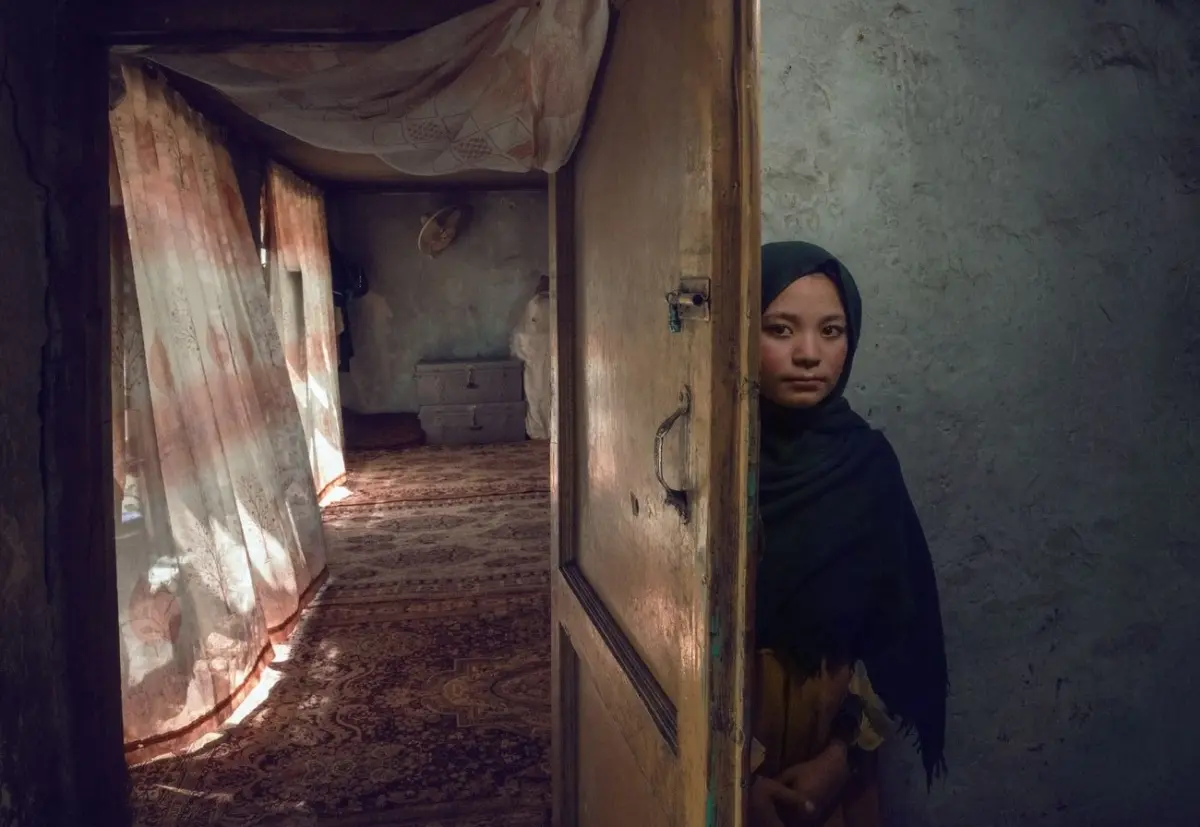
In this striking composition, light is the absolute protagonist. It is the very first element that arrests the viewer’s gaze, pouring in relentless streams through patterned curtains into a modest, dimly lit room in the heart of Afghanistan’s capital. The luminescence illuminates the dust motes and casts intricate shadows across the interior. Then, as the eye naturally drifts to the right, moving past a simple wooden door, it encounters a direct, unblinking gaze.
The person standing there is Amina. Positioned firmly on the dark side of the doorway, she is half-hidden by the architecture of the room, her face closely framed by a stark black headscarf. Notably, she does not smile. Her expression is a quiet testament to endurance, holding the weight of a reality that defies simple documentation.
Amina was captured on camera by Italian photographer Stefano Rosselli inside Kabul, a city currently under the grip of a tyrannical government run by the Taliban. In this constricted environment, Amina shares her daily existence with her mother, a sister, and a brother. Her family’s stability was fractured two years ago when her father, who worked as a driver, disappeared without a trace. In the current sociopolitical climate of Afghanistan, such disappearances are rarely investigated, leaving families in a state of perpetual limbo and grief.
It is a narrative arc that Rosselli encountered repeatedly as he gained access to the private homes of Afghan families. He describes meeting households where the death or disappearance of male relatives has left an unfillable void, effectively silencing all hope for the future.
That profound loss hits with particular severity in a nation where, as Rosselli poignantly notes, women have been systematically deprived of the right to work and stripped of their independence. For generations, these avenues represented the primary instruments through which women could shape and change their own destinies. With the removal of male breadwinners and the simultaneous revocation of basic civil rights, the future for households like Amina’s appears bleak and insurmountable.
Reflecting on his time documenting these communities, Rosselli observes that the individual narratives unfolding across Afghanistan ultimately resemble one another. They are universally marked by the stark awareness that a happy ending will rarely, if ever, be written for them under the current circumstances.
Dividing lines
What makes Rosselli’s winning photograph so technically and emotionally impressive is its economy of storytelling—how much it communicates to the viewer without relying on explanatory text or overt dramatization.
The composition is cleanly bisected by a plain wooden door, which effectively divides the frame into two distinct psychological zones. On the left side lies an empty, sun-drenched room, representing a space of openness that is nonetheless devoid of human agency or comfort. On the right side is Amina, physically squeezed into a narrow strip of deep shadow. The brilliant light that floods the adjacent room barely manages to touch the edge of her face. As a visual metaphor for a life lived entirely in the shadows, silenced and marginalized, the imagery could not be clearer or more evocative.
The surrounding details within the frame serve to emphasize this overarching theme of deprivation and restraint. The interior contents of the home are sparse, consisting of little more than a couple of storage trunks, a wall-mounted fan, and a piece of fabric stretched loosely across the ceiling. The color palette is similarly restrained, characterized by the dusty pinks and warm golds of the window curtains, which are carefully balanced against the cool grays of the surrounding wall and the absolute, absorbing black of Amina’s headscarf.
Furthermore, the engagement between the subject and the lens breaks conventional documentary tropes. Many contemporary images depicting human suffering tend to feature subjects looking away from the camera, a stylistic choice that can inadvertently render the individuals feeling passive or distant to the viewer. In stark contrast, Amina meets the camera’s gaze directly. This unwavering eye contact transforms the photograph from a passive window into an active confrontation, making the image both profoundly powerful and intentionally uncomfortable in all the right ways.
A shift from commercial polish to unfiltered reality
Rosselli’s path to capturing this award-winning image is an unusual one, forged over three decades spent working within the high-gloss world of advertising. During his long commercial career, he collaborated with major global agencies including Saatchi & Saatchi, DLV BBDO, and Leagas Delaney, crafting polished campaigns designed to sell consumer dreams.
Recently, however, after spending thirty years portraying what he candidly describes as "a perfect world far from reality," Rosselli experienced a profound shift in perspective. He felt an urgent personal and professional need to turn away from commercial artifice and begin showing the real world "without filters or censorship." That transition from the curated illusions of advertising to the raw immediacy of documentary photojournalism ultimately led him to the heart of Kabul, resulting in an image that has now resonated with judges and audiences on an international scale.
The photograph Amina, alongside the other winning and shortlisted images from the Siena International Photo Awards, is currently being showcased to the public. The exhibition runs until November 29, with displays hosted across multiple venues in Italy, including Siena, Castelnuovo Berardenga, and Sovicille.