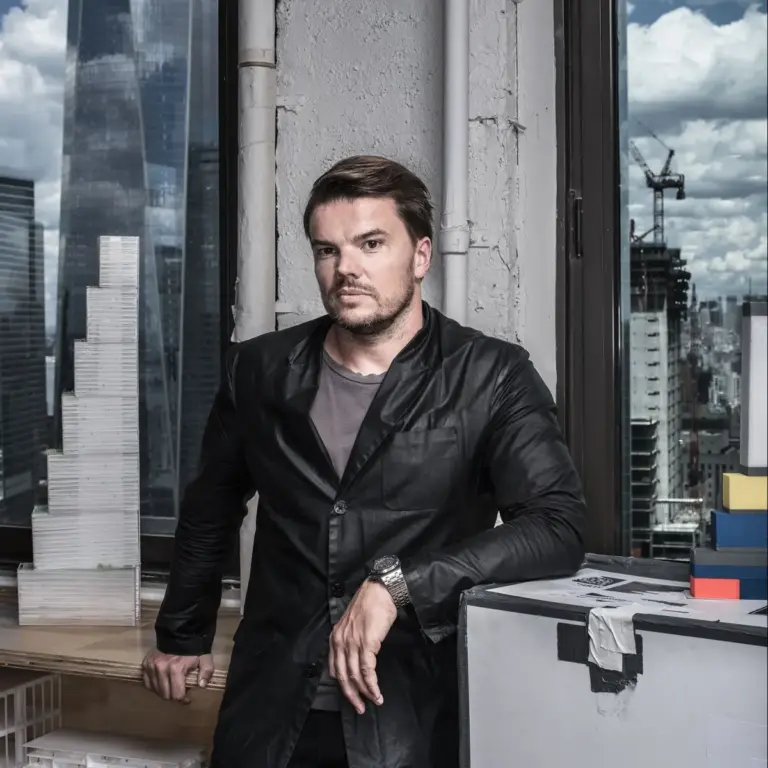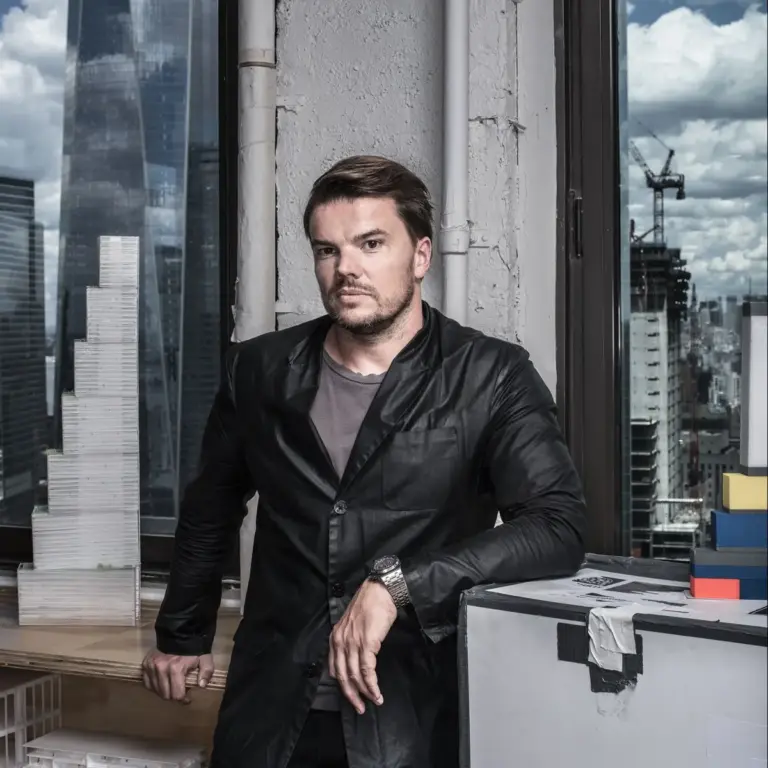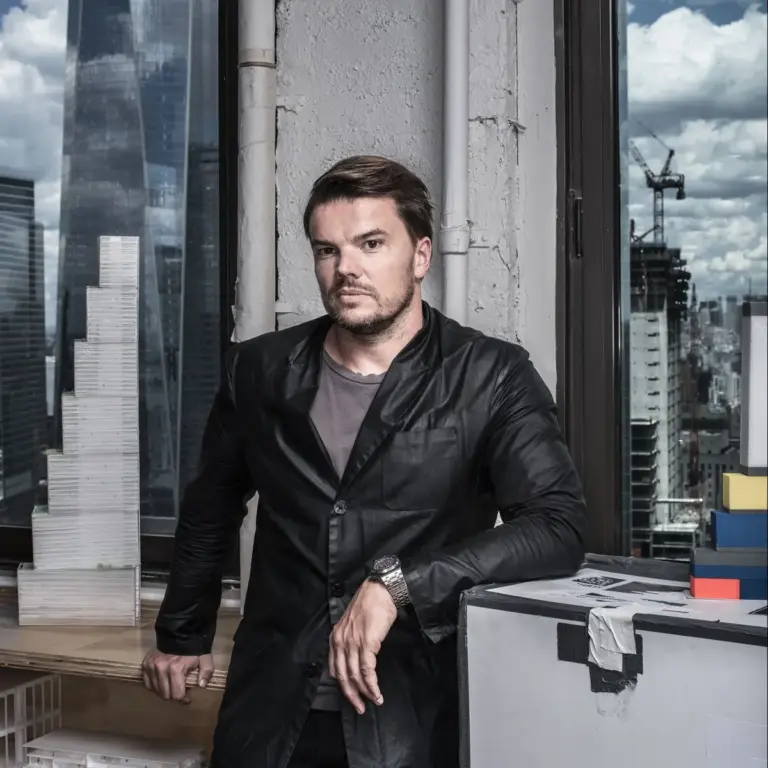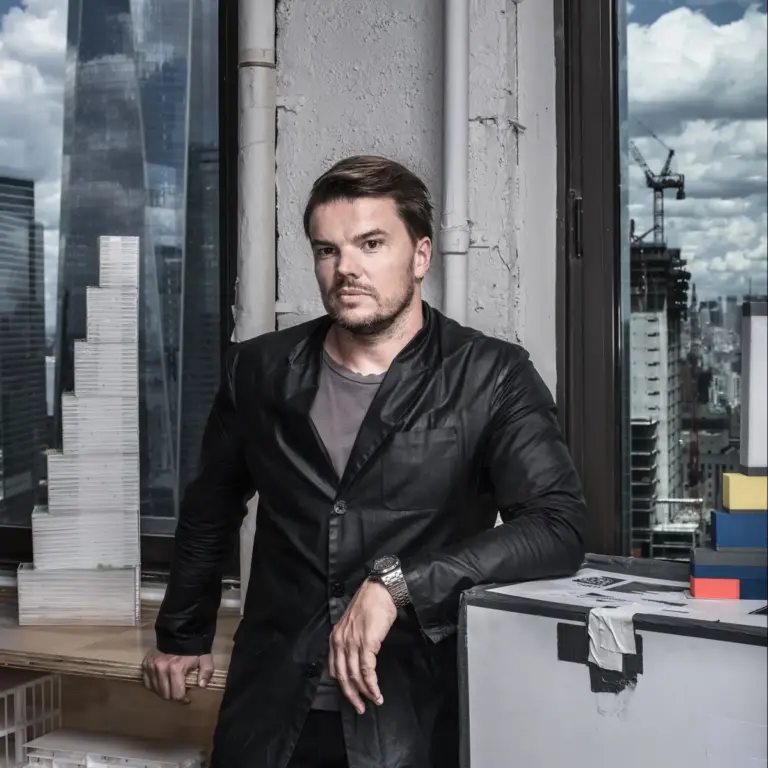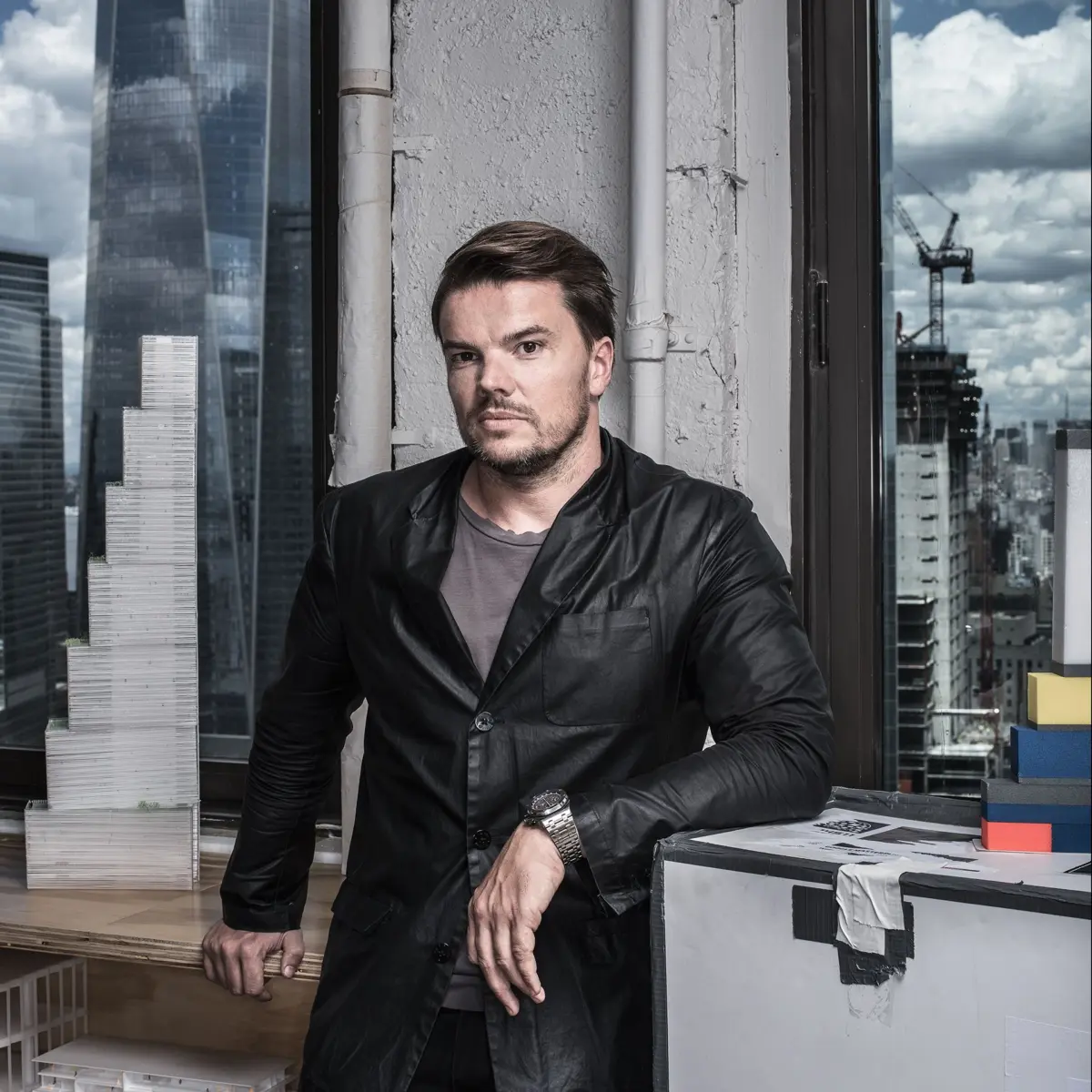
On a misty April morning in Lower Manhattan, Bjarke Ingels stood atop an old brick building with the collar of his black coat rakishly popped, shooting a promotional film for what would become the defining commission of his career. At just 40 years old, the Danish architect was pitching his radical design for Two World Trade Center, a staggering $4 billion skyscraper destined to complete the master plan of the redeveloped site.
Yet, as the hyper-eloquent architect traced the profile of a building only he could fully see against the grey skyline, his primary client—media magnate Rupert Murdoch—had still not officially signed off. Murdoch’s plan to relocate his corporate empire was one of New York real estate’s tightly guarded secrets, but Ingels was ready to shout the news from the rooftops. Between takes, he gestured toward a void in the densely packed Manhattan landscape, describing his design as a stack of seven blocks ascending like a staircase toward One World Trade Center.
"In a way, it is almost like a physical manifestation of the spirit of America," Ingels reflected. "Out of many, one."

If completed, the tower would stand as one of the tallest buildings in New York City, closing out the ensemble of four skyscrapers that ring two cascading pools paying tribute to the victims of September 11, 2001. But Ingels was not focused on looking backward. "The memorial is about the memorial," he noted. "The tower should be about the living city."
Ingels is fond of saying that architecture is "the art of turning fiction into fact." He possesses a rare combination of talents as a draftsman, a master salesman, and a charismatic cultivator of his own public image. Yet his greatest asset is an uncanny knack for storytelling—an ability to construct a compelling narrative around rigid practical necessities. His past designs frequently careen into the fantastical. In Copenhagen, he designed a waste-to-energy plant featuring a slanted roof that doubles as a public ski slope and a smokestack engineered to puff a symbolic ring of steam for every ton of carbon dioxide emitted. For a proposed expansion of Google’s campus in Mountain View, California, Ingels collaborated with designer Thomas Heatherwick on an elaborate complex of geodesic domes, envisioning an ecosystem of biking, hiking, and coding inside a sunlit glass terrarium.
Such imaginative flights have made Ingels an international phenomenon at an age considered remarkably precocious by the standards of traditional architecture. Still, fame in his profession can be a deceptive indicator. As Ingels acknowledged on the eve of his greatest challenge, despite his growing reputation and a striking pyramidal residential building under construction along Manhattan’s West Side Highway at 57th Street—dubbed Via 57 West—his firm, BIG (Bjarke Ingels Group), had not yet completed a single skyscraper.

With Two World Trade Center, Ingels believed he had devised a way to reinvent the high-rise work environment, transforming a structure that is fundamentally vertical and hierarchical into a space for horizontal interaction. The laborious part, however, was proving that his captivating story could be translated into hard facts on the ground.
Eclecticism on Demand
Ingels playfully refers to his approach to architecture as "BIGamy." Rather than adhering to a single, rigid aesthetic, he tailors his ideas to meet the distinct demands of his clients, resulting in designs unlike anything seen before. But realizing his vision for Two World Trade Center meant continually proving its value to two notoriously demanding octogenarians: Rupert Murdoch and Larry Silverstein, the developer controlling much of the World Trade Center site.
Before construction could even be financed, Murdoch and Silverstein had to agree on a complex, long-term lease. "There’s a lot of drama with the deal right now," Ingels admitted during his initial film shoot. "I don’t know how worried I should be." Beyond negotiations, he faced a volatile real estate market, the inherent political melodrama of building on a site of mass tragedy, and the bureaucratic hurdles of the Port Authority of New York and New Jersey, the agency that owns the land beneath the complex.

For 14 years, these very factors had conspired to stall the redevelopment process, dashing the architectural ambitions of predecessors like Lord Norman Foster, whose earlier design for Two World Trade Center was displaced by Ingels’ proposal. To avoid a similar fate, Ingels had to balance the conflicting priorities of Murdoch and Silverstein while managing a flood of new global commissions that had begun pouring into his firm.
The first major force Ingels had to overcome was pure inertia. Silverstein was initially attached to Foster’s design and expressed serious doubts about Ingels’ early drawings, fearing the stacked structure would appear asymmetrical or even teetering from certain angles. The developer nearly walked away from the deal before receiving assurances from the architects behind other World Trade Center structures.
Days later, Ingels faced a high-stakes review meeting with Rupert Murdoch. Uncharacteristically off-balance, Ingels navigated what he described as "kangaroo boxing" as the media mogul fired off rapid-fire questions, chief among them: "Why doesn’t it fall over?"

With assistance from David Childs, the architect of One World Trade Center, Ingels explained that the leaning effect was a calculated illusion. The unorthodox stepped form resulted from positioning the structural core off-center, generating expansive interior spaces for newsrooms, outdoor terraces, and direct views of the plaza for Fox News studios. Murdoch was ultimately convinced. "The more blatantly the architect can explain why things are the way they are, the better," Ingels said.
Ingels also found a vital ally in James Murdoch, Rupert’s son and corporate heir apparent, who served as the driving force behind the decision to relocate 21st Century Fox and News Corp. from their aging headquarters near Rockefeller Center. Looking for an open, creative, loft-like workspace rather than a conventional corporate monolith, the younger Murdoch found a kindred spirit in Ingels. "We were struck by what a great problem solver he was," James noted. "This is someone who can take a set of constraints and create something surprising and effective out of them."
However, overcoming the conceptual hurdle was only the beginning. Ingels soon encountered severe structural and engineering roadblocks tied to the remnants of Foster’s original foundation, which had already been built to accommodate a $4 billion underground transit hub. Ingels’ vision to retrofit the foundation by shoring up underground walls conflicted directly with Port Authority regulations. Like a Jenga tower, removing vital reinforcement risked collapsing the entire structural framework.

Simultaneously, a facade consultant delivered sobering news. To reduce costs, Ingels had hoped to use thinner glass panes in certain sections of the building. However, New York Police Department security standards mandated that all facades at the World Trade Center utilize heavy laminated safety glass to protect against potential explosions. The added weight drove projected facade costs up by tens of millions of dollars, placing the architecture under intense financial scrutiny as Silverstein and Murdoch’s lease negotiations hit a tense plateau.
For weeks, the project’s future hung in the balance. Yet, after accepting necessary structural modifications and streamlining elements of the design, Ingels managed to pull off a turnaround that earned praise from Silverstein’s top executives, including Janno Lieber, who commended the architect for navigating the complex web of cost and engineering demands.
By early June 2015, a tentative lease agreement between Silverstein and Murdoch was finally in place, allowing the team to publicly unveil the design for Two World Trade Center. Before the public rollout, Ingels sought a final blessing from architect Daniel Libeskind, whose master plan forms the foundational template for the entire World Trade Center complex.

Gathered in BIG’s conference room around a glowing plastic replica of the skyscraper, Ingels demonstrated how his design respected Libeskind’s famed "Wedge of Light" plaza and utilized diagonal lobby columns to align with preexisting foundation points. Libeskind gave his approval with an emphatic slap on the table, declaring, "Congratulations, that is a super building."
Initial public reviews of the June 9 unveiling were largely positive, but Libeskind offered a cautionary reminder of the realities ahead: "Between that first smile and the last stone is the challenge of architecture… this complex space filled with what the city really is: economics, society, power brokers, politicians."
As BIG continued to expand, opening a sprawling new office on Broadway with a clear view north toward the World Trade Center, Ingels juggled an ever-growing roster of ambitious international projects, from the Smithsonian master plan in Washington, D.C., to the expansive climate-defense park known as the Dryline in Manhattan.

Reflecting on his meteoric rise from a Copenhagen startup founder a decade prior to a dominant force in American architecture, Ingels remained philosophical about the continuous compromises required to turn utopian ideas into tangible steel and glass. Walking past the active construction zones of Lower Manhattan, he paused to frame the future site of his skyscraper in the air with his hands.
"Imagine, that’s where it’s going to sit," Ingels said with a grin. "I think it’s going to be pretty epic."