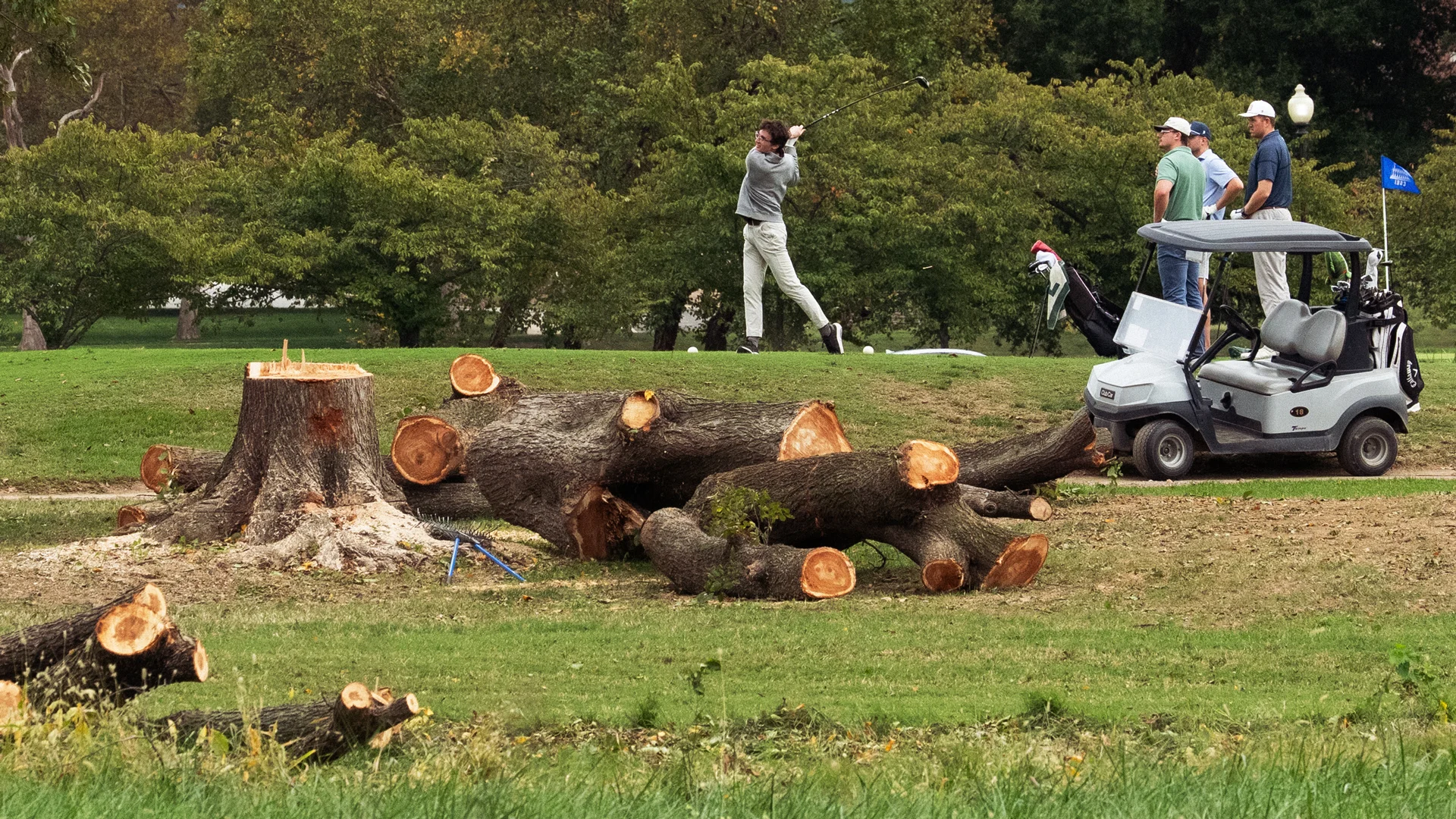
WASHINGTON — In what preservationists and legal advocates are calling a calculated move to circumvent environmental laws, workers removed more than 500 trees over the weekend at a historic public golf course in Washington, D.C., that President Donald Trump is currently working to remodel.
The rapid clearance operation took place at East Potomac Park, a prominent golf facility managed by the National Park Service, situated on a small island in the Potomac River just south of the National Mall. The sweeping removal of 529 trees occurred suddenly over the course of a single weekend, catching local historians, environmental advocates, and park users entirely off guard.
The swift action prompted an immediate legal response. Preservationists rushed to court on Sunday to ask a federal judge to halt the Trump administration’s operations. By Monday, a federal judge sharply rebuked the administration’s actions, condemning the sudden tree removal as "inexcusable."
The cleared landscape included a diverse array of mature elms, oaks, pines, and willows. Among the lost vegetation were some of the historic Japanese flowering cherry trees originally gifted to the United States government by the nation of Japan in 1912. Together, these trees formed a living archive that tracked the evolution of golf course architecture in America—illustrating the transition from a mostly treeless game along U.S. coastal regions to a sport defined by lush, heavily vegetated inland landscapes. In a matter of days, more than a century of landscape design history was systematically torn up.
According to a lawsuit filed by attorneys representing the D.C. Preservation League and a pair of local golfers, the removal happened "faster than anticipated." The legal filing argues that the Trump administration failed to meet its obligations under the National Environmental Policy Act (NEPA), which requires federal agencies to assess the environmental impacts of major actions before proceeding with them. The plaintiffs sought an emergency action to pause any further tree removal while the legal challenge moves forward.
Legal representation for the plaintiffs includes the prominent civil rights and defense attorney Abbe D. Lowell, a founding member of Lowell & Associates, working alongside advocacy organizations Democracy Forward and Democracy Defenders Fund.
"’Pulling a fast one’ has become the model this administration uses to circumvent the laws intended to protect the environment and D.C. landmarks," Lowell said in a strongly worded statement regarding the weekend operation. "It did so with the East Wing and the Kennedy Center, and we are continuing our effort to stop them before they succeed in destroying D.C.’s historic public golf course."
The sudden intervention at East Potomac Park mirrors a broader pattern of recent design and construction projects undertaken by the administration across the nation’s capital. Critics point to similar lightning-fast renovations and structural alterations, such as high-profile work around the White House East Wing and administrative changes at the Kennedy Center, as evidence of a recurring strategy to bypass standard public oversight, environmental reviews, and historic preservation protocols.
A Brief History of Parkland Courses
The setting for this latest controversy carries deep historical significance for both urban development and recreational design in the nation’s capital. East Potomac Park occupies a strategic and scenic geographic location on a small island in the Potomac River, sitting just south of the iconic National Mall.
Historically, the earliest known vegetation on the site consisted primarily of tall native grasses and wild willow trees. Most of this natural landscape was initially cleared during the early part of the twentieth century to design and construct the first golf course layout on the property in 1917.
According to a comprehensive 2017 cultural landscape inventory of the course conducted by the Urban Heritage Project—part of the University of Pennsylvania’s Stuart Weitzman School of Design—additional trees were systematically planted over subsequent decades to adapt to changing aesthetic tastes and architectural standards in the sport.
The inaugural course layout at East Potomac Park was designed by renowned golf course architect Walter J. Travis. During his initial design phase, Travis cleared the fairways of most existing willows, though he purposefully retained a selection of trees along the perimeter of the course to serve as natural dividers between the front and back nine holes.
As golf course design philosophies shifted during the 1920s toward a new paradigm known as the "parkland style," the philosophy around vegetation changed dramatically. This architectural movement emphasized lush, heavily treed environments that mimicked traditional European estate grounds, leading to the planting of hundreds of additional trees across the East Potomac property over the following century.
That layered history of landscape architecture and urban park planning was fundamentally altered over the weekend, leaving preservationists and legal teams fighting in federal court to prevent further alterations to the historic property while the administration’s remodeling efforts continue to draw judicial scrutiny.