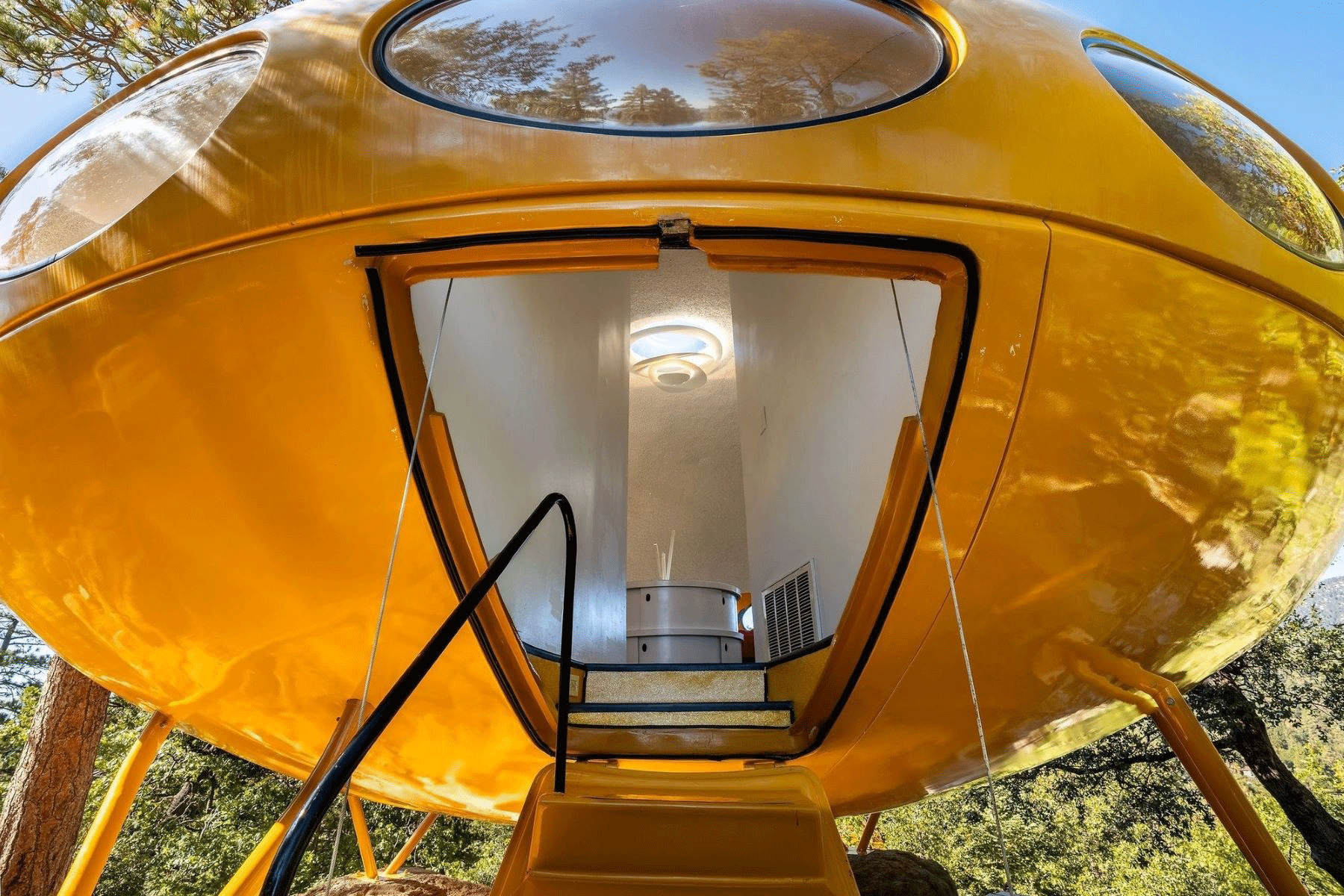
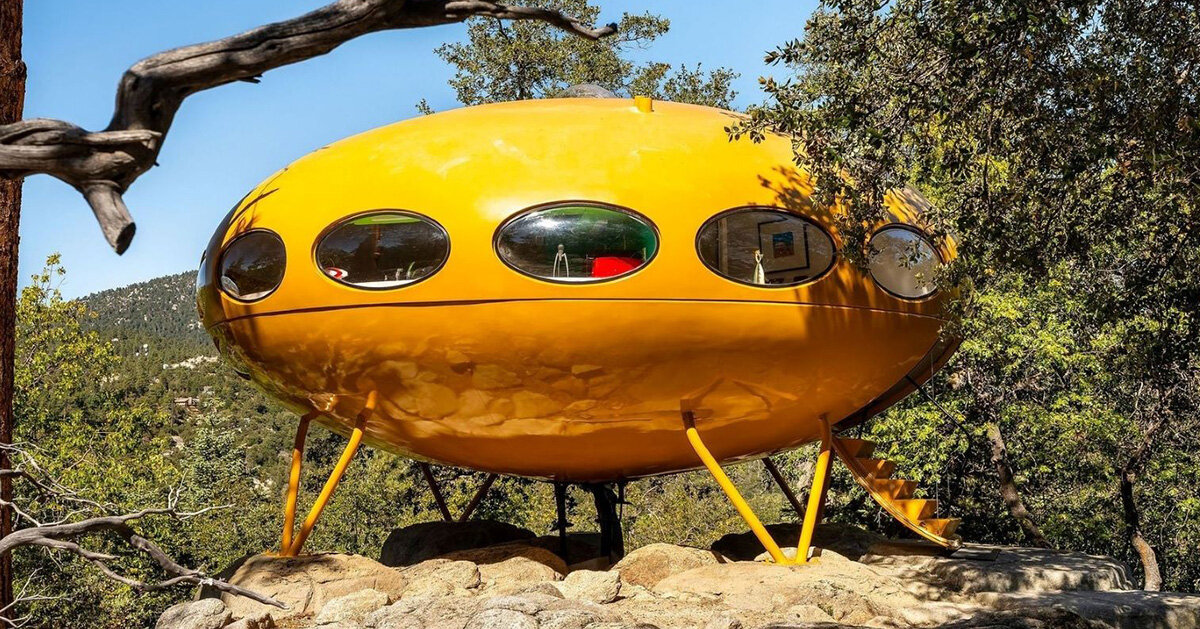
A rare, UFO-shaped Futuro house nestled among the pine trees and rocky terrain of Idyllwild, California, has officially hit the real estate market with an asking price of $1.495 million. Designed by visionary Finnish architect Matti Suuronen at the height of the Space Age, the prefabricated dwelling reflects a radical 1960s ideology of portable living. Conceived initially as a lightweight ski cabin that could be easily transported by helicopter and dropped into remote landscapes, the iconic structure represents a fascinating chapter in architectural history when new materials and aerospace technology promised entirely new ways to inhabit the earth.
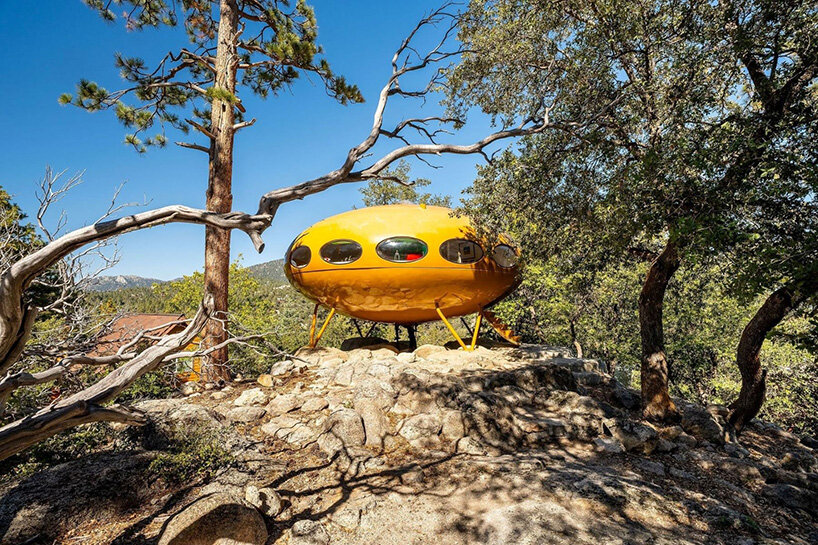
With fewer than 100 original Futuro units ever manufactured worldwide, this particular property offers collectors and architecture enthusiasts a remarkably preserved surviving example of mid-century experimental design. Its striking elliptical yellow fiberglass shell, punctuated by circular aircraft-style windows and accessed via an airplane-inspired folding ladder entrance, captures a time when the human imagination was transfixed by space exploration. The surrounding environment of the San Jacinto Mountains provides a dramatic backdrop for the structure, which appears much like a landed spacecraft resting effortlessly on a rugged mountain slope.
The Matti Suuronen-Designed House Is Designed to Go Anywhere
Listed through Desert Sotheby’s International Realty, the Idyllwild landmark is owned by prominent historic preservationist and former Obama administration appointee Milford Wayne Donaldson alongside his wife, Laurie Donaldson. Locally and historically referred to as the Donaldson Futuro, the architectural marvel holds official recognition on the National Register of Historic Places. This prestigious designation underscores its cultural importance, safeguarding an adventurous approach to residential engineering born directly out of the technological optimism and material experimentation of the late 1960s.
Matti Suuronen originally developed the Futuro concept around the radical premise of a lightweight, modular dwelling that could effortlessly adapt to virtually any geographical landscape. The engineering of the structure relied on precision-molded components that could be bolted together rapidly on-site. Furthermore, the entire assembly was engineered to be dismantled, reassembled, or airlifted by helicopter should the owner wish to relocate their home to an entirely different vista.
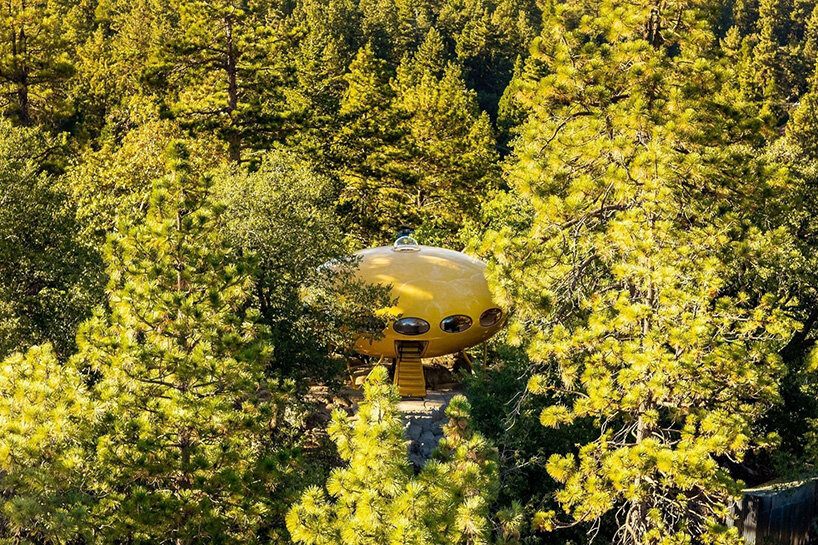
Constructed primarily from fiberglass-reinforced polyester plastic integrated with polyurethane insulation, the Futuro was thoughtfully engineered for extreme climates. The synthetic materials ensured that the cabin could be installed swiftly and heated with remarkable efficiency, even when subjected to harsh alpine winter environments. Ingeniously, the original concept required only four simple concrete piers to anchor the structure securely into the earth. This minimalist footing drastically minimized the need for extensive site excavation, heavy machinery, or conventional construction footprints, aligning with an early ethos of gentle engagement with nature.
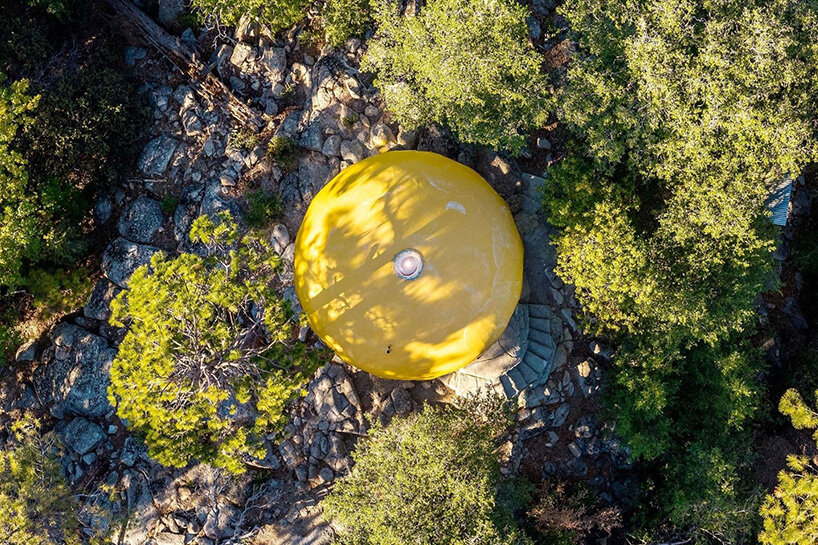
Measuring approximately 8 meters in diameter and standing roughly 4 meters tall, the Donaldson Futuro encompasses about 73.7 square meters of thoughtfully arranged interior living space. The entire aerodynamic dwelling weighs approximately 5,398 kilograms and rests securely on a tranquil 0.23-hectare parcel of land in the scenic mountain community near Idyllwild.
Why the Futuro Never Became the House of the Future
The genesis of the Futuro occurred during a decade characterized by profound confidence in mass industrial manufacturing, chemical engineering, and synthetic materials. Architects and industrial designers envisioned a future where homes would no longer be painstakingly constructed from the ground up using traditional bricks, mortar, and timber. Instead, houses would be mass-produced in factories, efficiently transported across vast distances, and plugged into pristine natural landscapes with minimal ecological disruption.
Despite the bold vision and international media attention garnered by Suuronen’s design, the Futuro ultimately struggled to secure widespread commercial acceptance. The unorthodox, alien aesthetic of the plastic flying saucer provoked skepticism, apprehension, and outright resistance from conservative neighborhood associations and municipal zoning boards. Furthermore, prospective buyers frequently encountered steep hurdles when attempting to secure traditional mortgage financing for such an experimental, non-standard residential structure.
Macroeconomic events also dealt a severe blow to the viability of plastic architecture. The global oil crisis of 1973 triggered a massive spike in petroleum prices, which directly inflated the manufacturing costs of the synthetic resins and fiberglass required to build the Futuro. Consequently, the core economic premise of affordable, mass-produced plastic dwellings evaporated almost overnight.
According to historical records tracking the initiative, fewer than 100 Futuro units were ever completed and distributed around the globe. What began as an ambitious commercial venture to democratize access to remote wilderness retreats through industrial production instead transformed into a restricted, short-lived architectural experiment. Today, the few surviving examples are heavily sought after by collectors, museums, and preservationists, valued precisely for their extreme scarcity and cultural symbolism.
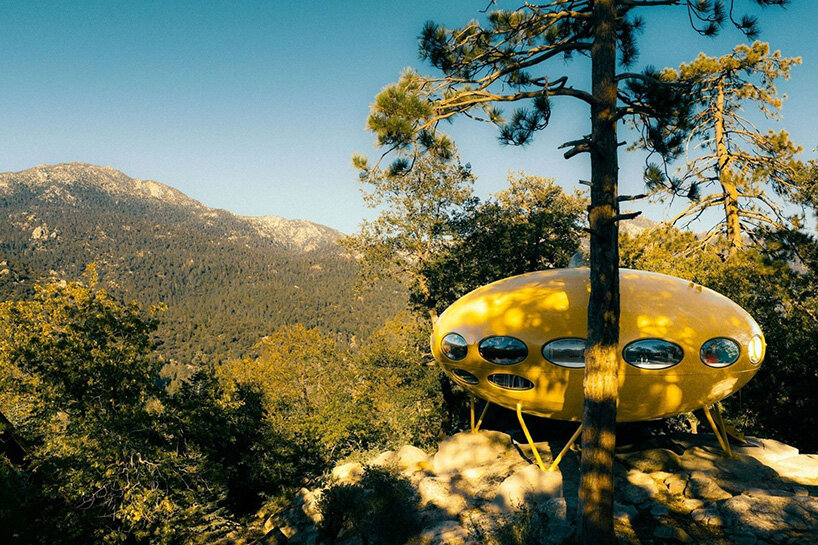
The Donaldson Futuro has benefited from meticulous, extensive restoration efforts that strictly honor the integrity of its original 1969 design specifications, construction methods, and material choices. Its protected status on the National Register of Historic Places cements its enduring importance within the broader evolution of experimental residential design.
In many ways, the property’s current standing highlights a profound irony at the core of the Futuro’s original mission. Conceived originally as a mass-producible, highly mobile dwelling capable of adapting to any frontier, it now functions as a static, carefully curated historical artifact—a physical time capsule preserving a distinct mid-century fantasy of tomorrow. With its $1.5 million price tag, the offering appeals directly to preservation-minded buyers and architectural connoisseurs, demonstrating how visionary ideas that fail to conquer the mass market can eventually achieve a different kind of permanence through rarity and historical reverence.