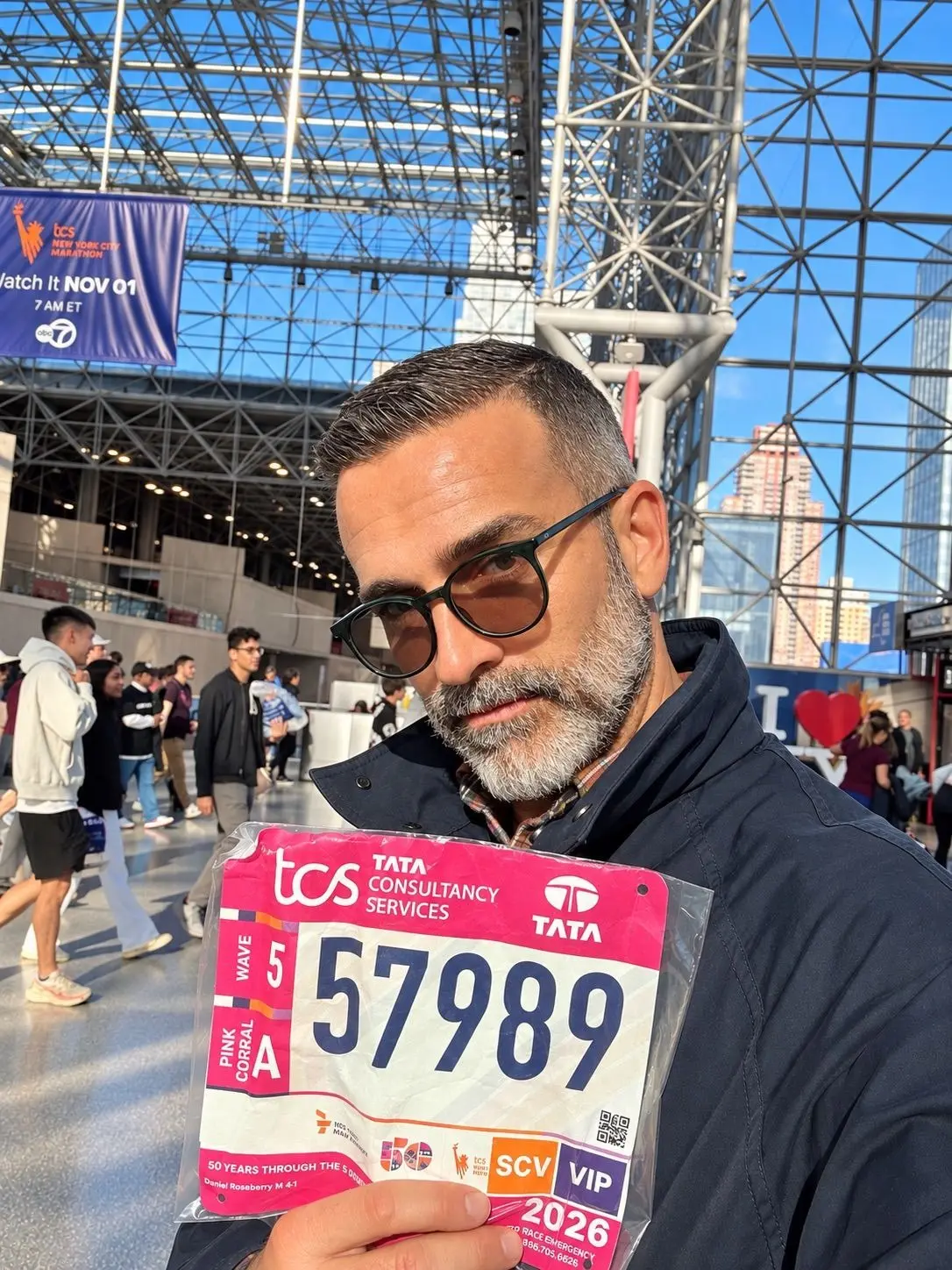
Marathon Sunday unfolded in a euphoric blur, but Daniel Roseberry, the visionary creative director of Schiaparelli, retains a series of remarkably vivid snapshots from the grueling 26.2-mile course. He remembers the dappled autumn light filtering across the iconic route; the rhythmic, hypnotic sound of sneakers striking pavement as he transitioned onto a bridge and the wall of city noise temporarily faded; the exceptionally crisp, near-perfect weather; and, above all, the overwhelming surge of emotion when he spotted familiar faces lining the sidelines, cheering him forward with unbridled enthusiasm.
“There are no words to describe it,” Roseberry tells Vogue of completing the New York City Marathon, marking his debut at the distance. “This day will stay with me… for a long time.”
The remarkable aspect of the achievement is that just a year prior, Roseberry had zero intention of subjecting himself to such an arduous athletic trial. Yet, during the Christmas holidays, the designer embarked on what began as an impulsive—and ultimately fateful—run through Paris, tracing the paths alongside the Seine, the city’s historic central waterway. Though he was thoroughly accustomed to the romantic allure of the French capital, where he has lived and maintained his design studio since 2019, that particular cold-weather run recalibrated his perception of his surroundings in a profound way. Something deep within him shifted. Barely ten months later, he found himself standing shoulder-to-shoulder with nearly 60,000 participants at the start of the New York City Marathon, ultimately crossing the finish line in an impressive 4 hours and 24 minutes.
“It was just the perfect day,” Roseberry reflected hours after the grueling ordeal, his finisher’s medal still resting heavily around his shoulders. He had just savored a post-race meal of pizza and pasta, with a comforting “second dinner” courtesy of Shake Shack already en route, and was eagerly anticipating some much-deserved recovery time inside his Therabody boots. “It really reconnected me to my love of this city.”

The designer’s race day commenced in the dead of night at 3:30 a.m., followed by a chilly 5:00 a.m. bus transport to Staten Island, the traditional ground zero for the world-renowned race before it snakes its way through all five boroughs to its triumphant conclusion in Central Park. “It was pin-drop silent on the bus,” he recalls of the pre-dawn commute. “But you can sense everyone’s energy. It’s like this pent-up anticipation.” Assigned to the final wave of runners, which stepped off at 11:30 a.m., Roseberry endured a five-hour wait on-site after his arrival before he could finally cross the starting line and begin his journey.
Conquering the race’s daunting opening obstacle—the four-mile-long Verrazzano-Narrows Bridge, featuring a punishing two-mile, 174-foot elevation gain that stands as the course’s steepest climb—he was met by the legendary, roaring crowds that define the New York running experience. “The city really shows up, and it’s beautiful. All these people cheering for you… and they don’t know you. They’re cheering your name, telling you you can do it. It really carries you and is a beautiful representation of humanity at its best. It transcended every expectation I had.”
Roseberry accomplished this athletic feat on a remarkably abbreviated timeline, completing just two months of targeted training beginning in September while simultaneously spearheading the development of his spring 2027 ready-to-wear collection. To prepare, he collaborated closely with Jonathan Fins, his trainer of two years, crafting a structured program designed to build upon an existing fitness foundation firmly rooted in strength training, mobility work, and calisthenics. (A testament to his physical conditioning, Roseberry is capable of executing not only avant-garde, glamorous couture gowns but also an impressive 24 strict pull-ups.) The conditioning regimen was necessarily intense and compressed: beginning in September, the pair introduced a weekly long run that steadily escalated in distance, peaking at 33 kilometers (approximately 20 miles) before tapering off to preserve his physical reserves ahead of the main event—following the conventional marathon wisdom that first-timers rarely cover the full 26.2-mile distance in practice.
For a man accustomed to directing every detail of a global fashion house, the training process offered an unfamiliar and welcome surrender of control. “Most days, everyone’s looking to me for answers,” he notes. “With this, I was able to put myself into the care of another person.”

Initially, Roseberry harbored no rigid expectations regarding his finish time. “I just want to finish, and be able to walk,” he half-joked during a FaceTime conversation the day before the race. Later, however, he acknowledged that he had successfully achieved his primary tactical objective: navigating the entire course without resorting to walking.
The decision to choose New York for his inaugural marathon was partly logistical, as he was already scheduled to travel to the city to accept the Leader in the Arts Award at the Hirshhorn Gala on Monday. But with the festive energy of Halloween bleeding directly into Marathon weekend, he quickly recognized it as the absolute prime time to experience the metropolis. “It just had to be New York,” he says.
Throughout his training miles, Roseberry established a distinct routine, spending the first half of each run conversing and occasionally bantering with Fins, before rewarding himself with a high-energy, pop-heavy playlist for the return stretch, with artists like Olivia Rodrigo, Taylor Swift, and Rosalía occupying heavy rotation. Yet, while he had meticulously curated an epic musical lineup for the marathon itself, he ended up unplugging after a mere 15 minutes. “It didn’t feel like it was in the spirit of the day,” he explains. “I wanted to be in the moment, honor it, and take it all in. I wanted to be present with the other runners, and with the people who came to watch.”
Naturally, as a high-fashion creative director, Roseberry curated his race-day kit with meticulous precision: Asics Gel-Kayano running shoes, Nike socks, open-weave cotton tank tops by Sunspel, and inexpensive, sporty wraparound sunglasses purchased in multiple colorways from a Dick’s Sporting Goods in Maine over the summer.

Beyond the physical challenge, preparing for and completing the marathon provided fresh perspective on his professional design work. “It had me thinking about the body in different ways,” he reflects. “How could it not? And I like that the marathon is this thing with a defined beginning and end; it’s a closed loop. There are so many things always going on in fashion, but I’d like to take that mentality into my work.”
On the morning of the race, Roseberry recorded a voice note reflecting on the profound personal significance of the two-month training program. “The thing I keep coming back to is this physical transformation is so important to me. It feels so vital because it’s a physical manifestation of an inner transformation that’s been happening over the past year,” he shared.
“I think for four decades I had been completely, in many ways, living for the approval of other people and living in total abandonment of myself, and my body, for sure. I think this marathon has significance because it’s the first real thing to be envisioned, worked and trained for, and completed in a really radical, new way of thinking. The transformation isn’t transforming into somebody different or somebody new or something better. It’s about remembering what my body was always capable of in the first place. I feel like I met this body, like it’s a person, that I re-met a year ago. And the last eight weeks of training have been a way of honoring that relationship going back into my life.”
Given his enthusiasm post-race, when Roseberry casually dropped a reference to next year during our conversation, it naturally invited the obvious question: will he return to the starting line?

“Oh, yeah,” he says without hesitation. “Early on in the race, like mile four or five, I called my friend and told her, ‘We’re so doing this next year.’”