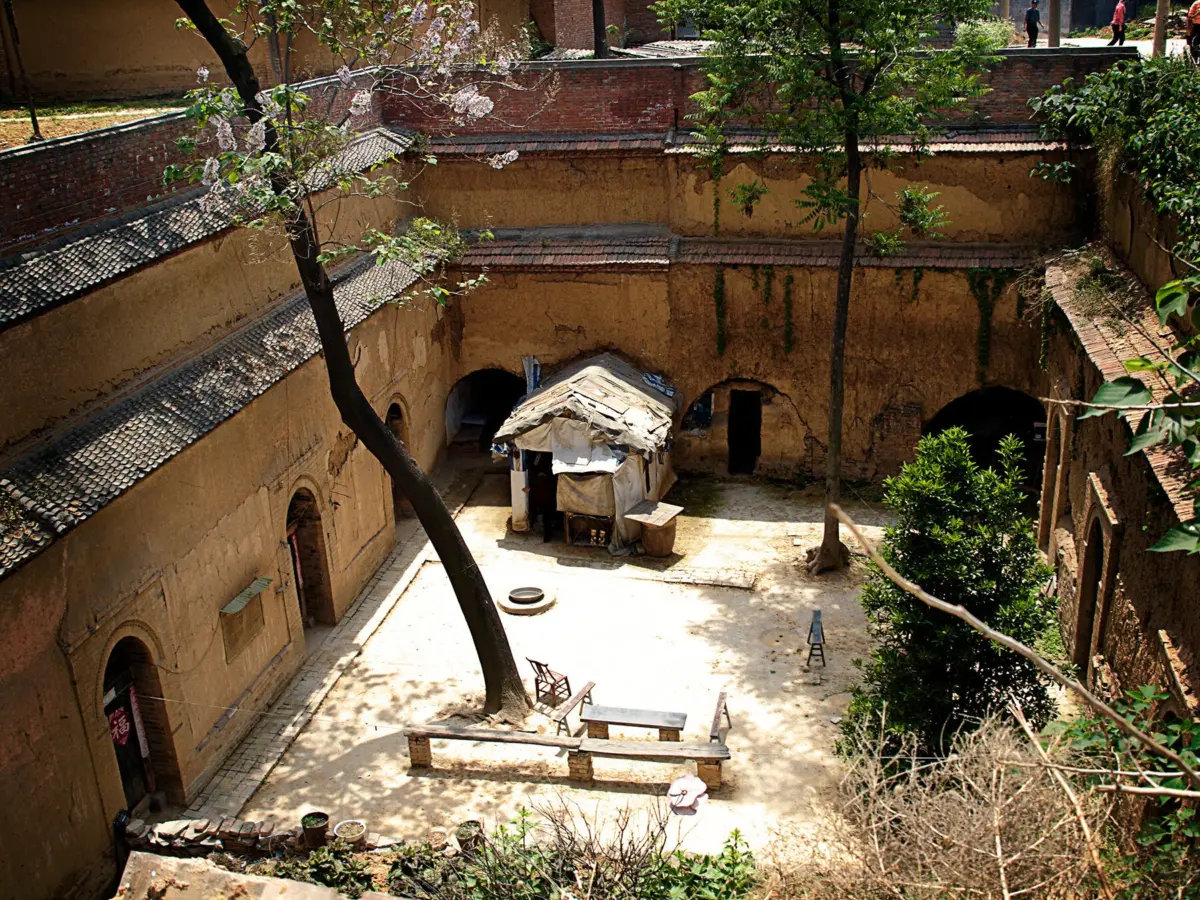
Across China’s vast and windswept Loess Plateau, an entire home can vanish seamlessly beneath a cultivated agricultural field. Known locally as dikengyuan, these remarkable dwellings begin with a simple yet radical gesture: a wide courtyard is excavated several meters deep into the earth. From there, the home expands sideways, with a series of vaulted, arched rooms carefully carved directly out of the dense soil walls.
Seen from above, the rural landscape continues nearly uninterrupted, stretching out in flat patches of crops and soil. Only a rectangular opening gives the subterranean household away—a sudden, dramatic patch of open sky surrounded by ground where an ordinary observer would naturally expect to find a pitched roof and chimney.
Living within a dikengyuan fundamentally reverses some of the most familiar, deeply ingrained cues of domestic architecture. The earth moves dynamically from beneath your feet to entirely enclose your body. Entering the home requires a conscious descent, and exterior walls cease to be constructed boundaries, transforming instead into heavy, enduring geological mass.
Even though human communities have lived this specific way for centuries, carving out lives beneath the topsoil, subterranean space retains a distinctly unusual psychological charge. A buried room can instantly evoke a powerful sense of primal protection, absolute quiet, and intimate sanctuary. Yet, that exact same physical depth can simultaneously provoke feelings of unease, claustrophobia, and disorientation. Situated precisely between these contrasting psychological reactions lies a fundamental architectural question that has fascinated designers for generations: what precisely makes being underground feel like a true shelter rather than a trap?
The House Has Always Had an Underground Mind
The cultural and philosophical fascination with subterranean living has long captured the imaginations of writers and theorists. In his seminal work, The Poetics of Space, philosopher Gaston Bachelard assigns the cellar an unusually powerful, almost mythic role in the geography of the home. His imagined house stretches vertically and dramatically between two opposing poles: the attic and the cellar, with each end belonging to an entirely different mental world. While the roof can be easily understood through the rational lenses of construction, timber, and weathering, the cellar reaches downward into what Bachelard famously terms the "irrationality of the depths"—a space deeply associated with darkness, shadows, and whatever mysterious elements lie beneath the familiar, comfortable parts of daily domestic life.
Cultural historian Rosalind Williams follows this deep cultural pull even further in her book Notes on the Underground. Within its pages, Williams traces subterranean spaces through both literature and the history of modern infrastructure, examining how tunnels and sewers were viewed simultaneously as vital urban refuges and as sources of profound collective fear. During the nineteenth century, as complex underground networks opened hidden worlds beneath rapidly industrializing cities, writers simultaneously filled the subterranean realm with imaginative civilizations, dystopian shadows, and technological futures.
Of course, these associations are deeply culturally specific. Someone who has been raised from childhood within an underground courtyard house will inherently understand spatial descent very differently from someone whose primary architectural references are limited to damp suburban basements or emergency fallout bunkers. Contemporary architects must reckon with these complex psychological associations, carefully acknowledging and negotiating them when designing spaces that look to the earth for inspiration.
Earth Can Do Much of the Work of a House
Beyond the realm of philosophy and literature, the practical case for going underground is surprisingly direct, offering profound environmental advantages. Soil possesses thermal properties that make it an exceptional insulator; it changes temperature far more slowly than ambient air, allowing thick layers of earth to effectively buffer interior living spaces against the extreme seasonal swings of the outside climate.

Across China’s Loess Plateau, this thermal mass helps dikengyuan rooms maintain remarkably stable temperatures, staying comfortably cool through blistering hot summers and remarkably temperate through freezing winters. A nearly identical architectural logic appears across the globe in vastly different cultures, such as the famous excavated troglodyte dwellings of Matmata in Tunisia and the historic cave houses carved into the hillsides of southern Spain, where the surrounding ground successfully becomes both wall and roof at once.
Recognizing these enduring environmental benefits, a research team from the University of Hong Kong recently revisited the traditional dikengyuan typology, developing an experimental project known as the Underground House of the Future in Henan Province. In this modern iteration, existing earthen chambers were structurally reinforced with sturdy brick vaults, while strategically placed skylights and rear openings were engineered to pull natural daylight deep into the interior floor plan.
The central courtyard was transformed into a stepped, dynamic communal space sitting beneath a protective, translucent canopy. Although modern techniques like digital fabrication and 3D-printed earthen construction elements are beginning to enter the construction process, the core spatial idea remains remarkably centuries old: the home is excavated downward and built outward sideways, leaving the open sky untouched at the very center of domestic life.
A Piece of Sky Underground
That vital, lifesaving opening to the open sky appears repeatedly as a central motif throughout the history of subterranean architecture. For instance, a residential earth-sheltered home completed in Scottsdale, Arizona, in 1979 brilliantly organizes its living spaces around an open-air courtyard sunken deep below the scorching desert floor. Full-height glass walls pull harsh desert sunlight deep into rooms that are otherwise buried completely on every surrounding side. From ground level, much of the physical architecture completely disappears into the landscape, but upon descending the outdoor stairs, the interior immediately opens outward once again.

Environmental psychology helps explain why this architectural gesture carries such immense weight for human inhabitants. Empirical studies of subterranean and windowless environments repeatedly connect occupant discomfort with reduced access to daylight, weak spatial orientation, and a diminished sense of control over one’s immediate surroundings. Recent environmental research has further confirmed that both human emotional states and cognitive performance can sharply decline as natural daylight decreases in underground settings.
Viewed through this analytical lens, the courtyard does far more than simply provide passive ventilation or aesthetic relief. It physically brings a slice of the surface down into the depths with you, ensuring that the open sky ultimately serves as an intuitive anchor for human orientation.
The Comfort of the Burrow
Architect Javier Senosiain, best known internationally for his undulating, serpentine masterwork Quetzalcoatl Park outside Mexico City, approached the concept of the buried house through the primal lens of animal refuge. His Organic House, completed in Mexico in 1985, draws heavily from the vernacular logic of natural burrows, animal shelters, and early human dwellings by placing curved, organic ferrocement rooms safely beneath rolling green grassy mounds. Walking across the property’s expansive garden literally means walking directly across the roof of the home. Inside, organic windows pierce the enclosing shell, pulling lush greenery right up against the curving walls.
There is, however, another distinct side to this profound physical enclosure. Human beings frequently seek out architectural spaces that wrap closely and securely around the human body, ranging from cozy sleeping alcoves to deeply recessed reading rooms. The psychological difference between feeling safely embraced and feeling trapped seems to be directly tied to human agency and freedom of movement.

Research into subterranean environments repeatedly returns to the metric of perceived control. Interestingly, post-occupancy studies of earth-sheltered homes suggest that public expectations can differ dramatically from actual lived experience. One major post-occupancy study of earth-sheltered homes located around Minneapolis and St. Paul revealed unusually high levels of resident satisfaction, with general attitudes toward underground living improving significantly after people actually moved in and experienced the spaces firsthand. It appears the underground house often feels far stranger in the human imagination than it does in everyday use.
Geology Enters the Room
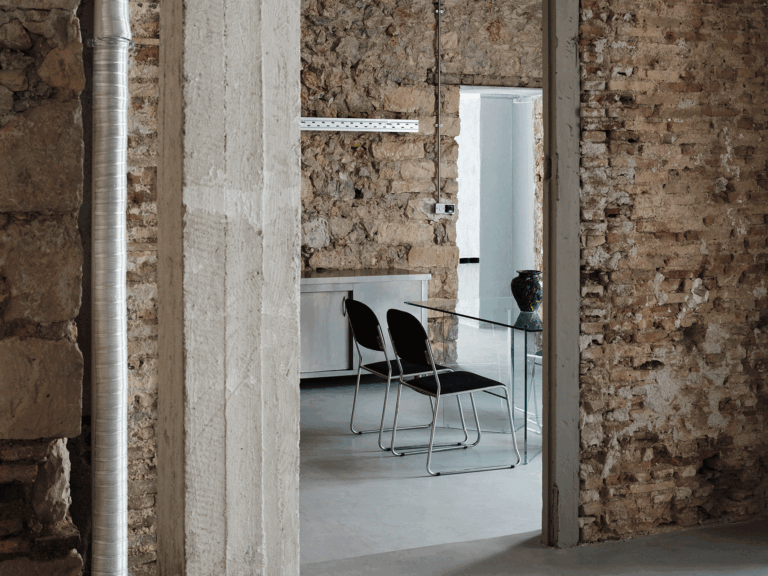
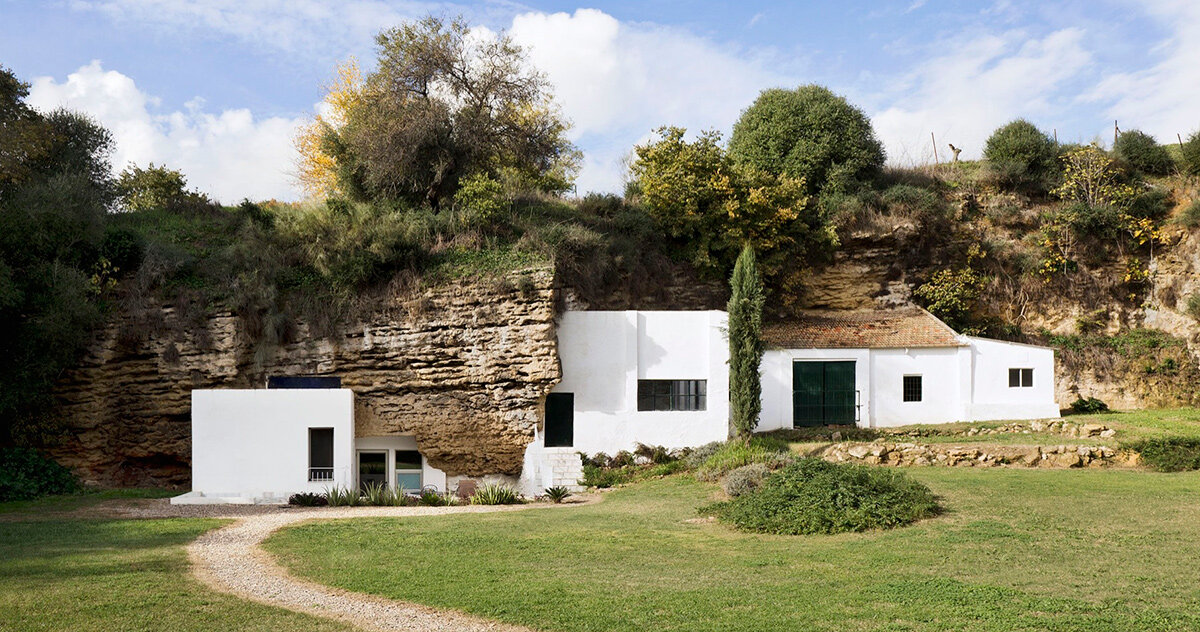
At Casa Tierra in Córdoba, Spain, architectural practice UMMO Estudio took a direct, site-specific approach by occupying an existing natural limestone formation, placing domestic living spaces directly against rough, exposed calcarenite surfaces. Smooth polished floors and newly inserted partitions sit directly beneath raw stone that was shaped by natural geological processes long before the house ever arrived. Part of the room firmly belongs to geology itself, and the architecture actively works around it rather than attempting to completely master or control its natural form.
Similarly, Olgooco’s Inside Home in Ammameh, Iran, takes another innovative approach, arranging cave-like, protective spaces around an interior void while heavily planted landscape surfaces continue overhead. Across all of these diverse international projects, a clear architectural pattern begins to emerge. Architects bury rooms deep into the earth, then carefully cut strategic openings back toward daylight. They cover roofs with heavy soil, then carve away specific sections to make courtyards. The ground provides the ultimate enclosure, while architecture ultimately decides how intensely the human body should feel it.