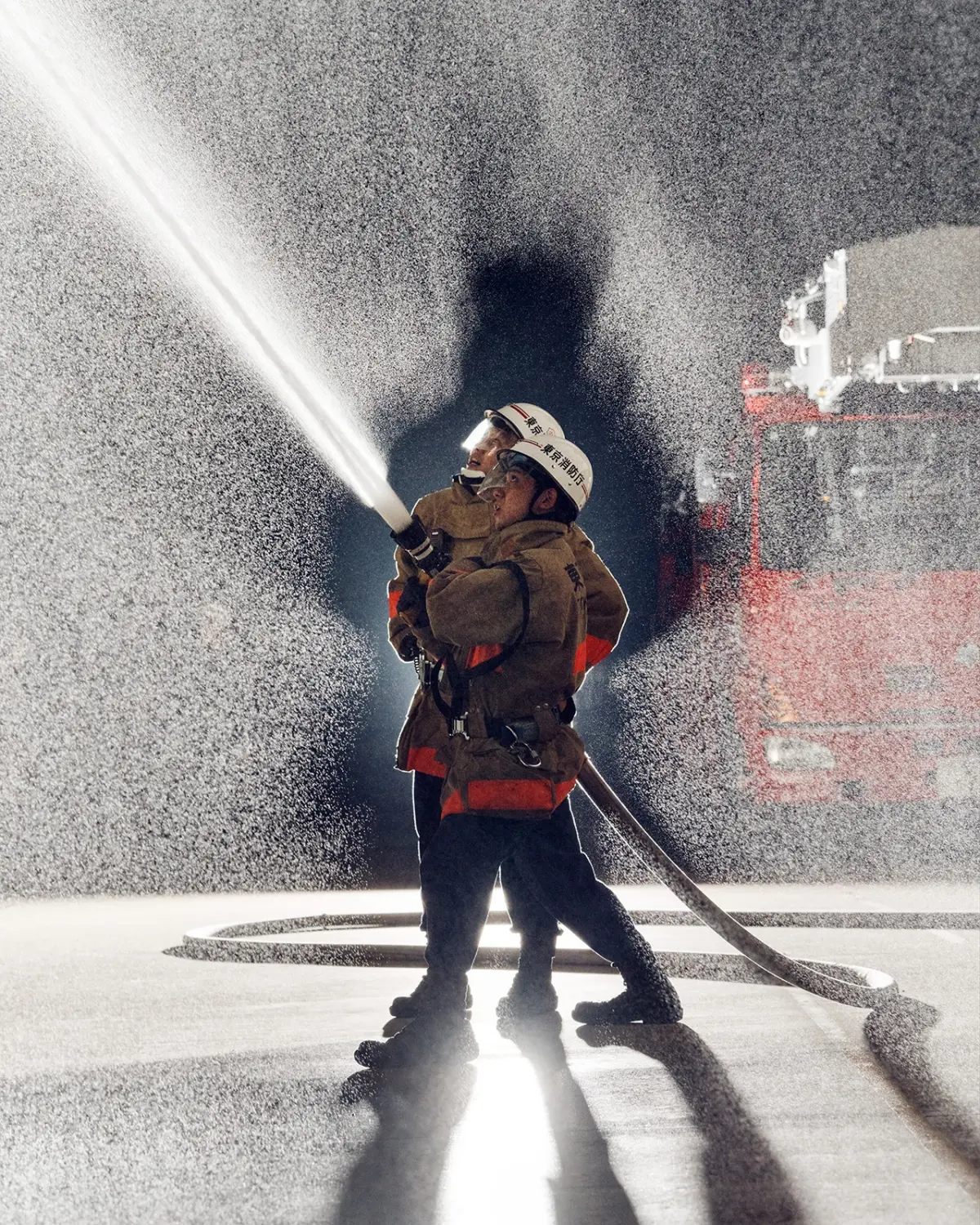
On a wet autumn morning in Tokyo, four firefighters clad in heavy, cumbersome hazmat suits move with absolute precision through a basement room filled with simulated poisonous gas. They are working against a ticking clock, with only 15 minutes before the oxygen tanks strapped to their backs are completely depleted. Despite the restrictive nature of their gear, their coordination is seamless. One firefighter quickly patches a leaking pipe, while the other three expertly secure an unconscious figure—a dummy representing a victim—into a stretcher. Within 10 minutes, the team has navigated two flights of stairs and successfully emerged back into the open air.
Thankfully, this is merely a routine training exercise. But the respite is short-lived. Seconds later, a sharp alert buzzes over the public address system, causing the firefighters to freeze in place. Word has just come down that a man has sprayed an unknown, potentially hazardous substance over teachers at a school in Higashiyamato city, leaving at least two people injured. "This is not a drill," Tokyo Fire Department (TFD) official Yuto Azuma tells Monocle, breaking the tense silence.
Within moments, a dozen firefighters are scrambling, loading three vans with specialized hazmat suits, oxygen masks, air tanks, rapid-testing kits, and high-precision gauges. Seconds later, the vehicles peel away from the station with their sirens wailing. All of them are members of Hyper Rescue 8 (8HR), one of five elite TFD teams deployed only when Tokyo faces its most catastrophic and high-stakes emergencies.
The specialized units were originally established in 1996, in the wake of the devastating 7.3-magnitude earthquake that leveled Kobe, claiming more than 6,400 lives and injuring nearly 43,800 people. Today, their operational mandate covers a daunting spectrum of crises: terrorist attacks, chemical fires, toxic industrial spills, nuclear meltdowns, severe landslides, and volcanic eruptions. When Monocle meets the 8HR team at its sprawling base in Tachikawa on the northwestern outskirts of Tokyo, the unit has just returned from spending weeks battling relentless wildfires in Iwate prefecture, located on the northern tip of Honshu, Japan’s largest island.
A Massive Megalopolis Under Constant Watch
With a staggering 18,800 personnel, the Tokyo Fire Department stands as the largest fire brigade in the world. It carries the immense responsibility of safeguarding a sprawling megalopolis of 14 million permanent residents alongside millions of daily visitors, commuters, and tourists. To maintain this colossal security apparatus, the TFD operates on a ¥310bn (€1.7bn) annual budget. This substantial financial backing supports a fleet of roughly 2,000 specialized vehicles and assets, including special-purpose trucks, rugged off-road vehicles, advanced ambulances, fireboats, heavy-duty cranes, motorcycles, helicopters, amphibious transport vehicles, drones, and experimental rescue robots.
Although the Japanese capital is, by many historical metrics, safer than ever before, the growing threat of global climate change has drastically increased the frequency and severity of extreme-weather incidents. Heatwaves, powerful typhoons, and torrential downpours are testing the limits of municipal infrastructure. Reflecting this dangerous new normal, the Japan Meteorological Agency (JMA) introduced the term kokushobi—which translates to "brutally hot day"—to describe conditions where temperatures soar to 40C or higher. Tokyo’s all-time high was recorded at a blistering 40.8C in 2018.
These rising temperatures have triggered a noticeable surge in fires across the capital. In 2024 alone, the TFD was mobilized for more than 4,500 fires, marking the highest volume recorded in a decade. Paramedics faced an equally grueling year, with ambulances dispatched a record-breaking 935,373 times—averaging out to an emergency response about once every 34 seconds. The spike in heatstroke cases has forced TFD ambulances to fundamentally reassess their operational guidelines. These protocols were particularly tightened after 2017, when a tragic incident saw a paramedic succumb to heatstroke following a rigorous summertime drill.
Precision, Drills, and Spatial Mastery
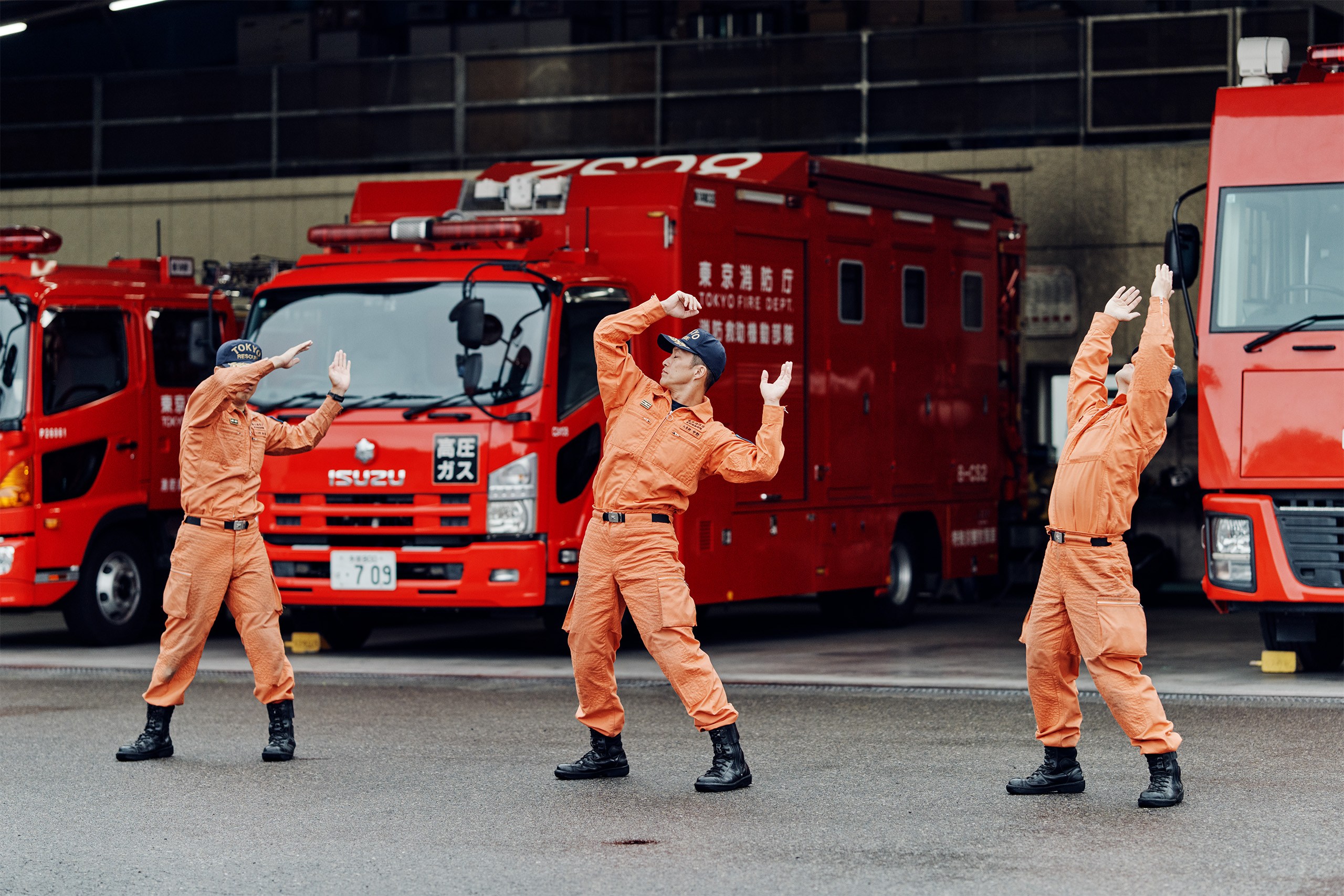
Every single morning across the metropolitan area, firefighters and medics arrive for their shifts at stations like Ikebukuro Fire Station—one of 81 main stations and 200 substations scattered throughout Tokyo. Following daily calisthenics, the morning routine moves directly into meticulous vehicle inspections. Every working part of the gleaming red machines is thoroughly tested: engines are aggressively revved, brakes are slammed, sirens are blared, and water-pump switches are manually flipped to ensure flawless mechanical reliability.
Next, all essential firefighting gear is meticulously laid out across the concrete garage floor: heavy coats, trousers, boots, waterproof gloves, helmets, oxygen masks, stretchers, thick hoses, and portable defibrillators. At dusk, this entire exhaustive process will be repeated from scratch. "We try to leave here within a minute of the alarm sounding," explains Toru Hishinuma, who heads fire investigations at the Ikebukuro station. "Everything has to be ready to go because every second counts."
From the rear of a heavy water-pump truck, firefighters carefully lower a two-wheeled cart laden with industrial hoses. The Ikebukuro district features one of Tokyo’s busiest and most complex railway stations, serving as a vital nexus linking the city center to sprawling suburbs to the north and west. Surrounding the transit hub are dense clusters of towering hotels, towering department stores, packed theaters, and tight clusters of restaurants. Many of the surrounding streets form a labyrinth of narrow alleyways completely inaccessible to standard-sized fire engines.
"If we can’t get the trucks close enough to a fire, we use the carts to move extra hoses," Hishinuma explains. Nearby, a group of firefighters and a paramedic huddle intently over detailed maps. The drivers maintain thick binders containing street layouts designed to help them memorize the absolute fastest routes to any address within a six-square-kilometer radius of the station. "On our days off, we go out and wander the streets," says Shoki Yamada, who drives one of the station’s two primary water-pump trucks. "I know which streets my truck can and can’t pass through, and which corners are too tight to get around."
A Rich History Forged Through Tragedy
Tokyo’s organized fire protection has deep historical roots, dating back to the early 17th century when the Tokugawa shogunate established the city—then known as Edo—as its central seat of power. The modern incarnation of the TFD traces its origins to a single fire station established in 1923 with just 12 firefighters and a Leyland fire engine near what is now Tokyo Central Station.
Since then, the Japanese capital has been catastrophically leveled by fire twice: first in the wake of the devastating Great Kanto Earthquake of 1923, and later during the destructive Allied firebombing raids at the tail end of the Second World War, which wiped out nearly 60 percent of the city’s built environment.
Tokyo’s harrowing wartime experiences catalyzed sweeping urban planning reforms, giving birth to remarkably strict building codes, comprehensive zoning regulations, ambitious street-widening initiatives, and rigorous, mandatory inspections for fire-safety violations. It was also around this pivotal era that the Shobodan—a massive volunteer corps comprising 26,600 civilian firefighters—was formally institutionalized to bolster civil defense.
Today, new recruits to the TFD are young adults hailing from all corners of Japan. "Most people seem to recognise how demanding it is to be a firefighter, working 24-hour shifts and putting your life on the line to save others," says Ryosuke Tomoguchi, a 37-year-old former Tokyo firefighter who currently runs Tosho Juku, a specialized cram school for applicants preparing for the rigorous civil service exams.
Following six intensive months of basic training, fresh recruits are assigned to active stations. There, they operate on a grueling schedule: one day on duty followed by two days off. At the Ikebukuro Fire Station in northwest Tokyo, firefighters are permanently on call from 08:30 until 08:40 the following morning, spending their nights sleeping at the facility.
During daylight hours, the personnel drill relentlessly in a half-completed tactical training structure situated directly behind the station—practicing high-pressure hose deployment from trucks, scaling vertical walls with extension ladders, and hauling heavy rescue dummies. Every few weeks, entire teams participate in specialized nighttime sessions designed to test and sharpen their emergency response skills in pitch darkness.
Ayuna Shimohara, one of only five female firefighters stationed at Ikebukuro, undergoes daily drills aimed at reinforcing core foundational skills, from strapping on oxygen masks and linking heavy hoses to extending massive ladders. "The drills test your stamina and physical fitness," notes the 24-year-old. Both physical attributes are utterly crucial, alongside an unyielding mental fortitude.
The psychological reality of the job can be daunting. Shortly after Genta Saito joined the department in 2021, he was dispatched directly to the scene of a violent gas explosion at a local restaurant. "Our team leader warned us that there might still be gas lingering in the air and a high chance of another explosion," recalls the 27-year-old. "I was so scared that I was shaking."
Even veteran personnel encounter moments of intense vulnerability. Masatoshi Komatsu, a 51-year-old driver with decades of experience, points to a surprisingly ordinary hazard as his most terrifying memory. "Years ago, I had to save a kitten that a dog had chased up a tree," Komatsu recounts. Standing fully outstretched on the very top rung of a three-piece extension ladder high above the ground, he admits, "I was so afraid that I would fall."
Educating the Public and Facing the Unimaginable
The punishing physical demands of rigorous training, long shift hours, and the persistent allure of higher financial compensation in the private sector lead many TFD firefighters to leave the profession before reaching retirement age. The average length of service hovers around 16 years. Some seasoned veterans who choose to remain transition into instructional roles, such as teaching at the Honjo Life Safety Learning Centre located in Tokyo’s Sumida ward.
Operated as one of three safety education facilities by the TFD, the center opened its doors in 1995 as a free, interactive disaster-simulation theme park designed to teach the general public vital survival skills regarding fires, floods, severe storms, and major earthquakes. On any given weekday, visitors ranging from preschoolers pushing against heavy doors held shut by simulated floodwaters to college students duckwalking through rooms filled with harmless theatrical smoke can be seen learning firsthand safety tactics.
Inside the facility’s earthquake simulation room, visitors and public relations officials curl up defensively on the floor as the ground beneath them suddenly bucks with violent force. "When there’s a big earthquake, you can only think about protecting yourself," shouts Shinji Kitamura, the center’s deputy head and a retired firefighter. "You won’t be able to do anything else." Visitors are then provided with protective coats and boots to enter a specialized chamber lashed by heavy artificial wind and driving rain. "If it’s pouring and you can’t see what’s in front of you, then you shouldn’t be outside," Kitamura cautions, recalling an instance where he witnessed a police officer accidentally fall into an open manhole on a flooded street. Through these simulated disasters, ordinary citizens learn how to drastically reduce their chances of injury and property damage when real disaster strikes.
However, there remains a hard limit to what the general public can realistically prepare for and what an ordinary fire brigade can safely manage. That is precisely why the Hyper Rescue 8 unit exists. It stands as the singular elite squad capable of coordinating responses to catastrophic mega-earthquakes alongside complex nuclear, biological, and chemical (NBC) disasters.
The unit possesses heavy industrial machinery specifically engineered to claw through debris and unearth survivors buried beneath homes crushed in massive landslides, alongside souped-up industrial trucks capable of blanketing large-scale blazes—such as a burning tire factory—in thick, fire-retardant chemical foam. The elite unit previously spearheaded the grueling emergency response efforts during the reactor meltdowns at the Fukushima Daiichi nuclear power plant following the catastrophic 2011 disasters, as well as the sudden 2014 eruption of Mount Ontake straddling Nagano and Gifu prefectures.
Back at the Tachikawa base, the school chemical spraying incident in Higashiyamato eventually concludes with a sigh of relief: the unknown substance is identified simply as ordinary pepper spray. The reality of day-to-day operations is that 8HR rarely encounters major catastrophe on a daily basis. Instead, much of the time between rigorous drills and rare callouts is spent rigorously testing bleeding-edge emergency equipment.
Ryo Yokota, a 36-year-old paramedic, proudly demonstrates an advanced, dog-like robotic quadruped. Using a handheld monitor and a video-game controller, he guides the machine to precisely pick up small objects with an articulated mechanical claw. One day, autonomous tools of this caliber could serve as the crucial eyes and ears of human rescue workers picking through unstable rubble in search of earthquake survivors.
Across the sunlit yard, another team practices vertical extraction, lowering one of their members upside-down via a secure rope harness from a high balcony down to a padded mat below. "Tokyo has a lot of narrow wells," notes Keita Morikawa, the 41-year-old team leader. "This is what we would do to save someone who had fallen into one." As the training proceeds, Captain Mitsuaki Kobayashi, 8HR’s second-in-command, leans over to summarize the unit’s core ethos: "We must be prepared to deal with anything."