SAN FRANCISCO — Adam Savage is clearly overjoyed about his new bag. Known globally as a gear-obsessed designer, former co-host of Discovery Channel’s hit show Mythbusters, and the editor-in-chief of Tested.com, Savage welcomed visitors to his bustling workshop in San Francisco to showcase his latest endeavor. He has officially designed his very first carryall utility bag, the EDC One, and launched an entirely new brand, Savage Industries, to bring the product to market. Exuding the same boundless, childlike glee that has captivated television and internet audiences for decades on camera, Savage eagerly flipped the bag around on his workbench. Opening and closing it, zipping and unzipping its compartments, he pointed out every meticulously engineered feature with palpable enthusiasm.
The EDC One is constructed almost entirely out of upcycled cloth sourced directly from retired boat sails. Because of this unique material choice, each individual bag possesses its own distinct quirks, ensuring that no two specimens look identical. Furthermore, every single unit comes straight off the production line boasting a rugged, broken-in aesthetic that feels both authentic and durable.
Attention to detail is evident in every mechanical aspect of the design. The handles are held together by powerful magnets rather than traditional snaps, buttons, or hook-and-loop velcro closures. For anyone who has ever wrestled with stubborn or worn-out bag closures, this magnetic innovation is a thoroughly welcome addition. A user simply needs to bring the handles close to one another, and they leap together with a deeply satisfying, crisp clonk.
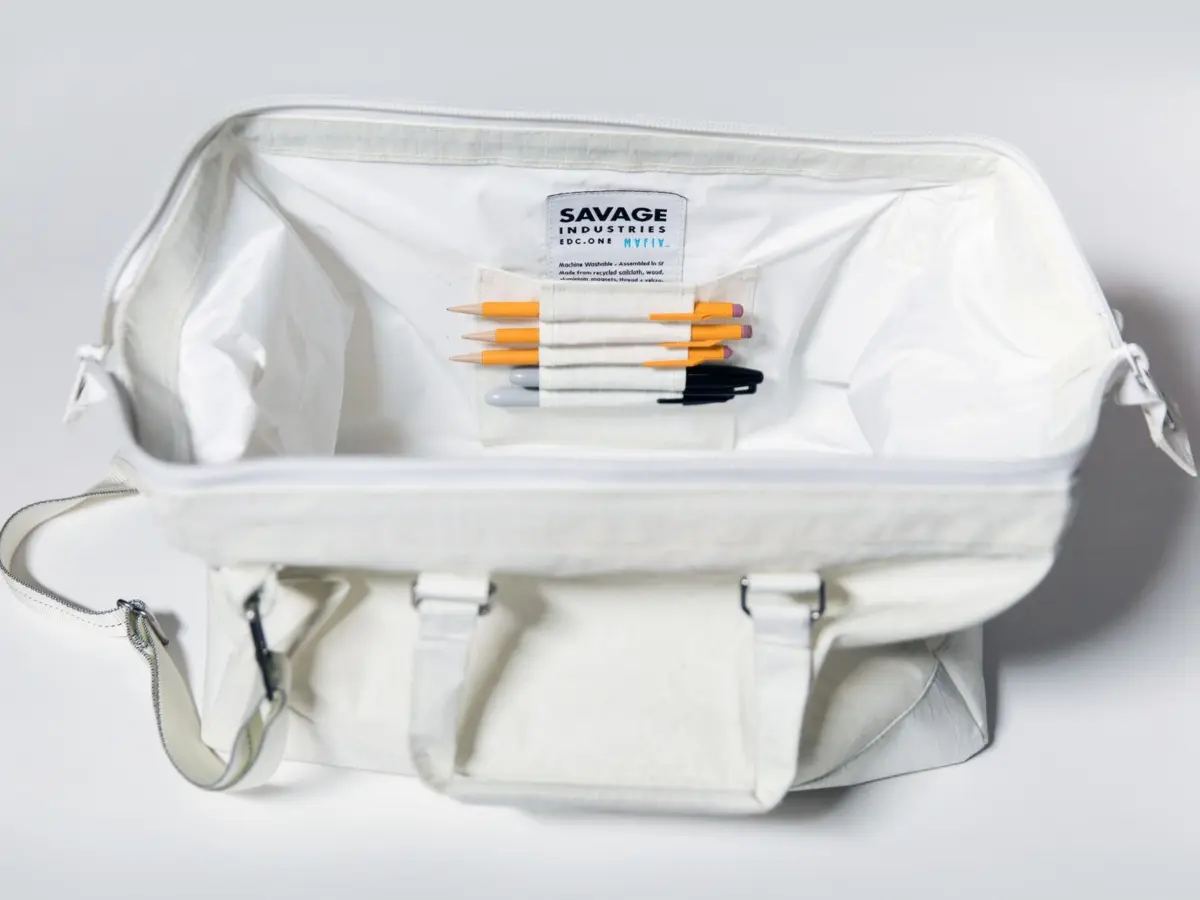
Equally clever is the structural integrity of the straps. They are stiff enough that when the handle is clasped, it remains propped upright like the frame of a tiny pup tent. When a user unzips and firmly pries open the bag, it stubbornly and reliably holds its shape in that configuration as well. This structural stability is achieved through a pair of spring steel inserts running neatly around the lip, keeping the mouth of the bag perpetually agape, much like the formidable jaw of a whale shark.
Inside the utility bag, thoughtful organization meets minimalist philosophy. There is a specialized interior pocket designed specifically to hold notebooks. While Savage himself humorously professes an absolute adoration for Tom Sachs Ten Bullets notebooks, he reassures prospective buyers that the pocket is completely brand-agnostic and will accommodate a wide variety of small journals and pads. Just adjacent to the notebook storage, a neat stack of horizontal loops provides secure holding space for pens and pencils.
Turning the bag over reveals a Kevlar-reinforced bottom featuring strips of heavy-duty velcro. This specific design choice serves as a subtle yet exciting hint toward a future ecosystem of accessories that Savage plans to release. These anticipated add-ons include padded bays tailor-made for delicate camera equipment or a specialized waterproof, bucket-like insert engineered precisely for toting around a standard 12-pack of beverages.
Savage carefully engineered the EDC One so that it could effortlessly carry absolutely everything he personally needs for a single day out in the field, ranging from precision tools and heavy reference books to his personal lunch. Explaining the genesis of the design, Savage notes that he drew heavy inspiration from two distinct historical and professional sources.
The first source of inspiration traces back to the old tool case he utilized during his employment as a professional model-builder at George Lucas’s legendary special effects house, Industrial Light & Magic. That classic case featured a distinctive clamshell top that flopped wide open, granting the user full, unobstructed access to the goods nestled inside. Savage spent years searching the modern commercial market for a suitable replacement that captured the spirit of that industrial tool case, but he grew consistently disappointed in the available retail options. Ultimately, he decided that the only way to get what he wanted was to roll up his sleeves and build his own version from scratch.

The second profound influence came from an unexpected historical artifact: the specialized purse given to Apollo astronauts during NASA’s historic missions to the moon. Officially designated as the Temporary Stowage Bag, and colloquially referred to by space historians as the McDivitt Purse, this unique tote was largely forgotten by the public until Neil Armstrong’s widow famously discovered it while meticulously sorting through her recently deceased husband’s personal belongings. Savage borrowed several key elements directly from this historic NASA design, including its remarkably simple overall shape, the robust steel closure mechanism, and an almost total absence of exterior pigment.
Yes, the bag is stark white. It is currently manufactured and sold exclusively in white, at least for this initial product run. While a brilliant white fabric is visually striking, it also seems remarkably impractical for an everyday carry utility bag that is inevitably bound to soak up urban dirt, workshop grime, and accidental oil stains. However, Savage is remarkably adept at selling customers on the concept. He explains that the white fabric will naturally develop a rich, honest patina over time, and in his view, patinas are inherently cool. Furthermore, he points out a practical utility: it is nearly impossible to find small tools or stray components at the bottom of a dark, black fabric bag.
By choosing white, Savage also deliberately steered clear of the current prevailing fashion trends dominating the tactical gear and accessory market, which are heavily saturated with aggressive tactical aesthetics and urban camouflage patterns. Instead, a bright white bag stands out as genuinely unique. It intentionally avoids the hyper-masculine vibe of the ubiquitous Cordura messenger bag, leaning instead toward an aesthetic that feels remarkably balanced, clean, and nonbinary.
While Adam Savage has been actively sewing and crafting since he was in middle school—a skill he regularly puts on display when crafting elaborate, high-end costumes for conventions and special projects—the heavy-duty manufacturing, industrial lifting, and precise stitching for this commercial venture were executed by Mafia, a prominent company also headquartered in San Francisco. Mafia has built a stellar reputation for producing an entire line of gorgeous, resilient bags crafted primarily out of upcycled, recycled sailcloth. For this inaugural launch, Mafia has produced a limited run of a few hundred Savage bags, and every single unit leaves the workshop backed by Mafia’s standard lifetime warranty.
The bags are officially available for purchase directly through Savage’s personal website. Each unit is priced at $225. Once this initial limited run inevitably sells out, subsequent orders will transition to backorder status until Mafia can ramp up production to catch up with demand. To add a layer of exclusivity for early adopters and collectors, each bag in this first run will be meticulously hand-numbered.
The launch of the EDC One officially establishes Savage Industries as a legitimate new brand in the design and carry gear space, and Adam Savage promises that there is plenty more on the horizon. He hints that future developments will include both a smaller version of this utility bag and a larger iteration. Notably, even the upcoming larger version will be carefully engineered and dimensioned to strictly meet all Federal Aviation Administration regulations for airline carry-on luggage.
When asked what else consumers might expect from Savage Industries down the line, Savage remains tight-lipped, declining to reveal further specifics beyond the upcoming bags and the modular accessories designed to velcro directly into them. Whatever innovative product arrives next from his San Francisco workshop, enthusiasts can only hope that, much like the EDC One, it maintains his signature aesthetic and comes proudly in white.