With less than two weeks remaining before the official launch of Grand Theft Auto VI on PlayStation 5 and Xbox, publisher Rockstar Games has significantly amplified its global marketing campaign for what is widely considered the most anticipated title in the history of interactive entertainment. Across major metropolitan areas around the globe, the promotional rollout has manifested in traditional high-impact formats, including massive highway billboards, comprehensive transit bus wraps, and prominent digital displays. The campaign has even extended to physical street art, such as a high-profile, hand-painted promotional mural in Brooklyn that recently ignited online debate after being tagged and ruined, underscoring the intense public visibility and cultural friction surrounding the upcoming title.
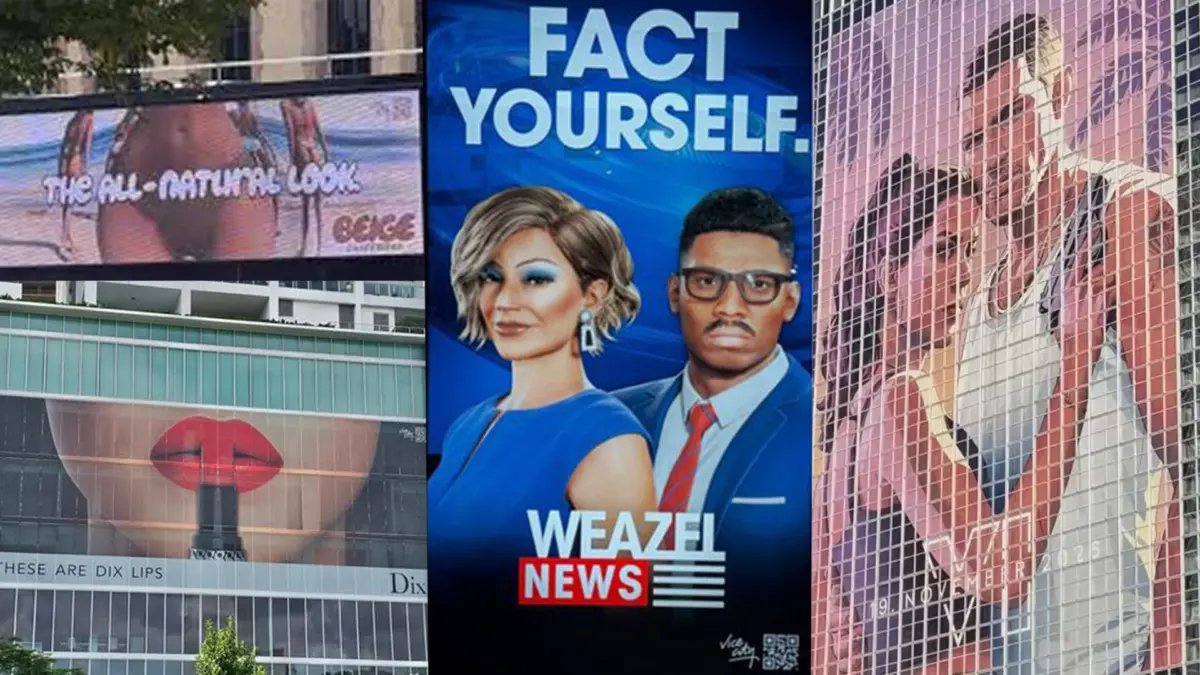
While much of this sweeping promotional push relies on standard promotional key art featuring the game’s dual playable protagonists, Lucia Caminos and Jason Duval, Rockstar Games is simultaneously executing a far more unconventional marketing strategy. Nowhere is this approach more visible than in Miami, Florida—the real-world geographic inspiration for the game’s fictional setting of Vice City. Rather than featuring gameplay footage, cinematic trailers, or even the title of the game itself, a significant portion of the outdoor advertising campaign across Miami consists entirely of advertisements for fictional, in-universe parody brands. By placing these satirical commercials directly into the real world, Rockstar is turning public spaces into living extensions of its digital universe, demonstrating both the massive scale of the game’s release and its unique place in modern pop culture.
This surreal campaign has transformed everyday public infrastructure throughout Miami into a canvas for Vice City’s fictional economy. Observant fans and local residents have spotted a wide variety of parody advertisements wrapped around tour buses and cycling through public digital kiosks in high-foot-traffic neighborhoods such as Wynwood. Among the fictional entities being advertised is Vice City Narcos, a satirical nod to the Miami Heat sports franchise, alongside Beige Shapewear, an unmistakable spoof of Kim Kardashian’s SKIMS line. Other prominent spots feature luxury watchmaker Crowex—a long-standing Grand Theft Auto parody of Rolex—and fast-food chain Taco Bomb, a play on Taco Bell. Digital displays have also showcased advertisements for cosmetic label Dix makeup, further populating the city streets with products that exist solely within Rockstar’s virtual environment.
Beyond merely showcasing fake corporate logos, these public advertisements rely heavily on the provocative innuendo and sharp social commentary that have defined the Grand Theft Auto franchise for decades. The outdoor ads operate as a biting satire of real-world corporate marketing, adopting the aggressive, suggestive tone of modern commercial slogans and elevating it to absurd heights. For instance, advertisements for the fictional watch brand Kronos prominently feature the tagline "Always come early," while displays for the luxury jewelry maker Kowalski exhibit a massive, diamond-laden engagement ring accompanied by the bold declaration, "Suddenly You Are Big Enough." Other public kiosk rotations feature provocative commands such as "Go Topless," seamlessly mixing into digital sign rotations alongside legitimate, real-world commercial advertisements.
The appearance of these uncompromisingly crude and double-euphemistic ads across public spaces in Miami directly addresses recent community speculation regarding the creative direction of the franchise. In the lead-up to the release of Grand Theft Auto VI, some commentary within the gaming community questioned whether Rockstar Games might tone down its signature brand of offensive, subversive humor to align with contemporary corporate sensitivities. However, the deployment of these unhinged slogans on public kiosks and transit systems signals that the studio’s cynical worldview, biting satire, and reliance on suggestive double entendres remain fully intact. Rather than softening its edge, Rockstar has chosen to put its most irreverent humor on prominent public display in the physical world.
This real-world integration extends beyond static billboards and digital kiosks into physical locations. As part of a broader promotional takeover of the Kaseya Center—the real-life home arena of the Miami Heat—Rockstar has established physical pop-up outlets and branding for iconic Grand Theft Auto fast-food chains, including Burger Shot and Cluckin’ Bell. This physical manifestation of in-universe locations highlights Rockstar’s strict adherence to its own corporate identity. While dozens of real-world corporate entities and retail brands frequently attempt "trendjacking"—leveraging the immense cultural buzz surrounding a Grand Theft Auto release to promote their own products on social media—Rockstar notably rejects traditional product placement inside its titles. The publisher remains exceptionally selective regarding real-world commercial partnerships, preferring instead to construct and market its own expansive ecosystem of hundreds of fictional parody brands.
The financial investment backing this ambitious promotional strategy is substantial. Industry analysts estimate that Rockstar Games and parent company Take-Two Interactive could spend anywhere between $200 million and $300 million on total global promotional costs over the full launch cycle of Grand Theft Auto VI. Given the astronomical budget involved, the decision to spend premium advertising dollars on fictional products—such as fake beverages like Juice Loose or non-existent fashion lines—has prompted discussion among marketing observers. On the surface, placing real-world advertisements for products that consumers cannot actually buy might seem counterintuitive, particularly since many of the ads feature only a small, obscure game logo or a tiny QR code tucked away in the corner of the display.
However, marketing specialists note that this unconventional methodology represents a highly strategic approach to modern promotional campaigns. By presenting the environment and tone of Vice City rather than overtly pitching a consumer product, Rockstar effectively avoids the pervasive marketing fatigue that often accompanies traditional video game advertising. Modern audiences are frequently saturated with cinematic trailers, pre-order pitches, and repetitive gameplay breakdown videos. By contrast, populating real-world cities with mock advertisements sells the atmospheric world of Grand Theft Auto VI without requiring a single frame of gameplay mechanics or mission footage. Because the franchise is fundamentally defined by its sharp parody of American consumer culture and media saturation, deploying fake slogans into real-world spaces communicates the precise tone and identity of the game in an immediate, experiential fashion.
Furthermore, the strategy creates a self-sustaining cycle of curiosity and organic engagement among the general public. When non-gamers or casual passersby encounter a bizarre, sexually suggestive advertisement for a non-existent jewelry store or shapewear line on a street kiosk, the lack of immediate context creates intrigue. This confusion frequently prompts observers to investigate the obscure QR codes, search for the brand names online, or share photos of the displays across social media platforms. In this manner, the ambiguity of the advertisements transforms everyday pedestrians into active participants in the marketing campaign, generating viral word-of-mouth discussion that far outpaces traditional static advertising.
Simultaneously, the campaign functions as a deeply satisfying reward for long-time fans of the series who possess an existing knowledge of Grand Theft Auto lore. For veteran players, spotting a billboard for long-running universe brands like Ammu-Nation, Sprunk, eCola, or Weazel feels like an exclusive inside joke. One notable digital ad spotted during the campaign highlights a fictional children’s animated program titled "Macca & Friends," accompanied by the text "Coming November 19 on Weazel." To an outsider, the placement resembles a standard television promo; to established players who recognize Weazel as the satirical mass-media conglomerate introduced in Grand Theft Auto IV, the advertisement serves as a subtle, highly contextual signal that deepens their connection to the franchise.
Ultimately, by blurring the boundary between real-world advertising and virtual world-building, Rockstar Games is executing a promotional campaign that transcends conventional industry practices. Placing Vice City’s satirical economic ecosystem directly onto the streets of Miami does more than simply remind audiences of an upcoming release date. It reinforces the notion that Grand Theft Auto VI is not merely another major video game release, but a massive, boundary-pushing cultural event that actively bleeds into the real world. As the final countdown to launch continues on PlayStation 5 and Xbox, this blending of fiction and reality ensures that the game maintains an unavoidable presence, cementing its status as one of the most heavily hyped entertainment products in modern history.