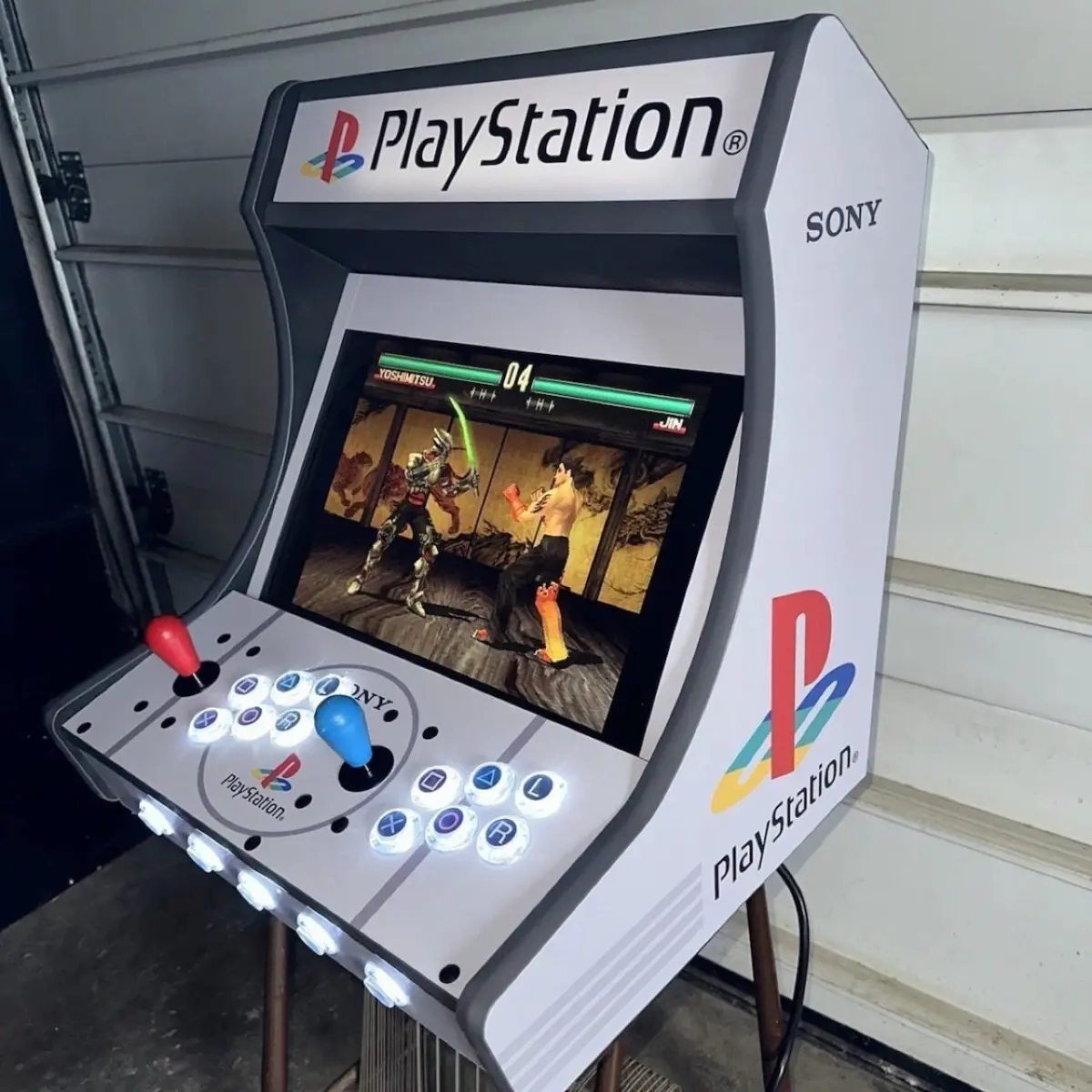
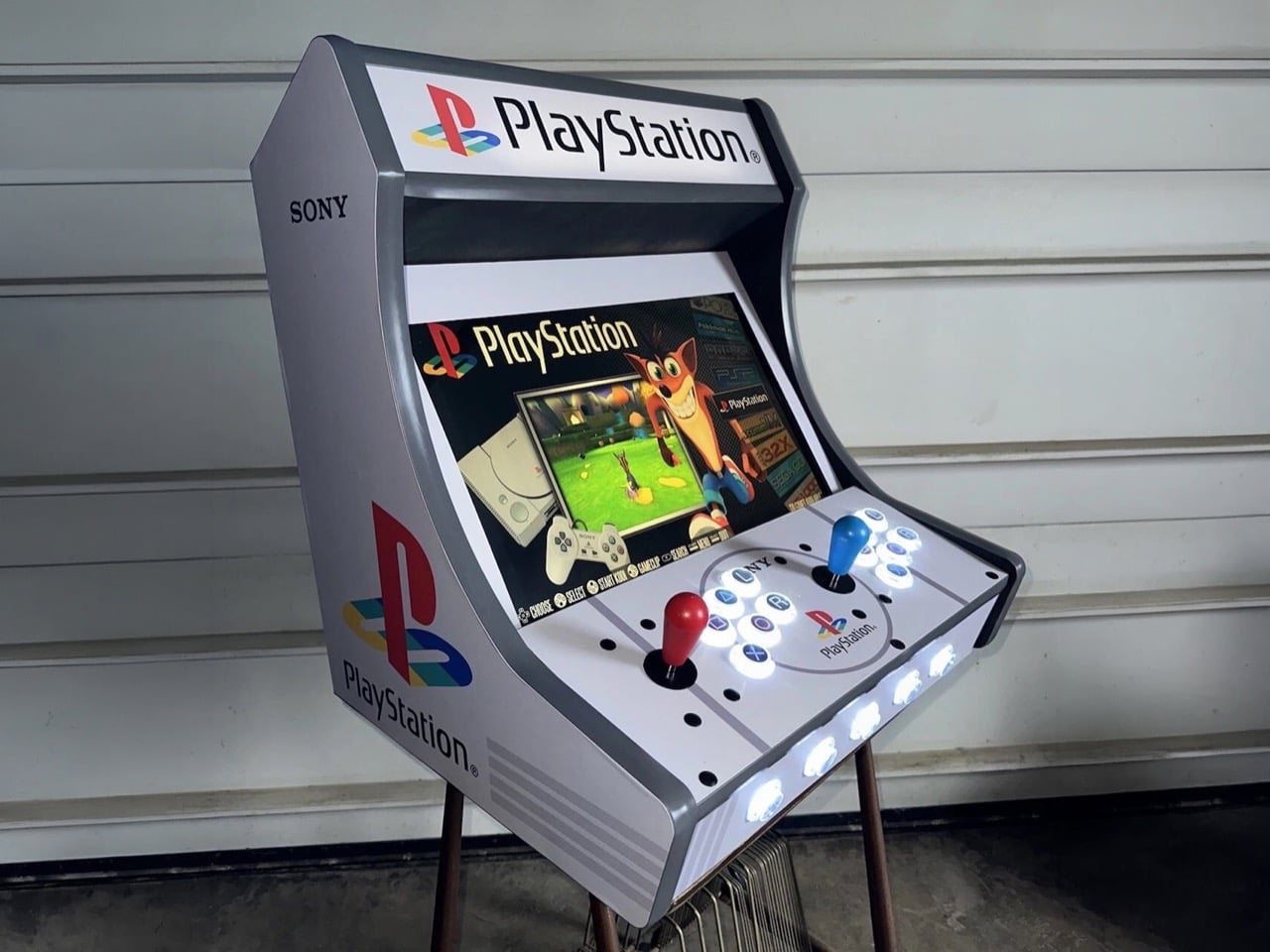
The autumn season has brought a wave of unconventional hardware modifications and nostalgic projects across the gaming community. While modern modders have been busy pushing the boundaries of contemporary hardware—harnessing Steam games on the PlayStation 5 and migrating PS5 titles over to personal computers in a digital cross-pollination experiment—independent creators are looking backward to honor the formative years of digital entertainment. In a particularly inspired nod to gaming history, an eBay creator operating under the moniker "arcadeplug" has constructed a striking, PlayStation-themed bartop arcade cabinet designed to run the legendary original PlayStation (PS1) library with authentic, stand-up arcade controls.
Priced at $1,029.99 and shipping out of Ohio with a one-year hardware warranty, the custom multi-game cabinet bridges a gap that Sony itself never officially crossed. Powered by a Raspberry Pi 4 running the open-source RetroPie software suite and housed within a custom-wrapped chassis, the machine captures the distinct visual language of 1990s console gaming. While official Sony hardware never took the form of a traditional upright arcade cabinet for the consumer market, a dedicated creator armed with high-grade laminated vinyl, custom cabinetry, and a free weekend determined that the gaming universe needed this missing link brought to life.
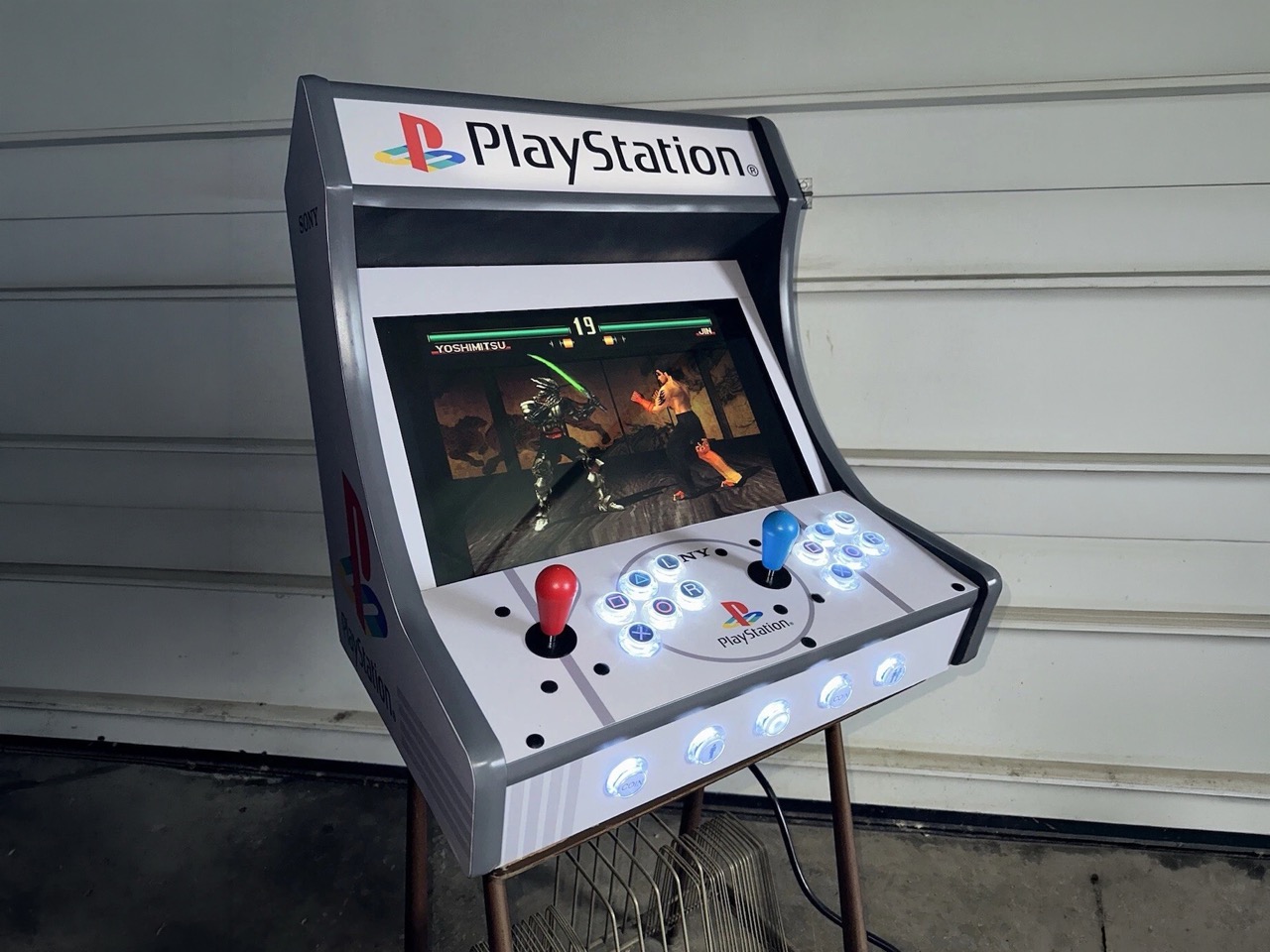
For anyone who grew up during the mid-to-late nineties, the visual presentation of the cabinet triggers an immediate wave of recognition. The signature light gray body color, the iconic four-color PlayStation logo stretching across the side panels, and the glowing, translucent face buttons featuring the classic triangle, circle, cross, and square symbols instantly transport observers back to the era of the initial console boot-up sequence. It is a fan-built creation dressed in meticulously crafted official-looking attire. The irony of the design is deeply rooted in industry history, given that PlayStation hardware actually served as the unseen engine for numerous 1990s arcade cabinets, most notably powering Namco’s groundbreaking Tekken on the System 11 board months before the home console ever hit store shelves. Those vintage arcade machines wore other corporate logos and artwork on their exteriors, whereas this modern tribute proudly wears Sony’s official branding while housing entirely different internal technology—a delightfully inverted way to close a historical loop.
Sony Snuck the PlayStation Into Arcades Before It Hit Living Rooms
The fascinating historical intersection between Sony and the commercial arcade industry began long before the original PlayStation became a household staple. The trajectory of Tekken into smoke-filled arcades traces back to a pivotal 1993 meeting where Sony executive Ken Kutaragi demonstrated the early internal specifications of the upcoming PlayStation architecture to Shegeichi Nakamura of Namco. At the time, Namco had been developing Tekken for its expensive System 22 board, a powerhouse designed to compete directly with Sega’s Virtua Fighter 2. Following the presentation, the development of the fighting game shifted decisively to the System 11 board, a more cost-effective hardware solution built directly upon PlayStation architecture.
This strategic pivot was driven by simple economics. While Sega dominated the high-end, premium arcade market with expensive dedicated hardware, Namco used the PlayStation-derived System 11 to target smaller arcades and venues that could not afford exorbitant cabinet setups. Furthermore, porting the game to the home console market became remarkably straightforward because the arcade board and the consumer console shared virtually identical sibling architecture. An upgraded System 12 board soon followed, making its grand debut alongside Tekken 3 in March 1997 and cementing the symbiotic relationship between arcade developers and Sony’s silicon.
Beyond its partnership with Namco, Sony also manufactured its own dedicated arcade hardware lines, specifically the ZN-1 and ZN-2 boards. These were distributed to major software publishing studios including Capcom, Taito, and Tecmo. Iconic arcade titles such as Street Fighter EX, Battle Arena Toshinden 2, and Tetris: The Grand Master all executed their processing on PlayStation-derived silicon, though average players would never have known by looking at the cabinets. Sony deliberately kept these arcade boards unbranded, allowing each respective publisher to plaster its own corporate name, marquee art, and side panel graphics on the exterior.
A notable piece of documentation highlighting this hidden history appears in the official manual for Acclaim’s NBA Jam Extreme, which casually and revealingly refers to the hardware as the "Sony Play Station Arcade Board." In essence, Sony’s official arcade boards were hidden PlayStations in complete disguise. By contrast, the custom eBay cabinet represents the exact opposite phenomenon: an unmistakable PlayStation disguise housing entirely different processing equipment within its compact bartop frame.
Why the PS1’s Graphic Design Looks This Good Blown Up
The aesthetic success of the custom arcade cabinet relies heavily on the timeless industrial and graphic design choices established by Sony in the mid-1990s. Teiyu Goto, the visionary designer responsible for shaping the original PlayStation console and its iconic controller, deliberately selected geometric face buttons rather than standard alphabetical layouts utilized by rival hardware manufacturers. Each shape was assigned a specific cognitive meaning: the circle and cross universally represented affirmative and negative choices, the triangle designated a viewpoint or perspective shift, and the square symbolized a sheet of paper, a document, or an in-game menu.
Goto also insisted on assigning distinct colors to each button, eventually convincing hesitant corporate management that the red circle and blue cross were essential design choices. Nearly three decades later, those four minimalist shapes function globally as a standalone corporate logo. On the custom arcade cabinet, those symbols are faithfully recreated as translucent physical buttons illuminated from within by internal LEDs, ensuring they remain clearly visible from across a room.
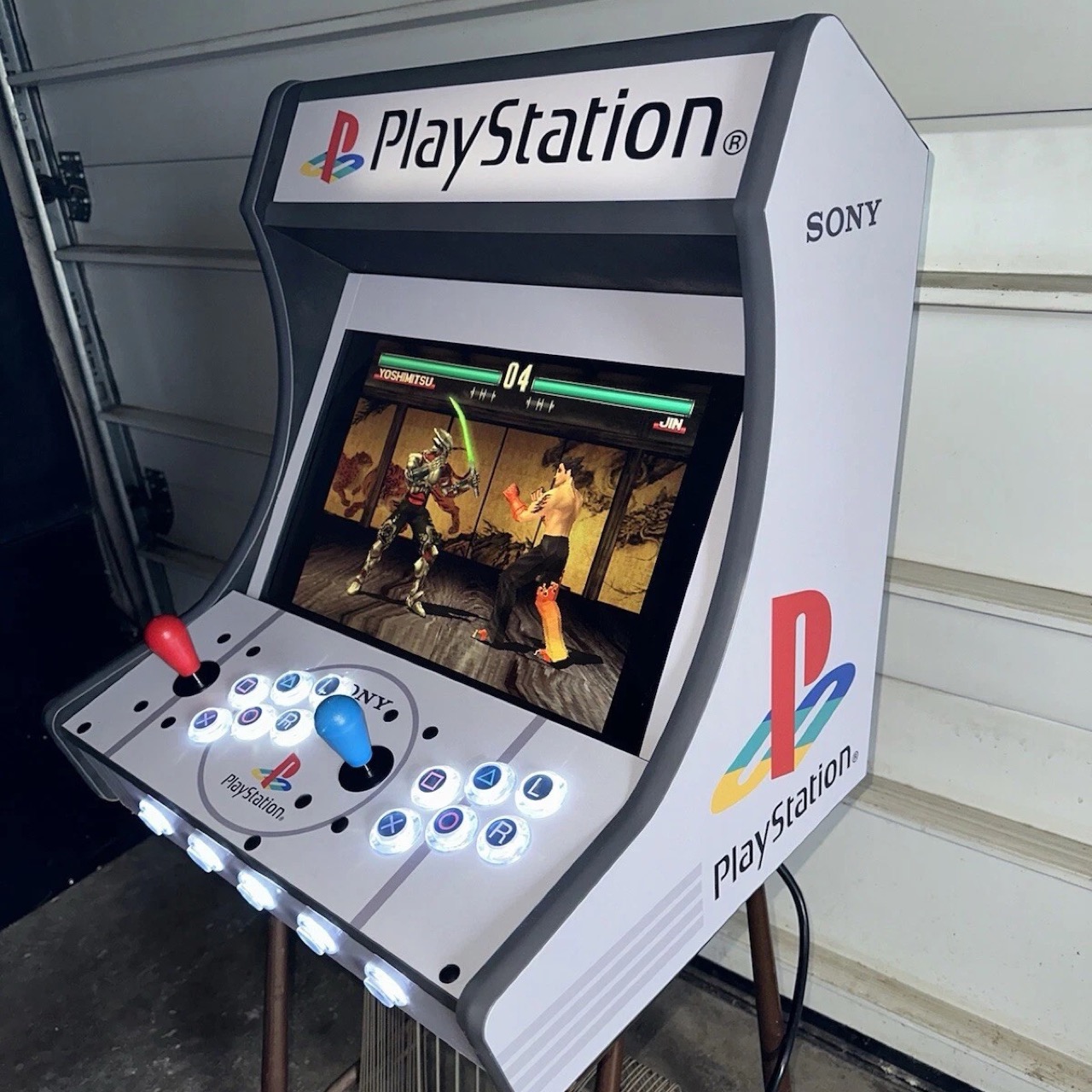
Similarly, Manabu Sakamoto’s groundbreaking 1994 PlayStation logo dominates the side panels of the cabinet, printed at a scale large enough to appreciate the intricate optical illusion built into its geometry. Sakamoto wanted the visual mark to imply three-dimensional depth without relying on simple drop shadows or artificial thickness. He achieved this by standing the letter "P" upright while laying the letter "S" flat behind it, utilizing four primary colors to establish contrast and form. When scaled up to the dimensions of an arcade cabinet side panel, that illusion of depth is remarkably striking, arguably looking even sharper than it did on the compact lid of the original compact disc console.
The main body of the unit borrows the exact light gray hue characteristic of the launch-era console, while a decorative circular ring surrounding the center of the control panel frames another prominent PlayStation logo—a clever design nod resembling the round disc lid of the original hardware. Executed entirely in high-quality laminated vinyl, the visual execution successfully sells the complete nostalgic fantasy.
A Raspberry Pi, Six Buttons, and a $1,029.99 Price Tag
Beneath its polished exterior, the technical foundation of the custom arcade machine consists of a Raspberry Pi 4 paired with a 128GB storage build running RetroPie, the popular open-source software platform that seamlessly bundles various emulators for the single-board computer. Gameplay is rendered on a crisp 19-inch LCD monitor, accompanied by a stereo pair of 4-inch audio speakers, durable Sanwa-clone joysticks and arcade buttons, and comprehensive internal LED accent lighting.
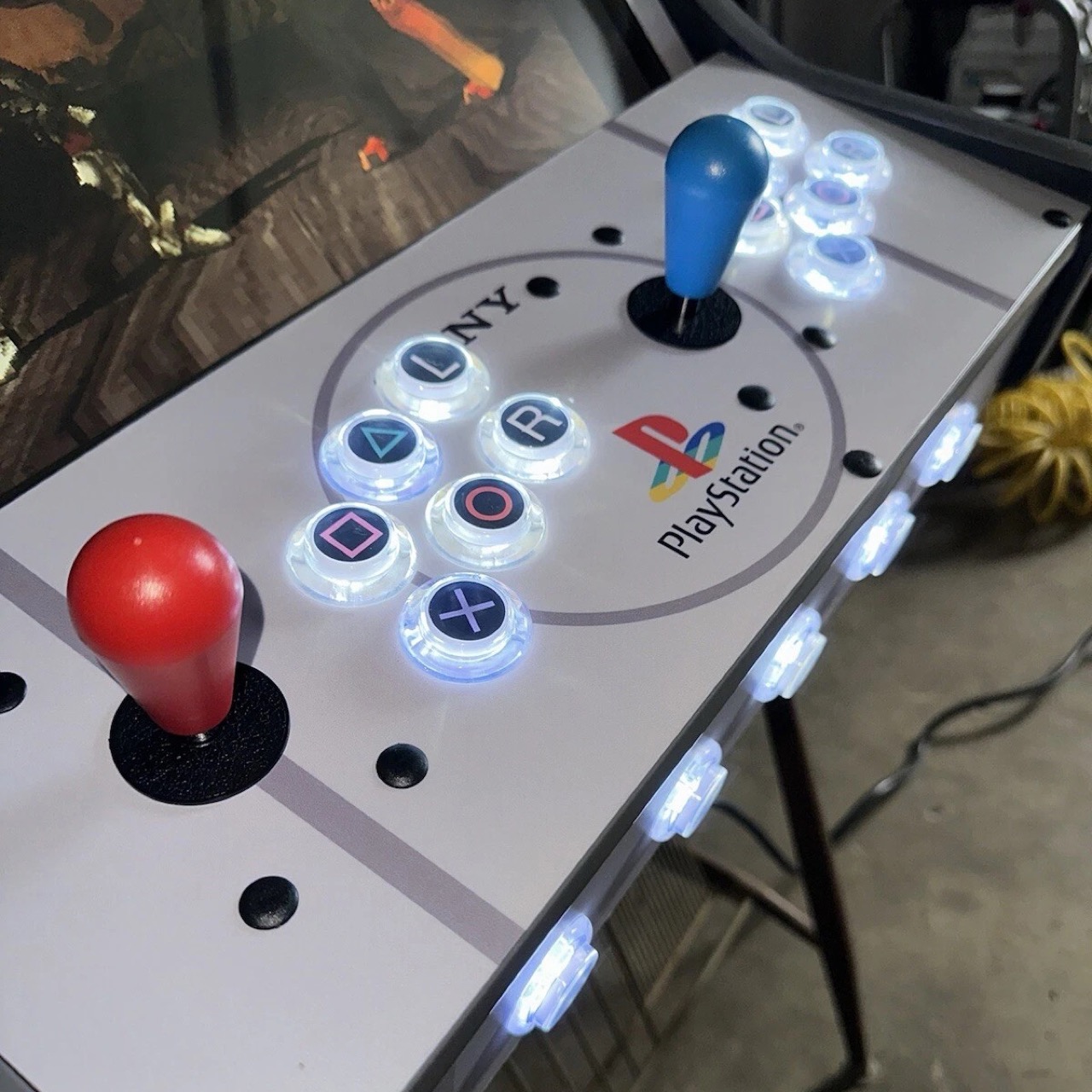
The control layout provides each player with a single precision joystick and a streamlined array of six action buttons, featuring the four foundational PlayStation geometric symbols supplemented by dedicated left (L) and right (R) shoulder buttons. This configuration intentionally omits the secondary pair of rear shoulder triggers found on standard dual-grip controllers, a modification that proves far more functional for classic arcade fighting games like Tekken and Street Fighter Alpha than it would for an extended role-playing adventure like a forty-hour playthrough of Final Fantasy. Furthermore, operating the unit requires standing upright throughout gaming sessions, capturing the authentic physical stance demanded by arcade fighters while remaining compact enough for countertop placement.
The Custom PlayStation Multicade cabinet commands an asking price of $1,029.99 with a "best offer" option on eBay, backed by a one-year vendor warranty covering core internal components such as the speakers, buttons, and Raspberry Pi system. When evaluated against broader market alternatives, licensed consumer options vary significantly; for instance, Arcade1Up’s manufactured Street Fighter II home cabinets typically retail between $350 and $650, while dedicated hardware emulators like the SuperStation One FPGA console cost roughly $210 to $250 for players who simply want to experience original PS1 software on a standard living room television.
Yet, none of those commercially produced alternatives replicate the specific physical aesthetic of a dedicated arcade enclosure styled after the original console. The timing of the build aligns with broader shifts in the industry, arriving as Sony prepares to phase out physical game disc production by 2028, effectively closing the chapter on the compact disc medium popularized for an entire generation by the original PlayStation. While contemporary software modders continue to pry open the architecture of the PlayStation 5 to explore its capabilities, an independent builder in Ohio has successfully gifted the original PlayStation the dedicated arcade cabinet it never officially received during its heyday.