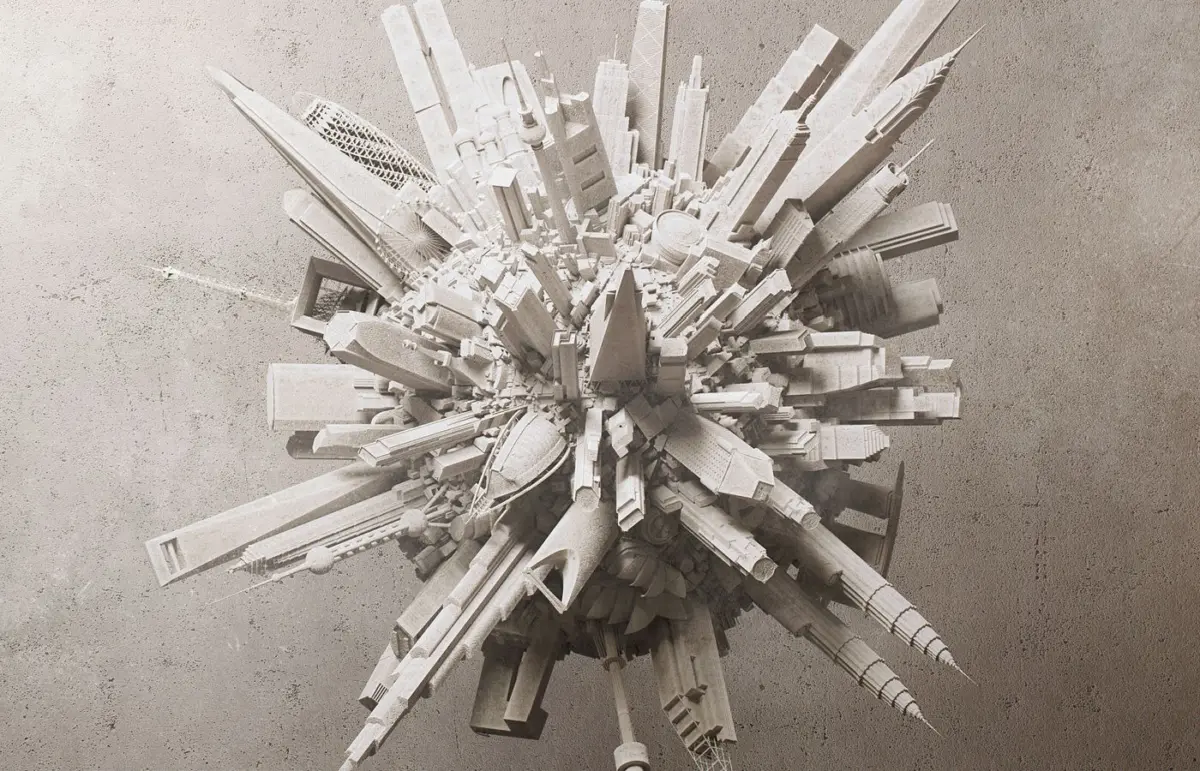
For the vast majority of human history, cities grew almost entirely by accident. While their foundational locations usually made practical sense—nestled in defensible positions on hills or islands, near extractable natural resources, or at the confluence of major transportation routes—what happened next was profoundly ad hoc. The people who worked in the local fort, mines, port, or warehouses needed places to eat, sleep, and worship, resulting in vast networks of improvisation where infrastructure like water, sewage, roads, trolleys, gas, and electricity threaded organically through the hustle and bustle.

While historical exceptions certainly existed—such as Alexandria, Roman colonial towns, specific districts in major Chinese cities, and Baron Haussmann’s sweeping redesign of Paris—urban growth was predominantly defined by happenstance, luck, and the continuous layering of the new on top of the old.

At least, that was the way things worked for most of human civilization. Around the second decade of the 20th century, however, urban development fundamentally changed. Cities started to happen on purpose. Beginning with New York City’s pioneering zoning laws in 1916, urban growth began to occur by commission rather than omission. Laws and regulations dictated the shape of the physical envelope, and functional decisions increasingly determined aesthetic outcomes—though not always for the best.

Now, a century after human beings first put their collective minds toward designing cities as cohesive wholes, urban planning and design are entering a golden era. High-tech materials, sensor networks, new scientific insights, and better data are empowering architects, designers, and urban planners to work smarter and with unprecedented precision. As a result, cities are becoming more environmentally sound, engaging, and visually striking. This evolution comes precisely in time, as a majority of the human population now lives in urban environments rather than rural ones.

Across the globe, visionary urban projects are redefining what a metropolis can be, ranging from hyper-connected streetlights and sacred spaces in constant flux to masterful museums and sophisticated infrastructure built specifically for bicycles. The cities of tomorrow may still self-assemble with occasional friction, but when executed correctly, the process is no longer accidental. Every block, building, and brick represents innumerable deliberate decisions, proving that when designed well, cities possess a transformative magic.

LA Goes LED and Gets Connected
In Los Angeles, the municipal government is undertaking a massive infrastructure retrofit, replacing 4,500 miles of traditional orange-yellow sodium-vapor streetlights with a moonlight-hued matrix of energy-efficient light-emitting diodes. Beyond simply making roadways brighter, the upgrade connects every lamp wirelessly to the Bureau of Street Lighting headquarters, providing real-time data on whether each individual light is operational, malfunctioning, or offline.

Looking forward, the city envisions smart lighting systems that dynamically respond to surrounding events. These advanced LEDs might blink to signal the approach of a police car or an ambulance, or brighten automatically for pedestrians dispersing from a major sporting event. While other cities worldwide have implemented LEDs primarily to cut costs and add decorative splashes of color, Los Angeles is constructing a comprehensive network designed to convey information about the entire urban landscape.

An Airport Within the Airport for Elite Travelers
More than 70 million travelers passed through Los Angeles International Airport in 2014, navigating a exhausting gauntlet of rolling luggage and travel pillows. To address this congestion, LAX initiated an $8 billion overhaul encompassing everything from concession areas to moving walkways. Airline partner Delta contributed $229 million to completely redesign Terminal 5, introducing the Delta One lounge—effectively an exclusive airport within the airport catering to celebrities and affluent fliers.

The experience begins curbside, where an attendant checks passenger names under velvet-rope conditions before escorting them into a private, high-end terminal lounge. When boarding time arrives, Delta staff guide travelers through a private elevator and dedicated corridor straight to the front of a priority security checkpoint. Upon returning from a trip, VIP Select passengers can opt for an expedited exit, receiving a personal chaperone to the tarmac where a hybrid Porsche whisks them across the airfield directly to Century Boulevard.

LA Adopts Less-Thirsty Landscapes to Beat the Drought
While iconic palm trees line Hollywood Boulevard, they are not native to Southern California. As the state endures a punishing multi-year drought, landscape architects are replacing imported plants and water-intensive turf with native, drought-resistant flora. This emerging aesthetic, often termed "California Dry," focuses on creative textures and architectural plant structures.

Traditional green lawns are increasingly giving way to decomposed granite and mulch, while rocky pathways, modern planters, and bridges add visual variety. Landscape designers are utilizing architectural plants like bold, pointy foxtail agave and spiraling echeveria in organized rows, complemented by native plants that introduce softness and color to the urban environment.

A Mobile Opera Cruises Through Downtown LA
For the production of Hopscotch, an opera staged across 24 limousines and SUVs driving through downtown Los Angeles, audiences sit knee-to-knee with vocalists and musicians. Throughout its run, the vehicles travel along three distinct routes tracing a narrative about the search for a lost love. Actors and dancers equipped with wireless microphones perform on sidewalks and in passing vehicles, seamlessly blending into the everyday choreography of city life.

Yuval Sharon, artistic director of The Industry opera company, notes that Los Angeles itself functions as the central character of the production. Limited to just 96 audience members per performance, attendees frequently step out of the cars to enter buildings and public spaces, with each transit leg revealing a portion of a 36-chapter story.

An Evolving Museum Spirals Between Past and Present in Shanghai
Shanghai has experienced an explosive vertical expansion in recent years, punctuated by dense clusters of towering skyscrapers. In contrast, the new Shanghai Natural History Museum spirals downward into the earth, evoking an excavation of the city’s pre-urban history. Located in a park near the Pudong financial district, the building features a central courtyard inspired by the classical water gardens of Suzhou, reflecting the profound cultural value ancient Chinese society placed on natural beauty. A honeycombed glass wall, designed to mimic cellular plant structures, floods the interior with natural sunlight.

Architect Ralph Johnson of Perkins+Will drew inspiration from the nautilus shell for the building’s geometry, which also serves a functional purpose in traffic management. Because Chinese museums frequently experience heavy crowds, the descending interior ramps guide visitors smoothly through a chronological exhibition of life on Earth. Along the way, patrons encounter approximately 11,000 specimens, including a towering Mamenchisaurus skeleton and fauna that once inhabited Shanghai’s vanished wetlands. Sustainable technologies are integrated throughout, including climate and water systems that utilize the courtyard pool for natural cooling.

Medellín’s Cable Cars Unify a Fractured City
Nestled within a high Andean valley, Medellín historically featured steep hillside neighborhoods where impoverished residents built sprawling informal settlements known as comunas. During the 1990s, drug cartels and guerrilla factions exerted tight control over these narrow, steep streets. As violence subsided and residents began venturing outward, they encountered a severe geographical hurdle: navigating across the city was exceptionally difficult.

To bridge this fractured urban landscape, former Mayor Luis Pérez introduced an innovative public transit solution: cable cars. Instead of negotiating perilous hillside paths, residents could board gondolas and soar directly to metropolitan transit stations. The inaugural Metrocable line commenced operations in 2004, quickly sparking a series of subsequent transit expansions.

Urban planners praise the system for directly serving low-income populations and integrating them into the broader economic life of the city. As individuals from diverse socioeconomic backgrounds began utilizing the cable cars to visit previously marginalized neighborhoods, public investment and civic pride surged, ushering in a decade recognized for cutting-edge urban planning.

Building upon the success of the transit system, municipal leadership deployed architecture as a tool for social cohesion. Alejandro Echeverri, director of urban projects from 2004 to 2008, spearheaded the construction of striking libraries surrounded by public green spaces within low-income areas. These "library-parks" provided safe community gathering spaces, while coordinated municipal efforts systematically upgraded local streets, planted trees, and rebuilt crumbling schools. Grassroots initiatives, such as community-led mural projects and historical tours in Comuna 13, further propelled the city’s holistic transformation.

The Hovenring Allows Cyclists to Bypass Eindhoven’s Traffic
Eindhoven was a quiet provincial town before the Philips family established a lightbulb manufacturing business there in 1891. Today, it functions as a vibrant technology and research center, drawing daily commuters from surrounding suburban developments. This rapid growth created congested intersections that presented significant hazards for cyclists.

As part of a broader municipal initiative to develop dedicated bicycle transit corridors, Eindhoven commissioned design firm ipv Delft to engineer a grade-separated solution for bike commuters. Opened in 2012, the $8 million Hovenring features a 1,000-ton steel deck suspended by 24 steel cables from a central pylon. Adorned with integrated LED lighting, the structure floats above the roadway while the surrounding roadbed was lowered to maintain gentle, accessible approach slopes for cyclists.

How Saudi Arabia Prepares for Millions of Hajj Pilgrims
Annually, the population of Saudi Arabia swells by three million people during the Islamic pilgrimage known as the hajj. Most urban centers lack the surge capacity required to manage such massive demographic shifts safely. To protect, accommodate, and guide millions of pilgrims, the Saudi government has enlisted prominent international architects and design firms to upgrade infrastructure while respecting Islamic traditions.

At King Abdulaziz International Airport, the 2.8-million-square-foot Hajj Terminal utilizes massive Teflon-coated fiberglass roofs inspired by traditional Bedouin tents. While baggage claim areas are fully climate-controlled, open-air waiting zones maintain comfortable temperatures through natural ventilation, offering shelter for travelers facing lengthy transit waits.

To manage the immense waste generated during the gathering, a subterranean network of pneumatic tubes processes up to 600 tons of trash daily, vacuuming refuse away from 400 access points at speeds reaching 40 miles per hour.

At the Masjid al-Haram, the Great Mosque of Mecca, architectural firm Gensler expanded the sacred site surrounding the Kaaba. By proposing multi-level, eight-sided platforms, designers effectively doubled the visitor capacity and improved pedestrian flow while preserving emotional sightlines and traditional rituals. Meanwhile, the Abraj Al-Bait hotel complex introduces a massive clock tower that dominates the skyline, alongside the upcoming Abraj Kudai development designed to offer extensive luxury accommodations.

In the Mina Valley, where pilgrims reside in tent encampments during the pilgrimage’s midpoint, the government replaced traditional cotton tents with over 100,000 fire-resistant, Teflon-coated fiberglass structures equipped with comprehensive water hydrant networks and dedicated medical facilities. Furthermore, the expansion of the Jamarat Bridge into a multi-level structure has improved safety and crowd movement during the traditional stoning ritual.

Taming Nairobi’s Minibus Network With Digital Mapping
In Nairobi, the primary mode of public transportation is a decentralized fleet of privately operated minibuses known as matatus. While inexpensive and abundant, these vehicles operate without fixed timetables, making route identification challenging for daily commuters.

To bring order to this informal transit network, a research collective named Digital Matatus deployed university students equipped with smartphones and GPS applications to map the city’s routes and stops. Publishing the resulting subway-style transit map provided riders—particularly women navigating the city after dark—with critical navigational clarity. The data was subsequently integrated into Google Maps, formally recognizing the matatu system on a global platform and establishing a blueprint for informal transit networks worldwide.

Coworking Spaces Redefine the Modern Office in San Francisco
The traditional corporate office layout continues to evolve as startups and remote teams embrace flexible environments. Companies like WeWork operate large-scale coworking spaces that extend far beyond standard open-floor plans, offering fully serviced environments complete with communal areas, private rooms, and integrated networking opportunities. By prioritizing natural light, architectural character, and operational flexibility, these spaces accommodate thousands of entrepreneurs and independent professionals seeking community without the long-term financial commitments of traditional commercial leases.

Dubai’s Turbine Interchange Combines Design and Velocity
The intersection of Emirates Road and surrounding thoroughfares previously relied on a conventional roundabout that forced high-speed highway traffic to come to a complete stop before merging. In 2006, municipal authorities initiated a redesign to eliminate chronic bottlenecks.

Rather than implementing a traditional cloverleaf interchange, engineers selected a turbine interchange design originally conceptualized in the United Kingdom during the 1960s. The configuration allows motorists approaching from four directions to execute turns without slowing down or weaving through conflicting traffic streams. Although turbine interchanges require a substantial land footprint—the Arabian Ranches Interchange spans nearly a third of a mile and incorporates 11 bridges totaling 1.5 miles—its rotational symmetry ensures a consistent, high-capacity driving experience across all approaches, balancing structural efficiency with modern aesthetic standards.