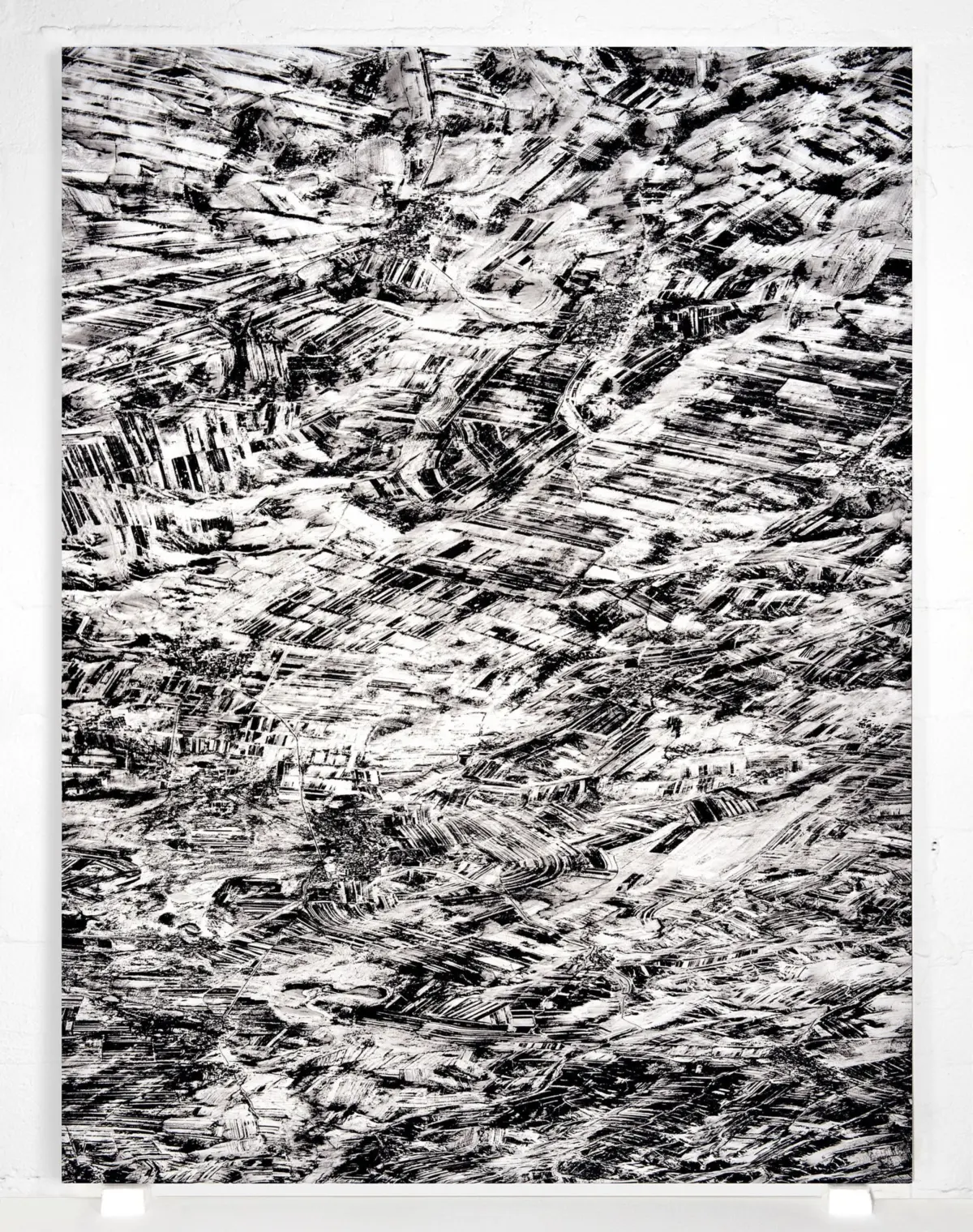
From a certain vantage point inside Justin Brice Guariglia’s Brooklyn studio, it is nearly impossible to tell what exactly hangs on the back wall. Viewed from a distance, the sweeping 16-foot print resembles a heavily textured painting with jagged, organic edges that practically invite the viewer to reach out and touch its surface. Upon stepping closer, however, the perception shifts; the eye registers that the image is entirely flat, functioning much like a high-definition photograph. In reality, this masterful trompe l’oeil exists somewhere fascinatingly between the two mediums.
"They’re paintings derived from photographs," Guariglia explains, describing a meticulous hybrid process that challenges traditional definitions of both fine art and documentary photography.
This particular monumental work originates from a recent, high-stakes flight Guariglia took alongside NASA’s Operation IceBridge mission. It captures a striking, sobering portrait of the Jakobshavn Glacier—widely recognized as Greenland’s largest and most rapidly melting hunk of ice. The piece forms a central part of an expansive series of landscape prints that the artist has assembled for his upcoming solo exhibition, Earth Works: Mapping The Anthropocene, which is scheduled to open at the prestigious Norton Museum of Art in Palm Beach, Florida.
The journey that brought Guariglia to this point in his career is as unconventional as his artistic medium. He originally established himself as a freelance magazine photographer working extensively across Asia, capturing transient moments and fleeting news events for various publications. Yet, the inherent ephemerality of magazine publishing began to weigh on him. Photographs printed on standard newsprint or magazine pages are routinely discarded, recycled, or forgotten. Desiring a profound shift, Guariglia made a deliberate transition to fine art a decade ago, determined to create enduring physical objects that would stand the test of time.
For his latest museum show, Guariglia devised an innovative method to print his sweeping aerial photographs directly onto industrial-grade aluminum and polystyrene canvases. The resulting works carry a poignant conceptual weight. "The physical object in the photo is already gone," he notes, pointing to the rapid, irreversible retreat of the glaciers and landscapes he documents. "But the actual image will last forever—as long as we don’t recycle it."
The source imagery for these compelling works was captured at altitudes ranging anywhere from 1,500 to 40,000 feet in the air. From these dizzying heights, Guariglia transforms ordinary agricultural countrysides in Asia and massive arctic landmasses into powerful abstract forms. Through his lens, working farmlands are reconfigured into intricate, gilded geometries, while colossal glaciers are reduced to stark, ambiguous vistas of brilliant white.
Many of the most striking photographs featured in the exhibition were secured during his time with NASA’s IceBridge mission. The ongoing mission deploys low-elevation research aircraft over Greenland to gather critical scientific data on the country’s rapidly deteriorating glaciers and ice sheets. During these intense, freezing flights, Guariglia would lay prone at the feet of the pilots, pressing his camera against the plane’s drop windows to snap crystal-clear images of the ever-shifting, melting terrain unfolding directly beneath them.

Back in his spacious Brooklyn studio, Guariglia takes a remarkably restrained approach to post-processing and digital manipulation. "I mostly just trying to reduce the image to its most basic essential form," he says, aiming for clarity and emotional resonance over digital trickery.
To bring these visions to life, he utilizes an industrial-grade printer that serves as the artist’s modern paintbrush. This specialized machine, entirely handmade in Switzerland and carrying a price tag roughly equivalent to the cost of a "very nice" Brooklyn apartment, operates far beyond its intended commercial scope. The printer is designed to dispense a microscopic, fine layer of acrylic ink onto various surfaces before powerful ultraviolet lights instantly cure and bind the pigment to the material.
Typically, this high-end industrial machinery is utilized exclusively for producing durable commercial signage. "I make it do things it’s not supposed to do," Guariglia says, pushing the limits of the technology by printing directly onto rigid polystyrene or laying down an astonishing 150 cumulative layers of ink at 900 percent saturation. "I’ve logged about 1,500 hours testing material and printing processes."
The painstaking experimentation yields a photographic print that is engineered to effectively last forever, creating a jarring juxtaposition against the profound ephemerality and rapid destruction of the subject matter it portrays.
Every element of Guariglia’s artistic process—from the choice of raw materials to the precarious subject matter itself—is deliberately designed to represent the Anthropocene. This current, unofficial geological age is defined entirely by humanity’s profound and often devastating impact on the planet’s ecosystems, climate, and geology.
The overarching goal, as the artist explains it, is to actively implicate not just himself as an creator utilizing industrial materials that will eventually become part of the geological fossil record in the Anthropocene age, but also every single viewer who confronts the artwork. The monumental prints serve as a stark, uncompromising reminder that the environmental crises humanity currently faces are enormous, largely stemming from our own collective actions. Yet, once captured, carefully cropped, and printed onto these solid rectangular panels, the immense scale of planetary change is rendered visible, making it undeniably harder to ignore.