Constructed almost entirely from upcycled cloth reclaimed from retired boat sails, the EDC One possesses a distinct personality right out of the box. Because no two sails weather identically, each bag features its own unique quirks, subtle imperfections, and a naturally broken-in look that defies the stiffness usually associated with brand-new gear. Among its most innovative touches is the handle closure system. Eschewing traditional plastic snaps or annoying Velcro that collects lint and loses its grip over time, Savage opted for integrated magnets. When brought within proximity of one another, the handles snap together with a deeply satisfying mechanical clonk.
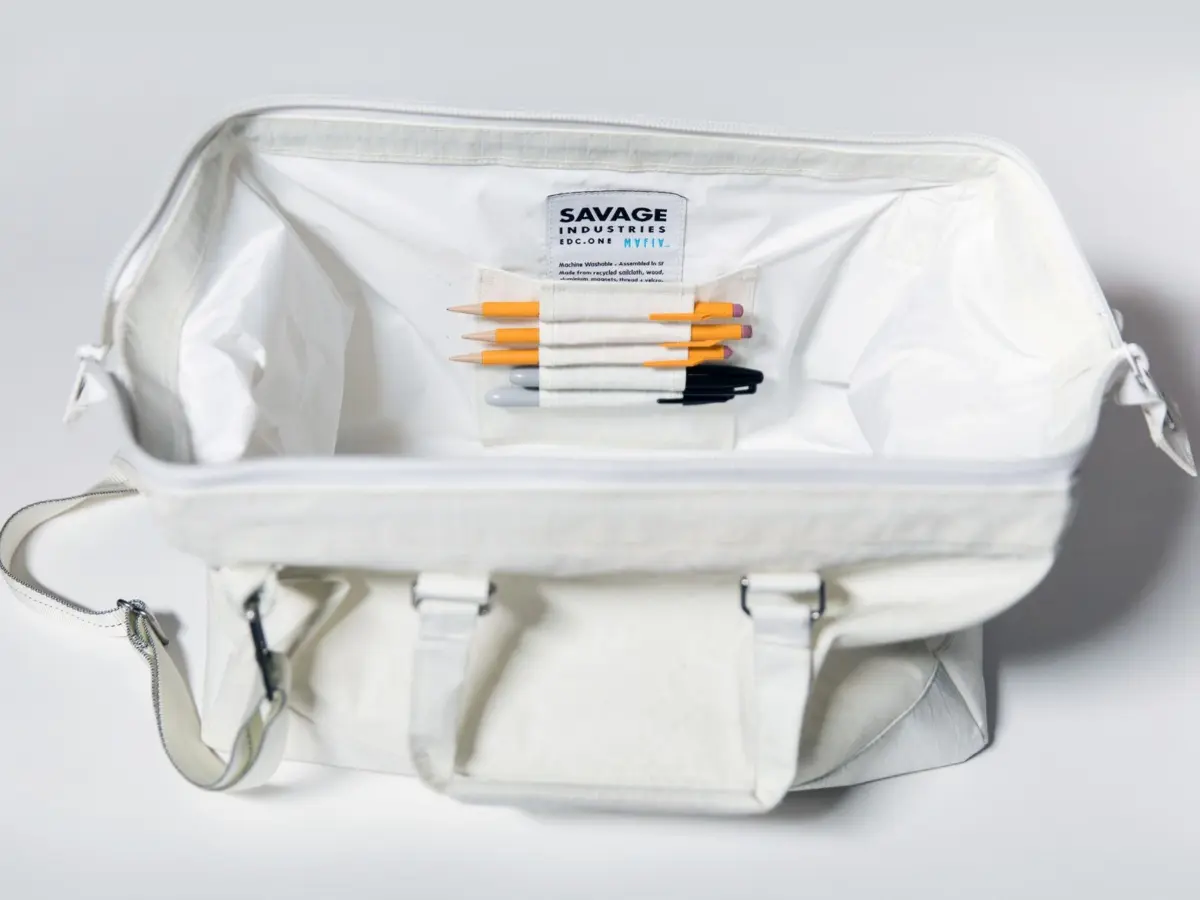
The clever engineering doesn’t stop at the handles. The straps are intentionally stiffened just enough to keep the clasped handle propped upright in the air, resembling the frame of a miniature pup tent. Unzipping and prying open the bag reveals another structural trick: a pair of spring steel inserts running neatly around the lip. These inserts ensure the mouth of the bag remains wide open and rigidly fixed in configuration, gaping like the jaw of a whale shark to provide unfettered access to the interior.
Inside, the layout caters directly to the needs of the hyper-organized maker and creator. A dedicated interior sleeve holds notebooks—though Savage is brand-agnostic, he harbors a deep personal fondness for Tom Sachs Ten Bullets notebooks—while a series of horizontal fabric loops keeps pens and pencils securely in place. The bottom of the bag is reinforced with tough, durable Kevlar, featuring strips of industrial Velcro. This inclusion hints at a modular ecosystem of accessories yet to come, including padded bays designed specifically to cradle sensitive camera equipment or waterproof, bucket-like inserts capable of securely hauling a 12-pack of beverages.
Savage designed the EDC One to serve as an all-in-one vessel capable of transporting everything required for a demanding workday, bridging the gap between delicate tools, reference books, and daily provisions. The conceptual roots of the design trace back to two distinct historical and professional inspirations. The first is an old tool case Savage relied upon daily during his formative years as a professional model-builder at George Lucas’s legendary Industrial Light & Magic. That vintage case featured a classic clamshell top that flopped wide open, granting instantaneous, full access to its contents. Having spent years searching the modern market for a suitable commercial replacement that captured that same functionality and coming away repeatedly disappointed, Savage decided to engineer his own solution.
The secondary inspiration comes from an unlikely piece of aerospace history: the temporary stowage bag given to Apollo astronauts during historic missions to the moon. Famously dubbed the "McDivitt Purse" after astronaut James McDivitt, this specialized tote had largely faded into obscurity until Neil Armstrong’s widow famously discovered it while sorting through her late husband’s personal belongings. Borrowing heavily from NASA’s space-tested philosophy, Savage incorporated the simple geometric shape, the robust steel closure mechanism, and a near-total absence of distracting color pigments.

Which brings the design to its most striking visual characteristic: the color. The EDC One is white—strictly white, at least for the initial product run. While an unblemished white bag might seem wildly impractical for daily urban commuting, field work, or workshop environments destined to subject gear to dust, dirt, grime, and oil, Savage is remarkably persuasive in his defense of the choice. In his view, the bag will inevitably develop a rich, authentic patina over time, and patinas are inherently cool. Furthermore, a stark white interior serves a crucial practical function: tools, small screws, and hardware are notoriously difficult to locate at the bottom of a dark, black-lined bag.
By avoiding the current fashion trends of "tactical" aesthetics and "urban camo" that saturate the modern accessory market, the EDC One deliberately stands apart. It rejects the hyper-masculine signaling of the ubiquitous Cordura messenger bag, offering instead a clean, minimalist aesthetic that feels refreshingly neutral and distinct.
Though Savage has maintained a lifelong relationship with sewing—having practiced the craft since middle school and regularly constructing intricate, high-end costumes for public appearances—the heavy manufacturing lifting for the EDC One was entrusted to Mafia, a fellow San Francisco-based company renowned for producing high-end bags primarily out of recycled sailcloth. Mafia’s skilled artisans produced a limited initial run of several hundred Savage bags, with each individual unit backed by the company’s standard lifetime warranty.
Priced at $225, the bags are distributed directly through Savage’s official website. Given the limited nature of the initial production batch, once the current stock sells out, subsequent orders will transition to a backorder status until Mafia’s manufacturing schedule catches up with demand. To reward early supporters and add a touch of collector appeal, every single bag from this initial launch is meticulously hand-numbered.
The debut of the EDC One marks the official commercial birth of Savage Industries, but it is merely the opening chapter for the brand. Savage confirmed that future expansions are already in the pipeline, including both a compact, downsized iteration of the flagship bag and a larger variant. Even the forthcoming larger version, however, has been deliberately engineered to strictly adhere to Federal Aviation Administration regulations for carry-on luggage. Beyond alternative sizing, Savage remains tight-lipped about what other hardware might join the lineup, noting only that additional modular accessories designed to integrate via the interior Velcro strips are on the way. Whatever shape those future creations take, they carry forward a meticulous standard of design born from decades of hands-on making.