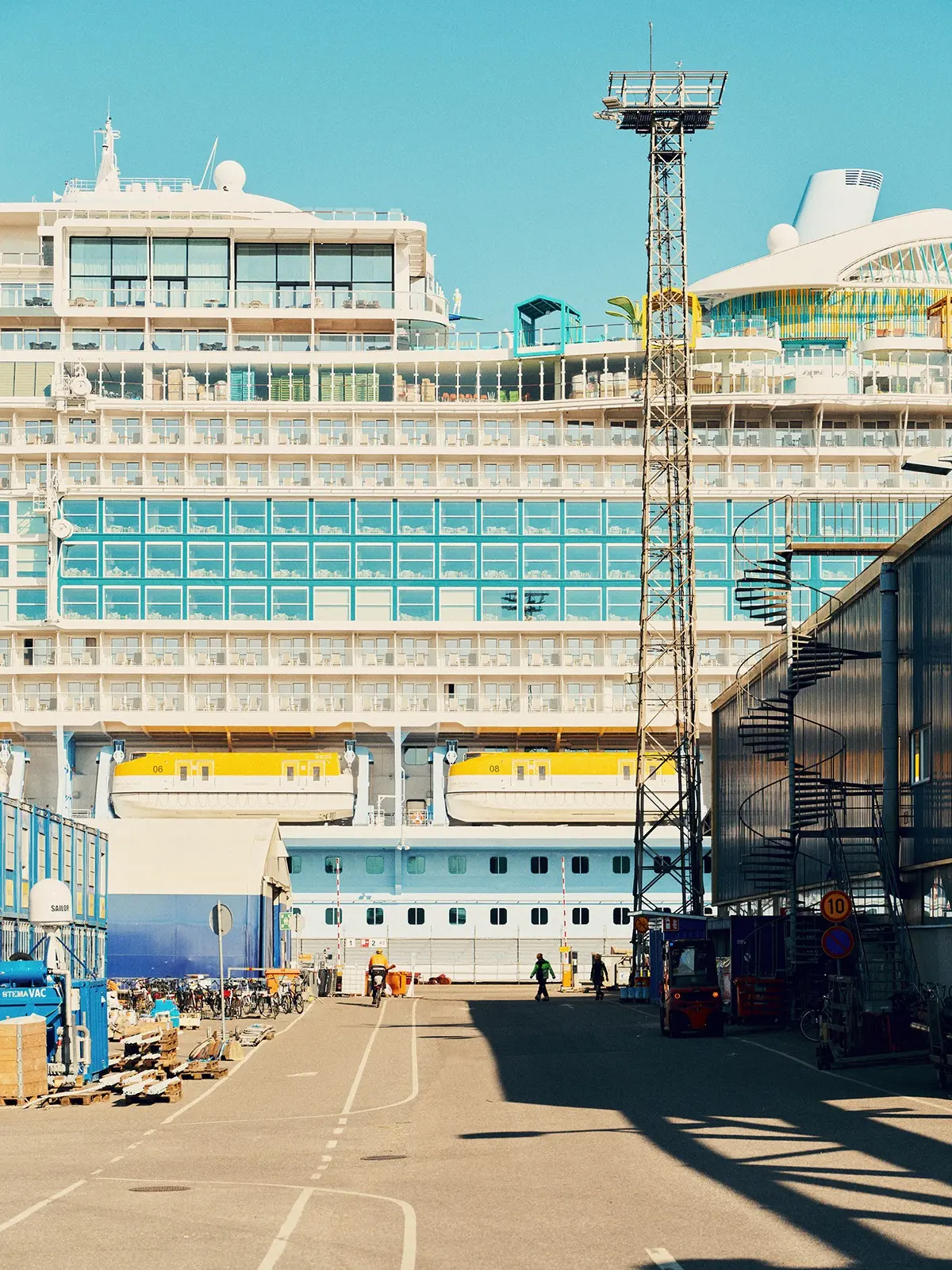
Towering over the Aura River near Finland’s oldest city, Turku, Royal Caribbean’s Star of the Seas cuts an imposing silhouette against the Scandinavian sky. Built to house an astonishing 5,610 guests at maximum capacity, the massive mega-ship spans 365 metres and encompasses 20 distinct decks. When visitors step aboard during a tour of the historic Meyer Turku shipyard, they quickly realize that the vessel is more than just a means of transportation—it is a floating metropolis, carefully engineered and meticulously designed to rival the world’s most luxurious land-based resorts.
The mammoth vessel is divided into eight distinct "neighbourhoods," each offering a completely different aesthetic and experiential vibe. Among them are Thrill Island, which features an expansive waterpark complete with six massive waterslides; Central Park, a lush, open-air enclave home to more than 33,500 individual plants; and the Aquadome, a giant glass structure perched high above the forward section of the ship. Serving as a tranquil retreat by day and an advanced show venue featuring robotic arms and diving platforms by night, the Aquadome is a true marvel of modern maritime engineering. Beyond these headline-grabbing zones, the ship boasts more than 40 bars and restaurants, three separate theatres, and a sprawling spa complex featuring 28 dedicated treatment rooms.
For the cruise industry at large, Meyer Turku has cultivated a sterling reputation as the go-to dockyard for the construction of the world’s largest and most technologically complex vessels. According to Sascha Lang, Royal Caribbean’s vice-president of Architectural & Design, the shipyard’s primary strength lies in its unmatched technical capability.
"The shipyard here has the ability to translate our most ambitious concepts into reality," Lang notes during a visit to the Finnish facility.
The ships constructed in Turku are so massive and intricate that they have catalyzed the growth of an entire surrounding marine cluster. This economic ecosystem comprises specialized universities, highly skilled subcontractors, and a vast network of suppliers, establishing the maritime industry as the foundational driver of the regional economy. Casimir Lindholm, CEO of Meyer Turku, emphasizes the immense footprint of this industrial network in Western Finland.
"This is the biggest single employer in Western Finland," Lindholm explains. "Every day more than 6,000 people work on-site, and the indirect economic effect doubles that."
While the sheer scale of the engineering is breathtaking, physical size alone does not justify the premium ticket prices passengers pay to vacation aboard floating palaces like Star of the Seas. Because guests frequently spend anywhere from several days to multiple weeks on these liners, the interior environments must look and feel exceptional. Star of the Seas addresses this by offering elegant interiors distributed across dozens of diverse accommodation categories. The standard cabins are bright, modern, and thoughtfully laid out, with many featuring private balconies that open directly onto expansive ocean vistas. For those seeking the ultimate in luxury, the ship’s most opulent suites span four distinct decks, complete with private sun decks and en-suite dining facilities.
To achieve this level of interior refinement, shipbuilders rely heavily on a tightly knit network of local Finnish firms.
"The interior design and fit-out companies in Finland are the crème de la crème," Lang says. "Companies such as Merima, Naval Interior Team [NIT], and Orsap are not just suppliers. They are partners who help us innovate."

Founded in 1987 and remaining proudly family-owned, Merima employs more than 140 people and is regularly trusted with the most complex and demanding interior assignments on major newbuilds. On Star of the Seas, Merima was tasked with bringing the Aquadome, the main theatre, the waterpark, and the sprawling outer decks to life.
"This has been our most complex project," Juuso Normio, Merima’s head of newbuild, explains while guiding a tour of the upper-deck pool area, where multi-story waterslides loom overhead, with some stretching directly over the open ocean for maximum thrills.
"We receive the architects’ concepts, adapt them so they can be built, make sure that the technical systems fit, and confirm that the materials suggested are possible to use," Normio continues. "Then we manufacture parts either at our factory in Helsinki or with our subcontractors and install them here at the shipyard."
Operating as a turnkey provider, Merima takes full responsibility for the entire delivery cycle, handling everything from the initial design phase through to final finishing touches. It is this comprehensive capability that has earned the trust of major shipyards and cruise line operators worldwide.
Because designing and fitting out a ship of this magnitude is intensely time-consuming and technically demanding, the workload is distributed among several specialized Finnish firms. The Royal Promenade, a 7,000-square-metre interior high street lined with bustling cafés, bars, and retail shops, was entrusted to NIT, a specialized shipbuilding firm based in Piikkiö, just east of Turku.
"In this project, the biggest challenge was to make the space feel light and airy, while not compromising on the physical security of the vessel," explains Sebastian Lagerlöf, NIT’s director of sales.
NIT’s work on the Royal Promenade highlights a broader industry shift toward maximizing visual connections with the surrounding marine environment. The light-filled avenue offers sweeping views of the Caribbean Sea—where the ship operates today—serving as a constant reminder to passengers that modern cruising is about much more than retreating to private staterooms. Furthermore, interior design trends within the cruise sector are evolving to reflect contemporary tastes.
"Large American cruise-ship operators are moving towards the Scandinavian style, which means lighter materials, cleaner lines, and more natural light," Lagerlöf observes. "That plays to our Finnish strengths."
Other crucial zones of the ship, including the monumental stair towers, a large conference centre, and the opulent wellness spa, were placed in the hands of Orsap. Founded in 1991, the interior specialist currently employs 71 people and prides itself on maintaining strict control over every link in the production chain.

"The spa features a lot of stone and marble, as well as curved forms and integrated steam technology," says Jukka Ansavuori, project director at Orsap. "We first prefabricated the treatment rooms in our workshop and then installed them here on the ship."
Unlike firms that outsource critical phases of development, Orsap manages design, electrical planning, fabrication, and final installation internally.
"We don’t outsource design. We take the cruise line’s concept, then we determine how to make it real. Almost everything is drawn and planned before production," Ansavuori adds.
Despite their domestic prowess, Finnish firms like Merima, NIT, and Orsap operate within a fiercely competitive international marketplace. Italy commands significant global market share thanks to its deep-rooted design credentials, while Germany remains a formidable competitor built on a historic tradition of engineering excellence. France also holds a major stake in the European shipbuilding landscape through Chantiers de l’Atlantique based in Saint-Nazaire.
"The cruise interiors industry is international," Lang acknowledges. "But Finland has carved a very particular niche for itself. The Finnish companies merge ambition with precision and they are willing to adapt to new challenges."
Finland’s dominant position in the high-end maritime sector may come as a surprise to casual observers, but the roots of this success run deep. Turku has served as a thriving shipbuilding hub since the 18th century, cementing an industrial culture that values meticulous craftsmanship and technical ingenuity. For Finland, the modern dividends of this heritage are both economic and reputational. The broader Finnish maritime cluster currently employs approximately 30,000 people nationwide and generates roughly €12bn in annual revenue.
"When we innovate, we want to create the next big thing," Lang says, summarizing the collaborative ethos shared by the cruise line and its Finnish partners. "Meyer Turku and its partners are willing to take risks with us to solve problems that look impossible at first. That’s why we build our most ambitious ships here."
For the average traveller walking the expansive decks of vessels like Star of the Seas, the immense complexity hidden behind the walls is easy to overlook. Most passengers will likely never encounter the corporate names Merima, NIT, or Orsap. Yet the specialized craftsmanship of these Finnish companies quietly shapes nearly every moment of the passenger experience at sea. For the city of Turku and its skilled workforce, the ultimate reward is international recognition as the undisputed capital of cruise ship interiors—a title the region is well-positioned to retain as the next generation of maritime leviathans takes shape in its historic docks.
Quick Facts: Royal Caribbean Group
- Global Fleet Size: 71 ships across global and partner brands
- Current Order Book: Two new cruise ships scheduled by 2032, alongside five new land-based destinations slated for development by 2028
- Workforce: Approximately 108,000 employees globally as of the end of 2025
- Passenger Milestone: More than 100 million guests carried across 50 years of operations
- Annual Turnover: $17.9bn (€15.9bn) recorded in the 2025 financial year