For decades, the standard playbook for independent creative agencies was relatively straightforward: hang out a shingle, accumulate a roster of clients, and pitch prospective accounts on a unique combination of strategic insight, creative firepower, and media prowess. But according to industry veterans who have spent a lifetime navigating the shifting tides of the advertising world, being an independent agency is no longer the distinct advantage it once was.
The marketplace has fundamentally transformed. Today, clients face an overwhelming array of choices, and the traditional differentiators that once separated the top-tier agencies from the rest of the pack have largely eroded. Most modern agencies now offer a familiar, hybrid combination of strategy, creative development, media planning, production capabilities, and, increasingly, artificial intelligence integration. Even when a mid-sized independent shop does not maintain every single specialized capability under its own roof, agency leadership typically possesses a well-rehearsed strategy for scaling up operations on demand through trusted partner networks and freelance talent.
In an environment where technical capabilities and service offerings have grown largely homogeneous, industry leaders are increasingly forced to confront a difficult question: What can an agency actually do to stand out in a crowded market?
For leaders who have spent decades guiding agencies through multiple economic cycles, the answer often points inward. One seasoned executive, drawing on more than four decades of leadership experience within the agency landscape, offers a blunt assessment to fellow founders and agency executives: do not forget to invest in your own corporate brand.
While the advice may sound obvious on its surface, the reality of agency life often gets in the way. It is remarkably easy for a creative shop to let its own brand identity rest on its laurels simply because the team is entirely consumed by building, nurturing, and promoting everyone else’s brands. The eventual consequence of this neglect is that the agency ends up having to work exponentially harder to prove its true capabilities to prospective clients, primarily because the market has already formed a rigid perception of who they are and what they can deliver.
To break this cycle, agency leadership argues that firms must actively invest in their own brands so that the brand equity can finally begin working for the business. In practice, that vital process always starts by fully owning your corporate story.
For one prominent agency, that story officially began in 2004, a pivotal year defined by a high-stakes management buyout that successfully rescued the firm from the brink of disappearance. At the time, the original group of 40 employees—affectionately and enduringly referred to by leadership as the "Brave 40"—deeply believed in the enterprise they were building and collectively decided to stay through the uncertainty. Demonstrating an extraordinary level of commitment to the firm’s survival, those initial employees even pooled their own personal money together to purchase the physical sign that would proudly hang above the agency’s front door.
Hailing originally from Rochester, New York, the agency started out as a small-market challenger determined to prove to a major-market-dominated industry that truly great creative ideas can emerge from anywhere. They operated with a distinct mix of scrappiness, intelligence, and a slightly rascally attitude—functioning precisely like the kind of agency that competitors never saw coming until it was already winning.
While that foundational spirit remained deeply embedded in the agency’s DNA, the organization also experienced significant evolution over the subsequent two decades. In 2012, the leadership team made the strategic decision to sell the agency to Project Worldwide. The acquisition was executed primarily to secure the long-term ability to scale operations effectively, driven by the fact that Project Worldwide’s Detroit roots closely matched the agency’s own gritty work ethic. Furthermore, the holding company’s independent and employee-owned operating model provided the crucial flexibility needed to preserve the agency’s distinct corporate soul. As the years progressed and the business continued to expand, leadership steadily raised the performance bar across every single facet of the enterprise, elevating the caliber of the talent they attracted, the creative work they produced, and the major brands they partnered with.
Yet, as the agency grew and matured into a different kind of powerhouse, a familiar problem emerged. The agency’s official brand identity gradually stopped keeping pace with who the organization had actually become. Along the way, the corporate brand had also drifted away from the very soul that provided the agency with its initial momentum. Leadership recognized that they urgently needed a comprehensive brand evolution—one that accurately reflected the sophisticated, modern agency they had grown into, while simultaneously protecting the hard-earned equity and stellar reputation they had spent decades building.
In a move that frequently catches industry observers by surprise, the agency’s long-standing leader made a deliberate decision to step back and not personally direct the rebrand.
Having always operated from a professional philosophy rooted in abundance rather than scarcity, the executive firmly believed in making deliberate room for more people, diverse perspectives, and fresh ideas. In the context of an agency setting, that leadership style requires placing genuine trust in the people immediately surrounding you—trusting them to perceive opportunities, market shifts, and creative angles that a veteran founder might completely overlook.
By letting go of direct creative control, the executive allowed the rest of the leadership team to take full charge of the rebrand initiative. They were granted the valuable operational freedom to challenge every single assumption about the business, including the very name displayed prominently on the front door.
Keeping the founder’s surname attached to the enterprise was never considered a mandatory requirement of the creative brief. In fact, the founder’s only explicit instruction to the internal team was a lighthearted caveat regarding what not to do: they were completely free to change the moniker, provided they did not shorten it into an uninspired corporate acronym like P+N.
To ensure the process was rigorous and objective, the leadership team brought in external branding consultants specifically tasked with challenging their internal thinking and pushing their boundaries. They also tested the emerging brand positioning directly with third-party search consultants to gain an unfiltered industry perspective on what messaging truly resonated and what aspects required further refinement.
One specific piece of feedback surfaced consistently throughout the testing and research phase: whatever the agency decided to say about itself in the market, it needed to go further. The consultants and industry insiders urged them not to be afraid to be provocative.
That consistent critique served as a timely, valuable reminder for an agency whose daily business revolves around selling creativity in various forms. In an industry where everyone claims to offer innovative thinking, how an agency tells its own corporate story serves as its ultimate lifeline. Firms simply cannot afford to sound like everyone else on the roster.
Consequently, while a significant number of contemporary agencies are actively moving away from traditional founder-based names in favor of descriptive monikers that literally spell out what services they deliver, this agency decided to move in the exact opposite direction.
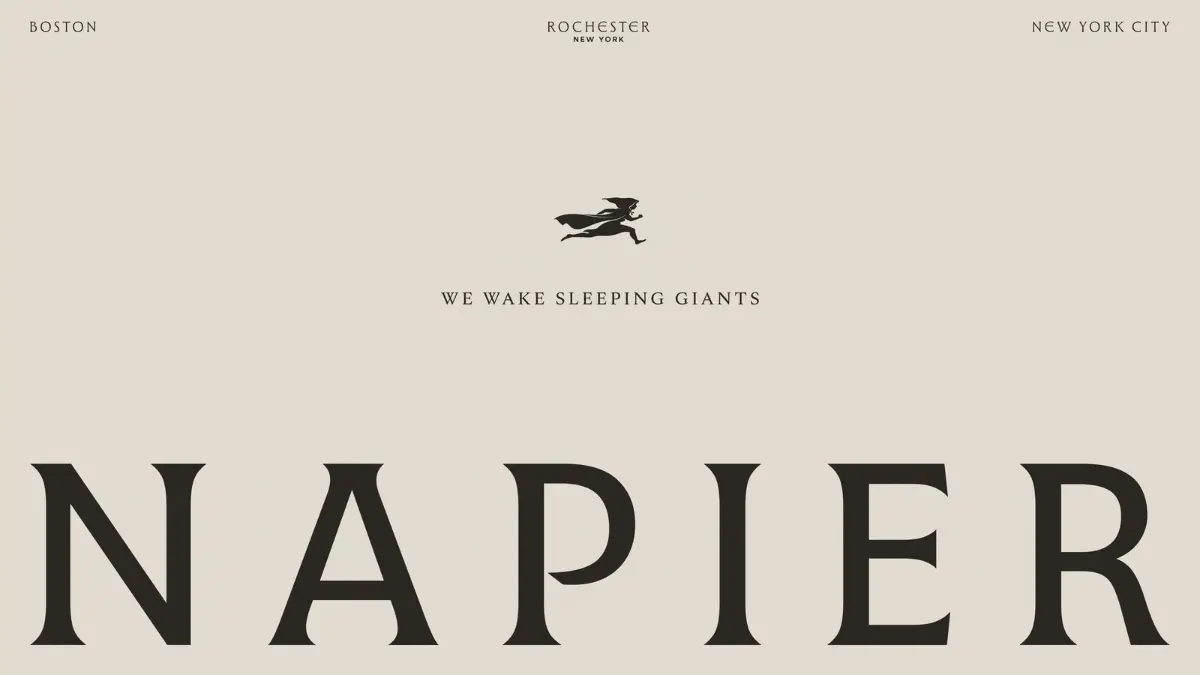
The leadership team ultimately selected the name NAPIER because it powerfully represented a specific mindset, attitude, and enduring spirit that had defined the organization since its inception in 2004. It honored the original founder who had risked everything because of an unwavering belief in her team, alongside the dedicated staff members who stood shoulder-to-shoulder with her to bring that vision to life. Throughout its history, the agency had consistently relied on its ability to outthink, outwork, and outshine competitors many times its size. By adopting the streamlined name, the organization found a way to own its historical roots in a fresh, contemporary manner—utilizing a simpler name that carried significantly more weight and operational power.
Alongside the streamlined naming convention, the agency also achieved a much sharper clarity regarding its ideal target clientele. Rather than pursuing every single emerging challenger brand in the marketplace, leadership consciously narrowed their strategic focus toward what they term "sleeping giants"—established brands that possess exceptionally strong equity or massive scale, but which are currently failing to realize their full market potential. These are corporate entities that need to break free from comfortable, familiar operational patterns and learn to move through the marketplace differently. While that high-impact approach represents what the agency has historically done best, the new brand positioning provides a much sharper, more compelling way to articulate those core strengths to prospective clients.
Following months of careful planning, internal alignment, and creative development, the transition became official. After operating for 22 years under the familiar moniker Partners + Napier, the agency formally unveiled its brand-new name, visual identity, and strategic market positioning. For longtime leadership, watching the comprehensive rebrand transition from abstract internal discussions into a vibrant, living market presence has been a surreal experience. More importantly, it has powerfully validated the foundational leadership belief that organizational growth stems from leading with abundance.
Achieving true long-term success requires an agency to possess a razor-sharp understanding of what makes it genuinely special, while simultaneously having the humility and confidence to give others the room to discover possibilities that leadership might not have initially seen. That collaborative approach is precisely how an enterprise is built to continue growing long after the original founders have stepped away, ultimately transforming a successful business into a lasting industry legacy.
As an organization firmly rooted in the daily business of building, launching, and revitalizing brands, the agency routinely challenges its corporate clients to maintain firm conviction, embrace necessary evolution, achieve absolute clarity about their identity, and make bold strategic choices that clearly set them apart from their competitors.
Industry veterans argue that agencies should be entirely willing to hold themselves to that exact same rigorous standard.
For fellow agency leaders navigating the complexities of the modern marketing landscape, the overarching message is clear: do not wait for a major business disruption or an economic downturn to take a fresh, critical look at your own corporate brand. Furthermore, never assume that simply because you intimately understand what makes your particular agency unique, the rest of the industry or your prospective clients automatically understand it as well.
Instead, agency executives are encouraged to invest the exact same level of meticulous attention, creative energy, and strategic rigor into their own corporate brands that they would routinely dedicate to their most important, high-value clients.
At the same time, founders must consciously provide the talented professionals they have brought into their businesses the operational freedom and creative space necessary to make the enterprise even better than it was before.