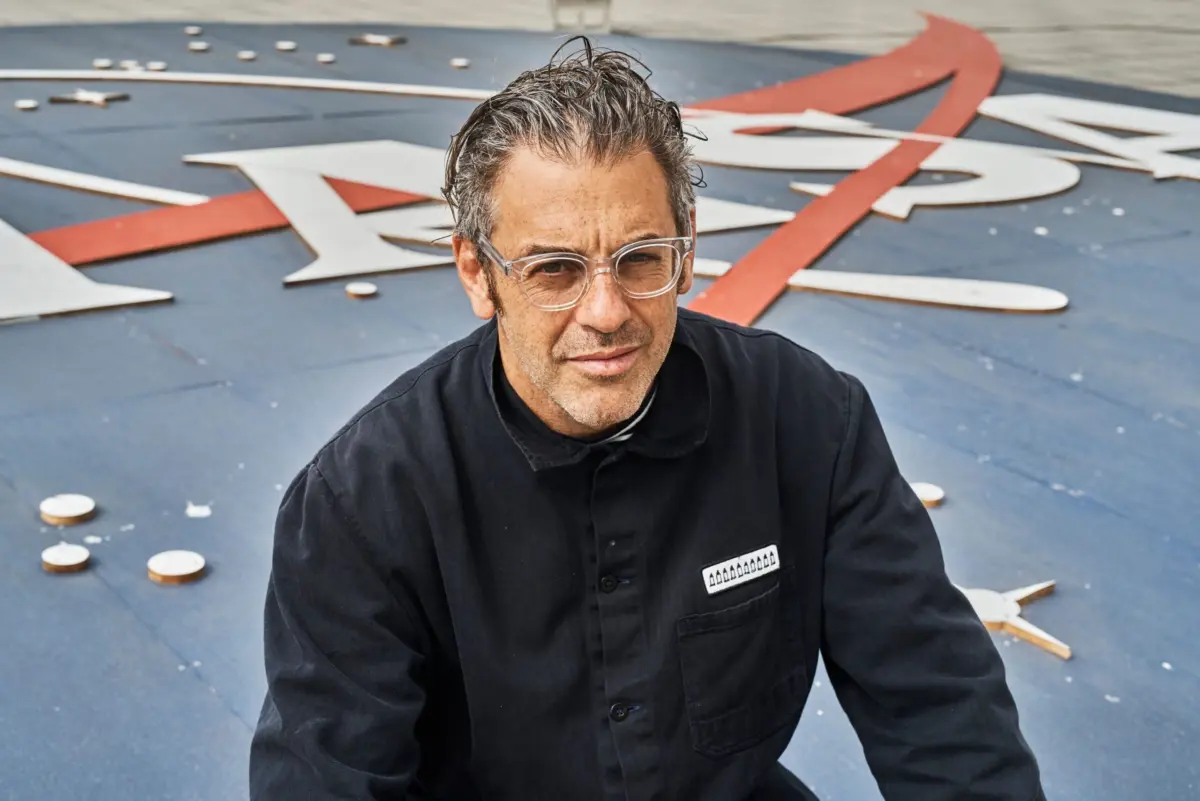
Tucked away in the bustling streets of lower Manhattan, sculptor and bricoleur Tom Sachs runs a workshop that looks less like a traditional fine art studio and more like a high-stakes, meticulously organized laboratory. Cabinets, shelves, work tables, and custom sorting systems line the warren of rooms, where every single tool has been thoughtfully altered or integrated into a grander scheme. Even the humble drill press has undergone a heavy mechanical makeover, featuring twin machine lamps spidering off the top, a cleaning brush mounted on a retracting cord, and a chuck key paired with a center punch stuck securely to magnets on its face. For Sachs, these intricate rituals and customized setups are not mere organizational quirks—together, they represent a deeply considered philosophy of work.

Sachs prefers to describe himself as a bricoleur, a term denoting someone who cobbles together functional contraptions out of received or collected materials. A decade ago, the contemporary art world began taking serious notice of his provocative, subversive sculptures, which have included a cardboard hand grenade housed inside a mock Hermès box, and a Glock pistol decorated and branded as a luxury Tiffany item. Today, Sachs and his dedicated 12-person studio team mount ambitious, large-scale museum exhibitions across the globe, capturing the unwavering loyalty of art enthusiasts and collectors alike.
On a typical studio visit, the atmosphere hums with anticipation as the team preps for a major installation at San Francisco’s Yerba Buena Center for the Arts. The project, a simulated space mission to Jupiter’s icy moon Europa—a celestial body scientists believe might harbor alien life—marks the third installment in Sachs’ acclaimed Space Program series. The exhibition features two assistants playing the roles of astronauts, embarking on a simulated voyage inside a hand-built plywood mock-spaceship. As the studio buzzes with activity, assistant Sam Ratanarat works carefully to stabilize a custom cart the astronauts will wheel out onto the alien surface, a task requiring precise titanium welding.

Sachs inspects the work, offering praise for Ratanarat’s first weld. "Talk about material bragging rights," he remarks. "Titanium is up there!" Yet, despite his appreciation for high-grade materials, Sachs is eager to overhaul the studio’s older equipment, eyeing a beat-up MIG welder with skepticism. When he suggests getting rid of it, Ratanarat responds protectively, noting its utility in day-to-day operations.
While his team handles the heavy infrastructure, Sachs focuses on smaller, edgier details tailored specifically to the narrative of the upcoming mission. Reflecting on past projects, he recalls how Spyderco manufactured white Delica folding knives for an earlier moon mission, which Sachs then engraved with the iconic 1970s NASA logo. Europa, however, demands an entirely different tool and a much darker narrative context.

"Europa is a mission about imperialism. We go to another planet, find some Europans, and abduct them," Sachs explains. "So what’s the knife of colonialism? A machete!" True to form, he is currently milling his own version from a discarded Japanese lawn-mower blade. With three concurrent shows in New York and the impending Europa landing exhibition in San Francisco, Sachs stands at the peak of a two-decade career defined by cobbled-together, rough-edged, and joyful contraptions that have cemented his status as arguably the most famous bricoleur in the world.
Sachs’ unconventional path to artistic renown began in his youth. Described as a peculiar child who bought his clothes at Goodwill and had them tailored, he struggled academically, earning poor grades, failing to fit in socially, and ultimately repeating the ninth grade. Miraculously, he gained admission to Bennington College, where a senior named Babs taught him how to weld and introduced him to the profound works of Brancusi and Richard Serra. Though a brief romance ended abruptly when she left him for another student, the encounter fundamentally altered his creative trajectory. She introduced him to a more complex way of working—creating physical objects while engaging in political and social discourse about how those objects function within the rituals of daily life. He nursed his heartbreak in the workshop, leaning heavily into the sparks of an angle grinder.

Years later, filmmaker and fellow space enthusiast Tom Hanks helped bridge the gap between Sachs and writer Adam Savage, who had stumbled upon a video of Sachs’ simulated Mars landing mission. Discovering a shared obsession with meticulous organization, building replicas, and fabricating workshop infrastructure during moments of creative block, Savage and Sachs quickly formed a unique bond. Savage’s own longtime hobby involves building hyper-accurate replicas of cinematic artifacts from movies and television shows, such as the pistol from Blade Runner, spacesuits from Alien, and the mecha-glove from Hellboy.
When Savage looks at Sachs’ workshop, the familiar tools speak to a shared creative language, but the underlying motivations diverge slightly. While Savage builds props to converse with his ten-year-old self and enter beloved fictional narratives, Sachs endows his younger self with an infinite supply of art supplies and sets him loose to play. Sachs weaves narratives directly into the raw construction of his pieces—revealing the exposed edges of plywood, visible screwheads, greasy fingerprints, and accidental tool marks. The objects proudly declare that they are handmade, turning the very rituals of manufacture into stories about the artist himself.

This philosophy extends directly into Sachs’ immersive public performances, such as the elaborate tea ceremonies he stages for museum donors and guests. Transported to a teahouse constructed of plywood and resin at the Noguchi Museum just outside Manhattan, participants shed their modern lives, locking smartphones and wristwatches into a Faraday cage while donning makeshift sandals cut from sneakers. Sachs serves as tea master, earnestly frothing matcha and pouring water while subverting tradition by offering participants smoke from a homemade pipe, sake served in stacked plywood vessels coated in resin, and snacks like Oreos and peanut butter-topped Ritz crackers.
The blend of rigid tradition and irreverent hardware mirrors Sachs’ fascination with NASA and the space program. Whether people are drawn to astronomy for navigation, existential philosophy, or hardware and rockets, Sachs admits his own primary attraction lies in the physical gear. "I think if I were to be honest with myself, I’m more about the hardware," Sachs notes. "लेकिन इसका मतलब यह नहीं है कि…"—or rather, as he emphasizes, the hardware means nothing without the ritual that surrounds it.

That dedication to ritual and the high potential for failure is precisely what powers Sachs’ Space Program exhibitions, earning the genuine respect of actual NASA roboticists and engineers who appreciate the authentic technical lineage hidden beneath the roughly cut plywood and half-worn paint. The upcoming Europa mission features a grueling sequence of events: astronauts emerging from a quarantine trailer, transferring via scissor lift to a landing module, and executing a model rocket liftoff filmed with miniature cameras to mimic real NASA launches.
If an astronaut fails the interactive Lunar Lander arcade game used to simulate touchdown, a television screen will project a recorded speech by a Richard Nixon impersonator that was originally prepared in the event the Apollo astronauts perished. If successful, the crew will step out onto the gallery floor—their spacesuits cooled by ice-water tanks hidden in backpacks—to drill through an icy pool, capture alien sea life, and inevitably face the logistical challenge of feeding their findings to the audience without drawing the ire of animal welfare advocates.

The meticulous preparation, the potential for mechanical failure, and the sheer physical toll of setting up exhibitions that run for only a few days highlight Sachs’ unwavering commitment to his craft. For him, the deep philosophical questions about space exploration are secondary to the tactile satisfaction of making things with his own hands. "I love getting my hands dirty. I only feel good if I have a cut somewhere," Sachs says. "If I have a little burn, it means that I’m probably doing something right."
That shared ethos of making recently culminated in a collaboration between Sachs and Savage to build replicas of the lunch box carried by character Heywood Floyd in 2001: A Space Odyssey. While Savage approached the project with refined fiberglass, machined hinges, and NASA-sourced Mylar insulation, Sachs crafted his version out of raw plywood, visible screws, and resin with deliberately rough edges. Both objects achieved accuracy, yet each distinctly reflected its creator.

For Sachs and fellow makers, the ultimate validation of art is the reluctance to let a piece go once it is finished. When the labor of cobbling together everyday materials results in an object that hurts to part with, you know you have truly made art.