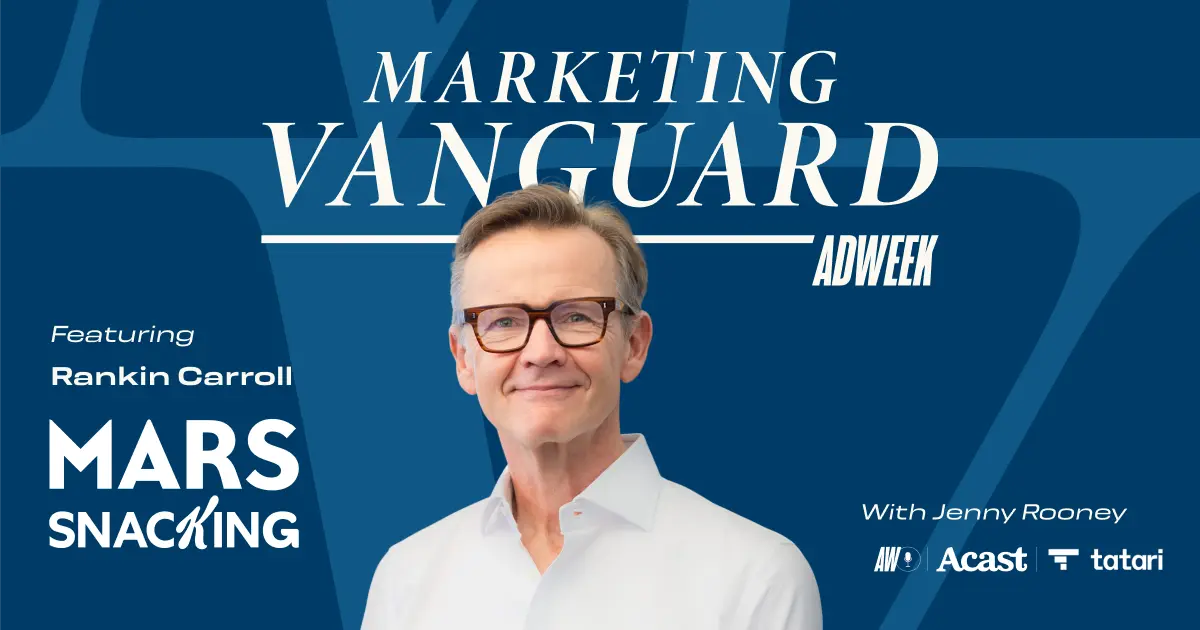
The best creative risks should always make a brand team feel a little nervous, but they should never force a company to question why it is taking them in the first place. That was the central premise delivered by Rankin Carroll, chief brand officer of Mars Snacking, during a live appearance on the Marketing Vanguard stage at Brandweek 2026. Sitting down for a special vidcast conversation hosted by Jenny Rooney and presented in partnership with Tatari, Carroll unpacked the delicate mechanics of keeping some of the world’s most recognizable confectionery and snacking brands—including M&M’s, Snickers, and Skittles—culturally relevant without letting boldness bleed over into reckless corporate chaos.
Throughout the session, Carroll took the audience behind the scenes of some of Mars’ most ambitious modern campaigns, offering a candid look at the real-world friction of digital experimentation. He dissected the company’s steep learning curve when working with digital creators, the psychological barriers of deploying emerging technology, and the profound responsibility modern marketing leaders hold toward the next generation of professionals as the industry undergoes a rapid, technology-driven transformation.
The Snickers AI Bet That Looked ‘Potentially Crazy’
Among the most revealing stories of the session was a look back at 2023, when Mars placed Snickers directly into an agentic creative experience. At the time, the safety, brand-safety, and reputational risks associated with generative and agentic technologies were far less understood than they are today. To most traditional corporate risk managers, the concept felt genuinely perilous.
Carroll recalled that the initiative required a massive, coordinated effort involving roughly ten separate technology partners, alignment from legal and security leadership, and the meticulous compilation of a list containing 8,000 blocked words to safeguard the brand’s reputation. Rather than offering a simplistic lesson on the virtues of taking more risks, Carroll’s takeaway was far more sophisticated. He emphasized that ambitious, cutting-edge experimentation only becomes possible when an entire organization commits to solving complex operational and security risks collectively, rather than leaving the marketing department to navigate the danger zone alone.
Earn the Right to Take Risks
When discussing how iconic brands maintain their edge in a polarized and fast-moving cultural landscape, Carroll drew a sharp, uncompromising line between calculated cultural risk and performative brand behavior. He pointed to Skittles and its sustained, long-term relationship with the LGBTQ+ community as a prime example. The brand was able to maintain that vital relationship during a notably volatile political and social period precisely because it had spent years building genuine credibility and equity within that community long before it became a trendy marketing checkbox.
To prevent teams from leaping blindly into cultural conversations where they do not belong, Carroll relies on a strict filtering process for every major marketing swing. The criteria are disarmingly simple: Why us? Why this brand? If the internal strategy team cannot produce a convincing, authentic answer to those two questions, the idea is immediately shelved, regardless of how much short-term attention it might generate. For Carroll, true brand stewardship means protecting what makes these century-old products valuable, ensuring they are handed over to the next custodian stronger than they were received, and still creating enough healthy strategic tension to keep them firmly embedded in modern culture.
Are We Preparing the Next Generation for What Marketing Becomes Next?
Shifting the conversation toward the human element of the industry, Carroll raised one of the most uncomfortable and urgent questions facing leaders at Brandweek 2026: what actually happens to junior marketers when the profession itself is being rewritten around artificial intelligence and automated systems?
Carroll acknowledged openly that he does not yet have a fully satisfying answer for how entry-level professionals should be trained for an environment that will look completely different within the next three years. However, rather than viewing this skills gap as a distant human resources problem, he framed talent development as an urgent, non-negotiable leadership responsibility. If the baseline skills required to enter the marketing industry are shifting beneath our feet, senior leaders must take an active role in redefining how the next cohort of brand stewards learns to think strategically, manage technology, and exercise creative judgment.
‘A Thousand Pilots and No Progress’
Addressing the chaotic reality of corporate technology adoption, Carroll issued a direct warning to fellow marketing executives. He believes that leaving artificial intelligence adoption to disconnected enthusiasts and siloed innovators scattered across various departments is a guaranteed recipe for corporate disorder.
According to Carroll, modern chief marketing officers must firmly own the technology and innovation agenda in close partnership with chief information and technology officers. This requires bringing top-down clarity to capital investment, setting definitive operational priorities, and establishing a clear framework for what the company should build, buy, rent, or borrow. His ultimate caution to the industry was a reminder of strategic discipline: just because a brand technically can use artificial intelligence in a given workflow does not automatically mean that it should.