For Albert Kriemler, the creative director of the storied Swiss fashion house Akris since 1980, the worlds of high art and luxury fashion have never been mutually exclusive. Growing up as a teenager in a family of fashion entrepreneurs who founded Akris, Kriemler spent his formative years traveling alongside his family to international fabric fairs. During these trips, he was occasionally given the rare privilege of attending the legendary runway shows of Yves Saint Laurent. Those early experiences left an indelible mark on the young designer, particularly Saint Laurent’s groundbreaking art-inspired collections that effortlessly brought the masterpieces of iconic painters like Vincent van Gogh, Georges Braque, and Piet Mondrian to vibrant life on the runway.
Given that early exposure, it is hardly surprising that Kriemler has consistently turned to the art world throughout his decades-long career to nurture, challenge, and refresh his creativity. Rather than treating art as a mere aesthetic reference point, he has spent decades forging deep, collaborative relationships with painters, sculptors, photographers, and textile artists. These partnerships have fundamentally shaped the trajectory of Akris, steering the brand away from predictable commercial formulas and into a realm where high-end ready-to-wear functions as a living canvas.
His vibrant and striking fall 2026 Akris collection serves as a prime example of this philosophy in action. The collection was the direct fruit of an intensive collaboration with Colombian artist Olga de Amaral. De Amaral, renowned for her monumental, large-scale textile installations frequently covered in shimmering gold or silver leaf, emboldened the Swiss designer to step far outside his traditional comfort zone. Known primarily for a sophisticated aesthetic rooted in luxurious understatement, Kriemler used the collaboration to push boundaries, embracing a level of uninhibited shine, color, and rich texture that electrified the Paris runway.
Kriemler first drew a direct, institutional line between his fashion designs and the contemporary art world during the brand’s milestone first Paris runway show in 2004. That foundational collection drew its poetic color palette and mood directly from the works of Swiss-French painter Félix Vallotton. That successful creative translation sparked a lasting passion. In the years that followed, Kriemler began actively collecting fine art, cultivating genuine friendships with working artists, and occasionally lobbying creators to partner with him on upcoming collections, effectively opening up his proprietary creative methods to their artistic scrutiny.
His dedication to these collaborations is absolute. When preparing to work with Olga de Amaral, Kriemler traveled all the way to Bogotá, spending several immersive days visiting the then-94-year-old artist at her home studio, deeply soaking up the wisdom of her decades-long mastery of craft.

A Broader Base of Inspiration
Reflecting on the profound impact of these creative exchanges, Kriemler explains how deeply they influence his design process. "I found out that when you get involved in an artist’s work and how she does art, that you get a much broader base for inspiration. You learn how she thinks about color, how she thinks about light, how she thinks about proportion," he shares.
Such close-knit artistic tie-ups have repeatedly unlocked Kriemler’s most experimental tendencies. Perhaps the most dramatic manifestation of this occurred during the development of his fall 2014 collection, which featured stunning dresses and tailored pieces embedded with cutting-edge LED technology. The glowing, futuristic garments were created to evoke the mesmerizing "Stars" photography series by acclaimed German photo artist Thomas Ruff.
Recalling the discovery with fresh excitement, Kriemler notes how he learned that Forster Rohner, a prominent fabric house located right in Akris’ hometown of St. Gallen, was simultaneously incubating a burgeoning practice in electronic-enabled embroideries. The convergence of high fashion, advanced engineering, and fine art opened up entirely new creative horizons for the brand.
"It’s always interesting when you can infuse new technologies into the workmanship process, because you create a new appearance," Kriemler says. "It’s like a new playground."
While major global fashion conglomerates routinely forge partnerships with heavily established, blue-chip artists for marketing splash, Kriemler possesses a rare and discerning knack for seeking out under-the-radar, overlooked, or on-the-cusp talents, consistently trusting his own sharp instincts rather than following market trends. Over the years, he has successfully shone an international spotlight on Reinhard Voigt’s intricate, pixelated oil paintings, the striking abstract color planes of Cuban-American artist Carmen Herrera, and the playful multimedia hijinks of Rodney Graham. Crucially, Kriemler does not simply transpose their artworks onto standard garments as a flat print; instead, he allows the foundational structural principles, proportions, coloration, and underlying spirit of the art to directly inform the architecture of his designs.

Intriguingly, Kriemler was initially drawn to Olga de Amaral’s expansive body of work because of the artist’s characteristic penchant for utilizing horsehair—a distinctive material that serves as a vital linchpin for Akris luxury handbags and is occasionally incorporated into the brand’s tailored jackets. This material bridge provided an organic starting point for an artistic dialogue that ultimately transformed the fall 2026 runway.
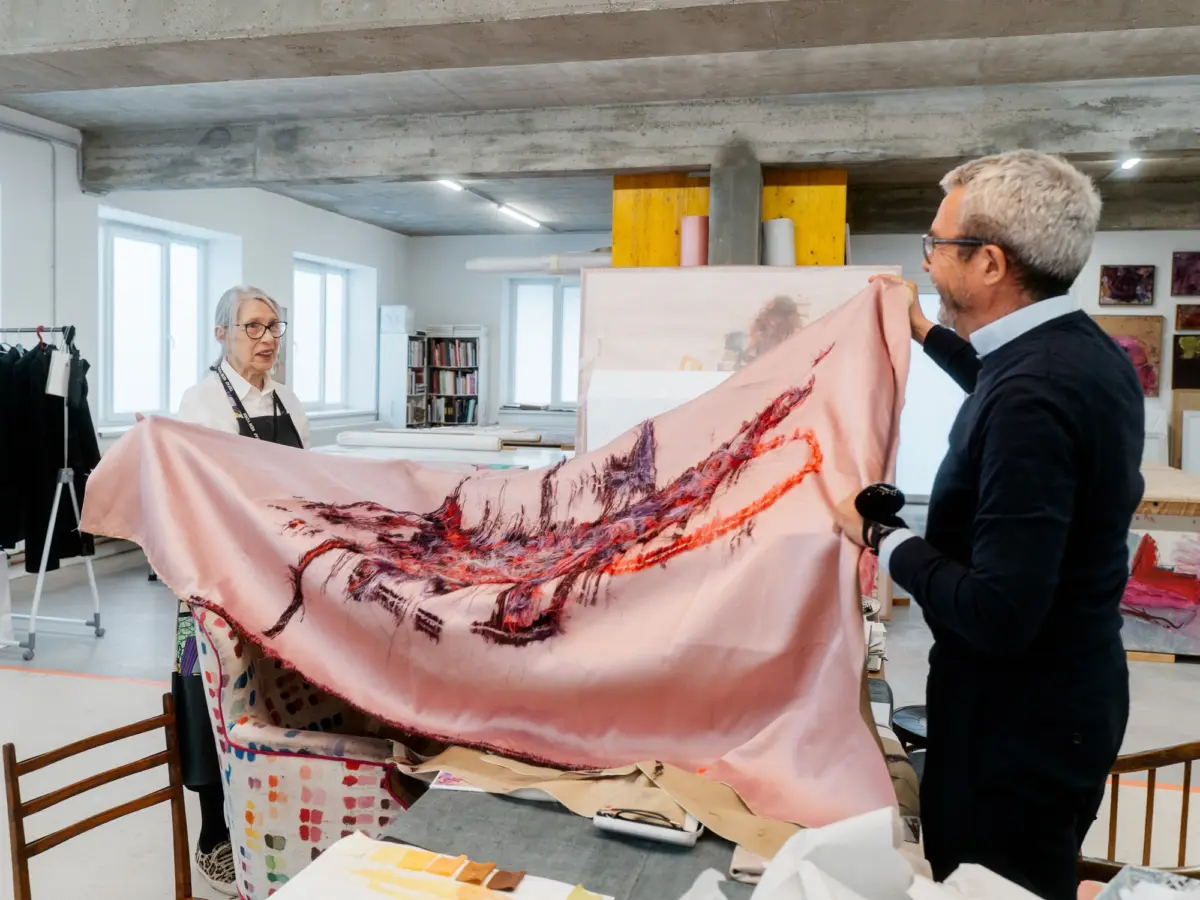
Similarly, Martha Jungwirth, the celebrated Austrian artist who served as the primary muse for the Akris spring 2027 collection, instantly pulled him in with her uniquely expressive painting style and her fearless approach to color.
"But what I loved always is that she works not on white canvas like a lot of artists. She uses a natural linen canvas always, and that’s always part of her work," he enthuses, marveling at the technical integration of texture and support.
Kriemler first encountered Jungwirth’s powerful paintings at the Thaddaeus Ropac gallery roughly five years ago, and his dedication to experiencing art firsthand was demonstrated when he traveled expressly to Bilbao, Spain, two years ago just to catch the major, comprehensive Jungwirth retrospective hosted at the Frank Gehry-designed Guggenheim museum.
Enjoying the Unexpected
For Kriemler, experiencing art is not a scheduled corporate chore, but an organic lifestyle and a constant source of renewal. He makes it a point to visit local galleries, independent spaces, and major art museums whenever he travels internationally for business or pleasure. To maintain focus and quiet reflection, he often times his visits for precisely one hour before closing time to avoid long queues and heavy crowds. This contemplative approach has frequently rewarded him with unexpected, breathtaking discoveries, such as stumbling upon a quiet, exquisite Vilhelm Hammershøi exhibition back in 2019 at the Musée Jacquemart-André in Paris.

"I’ll never forget that moment: An artist I’d never heard about before, and then you get to see such an exquisite work," he says, recalling the serendipity of the encounter.
While Kriemler maintains a mental map of his usual haunts and favored cultural destinations across the globe, his foundational commitment remains anchored to a lifelong pursuit of aesthetic discovery, ensuring that the dialogue between Akris and the global art community will continue to evolve on runways for years to come.