For many Serbians, Sunday’s parliamentary elections will feel like a distinct novelty. It might be the country’s seventh such vote since 2012, but for the first time in 14 years, the final result will not be easy to predict.
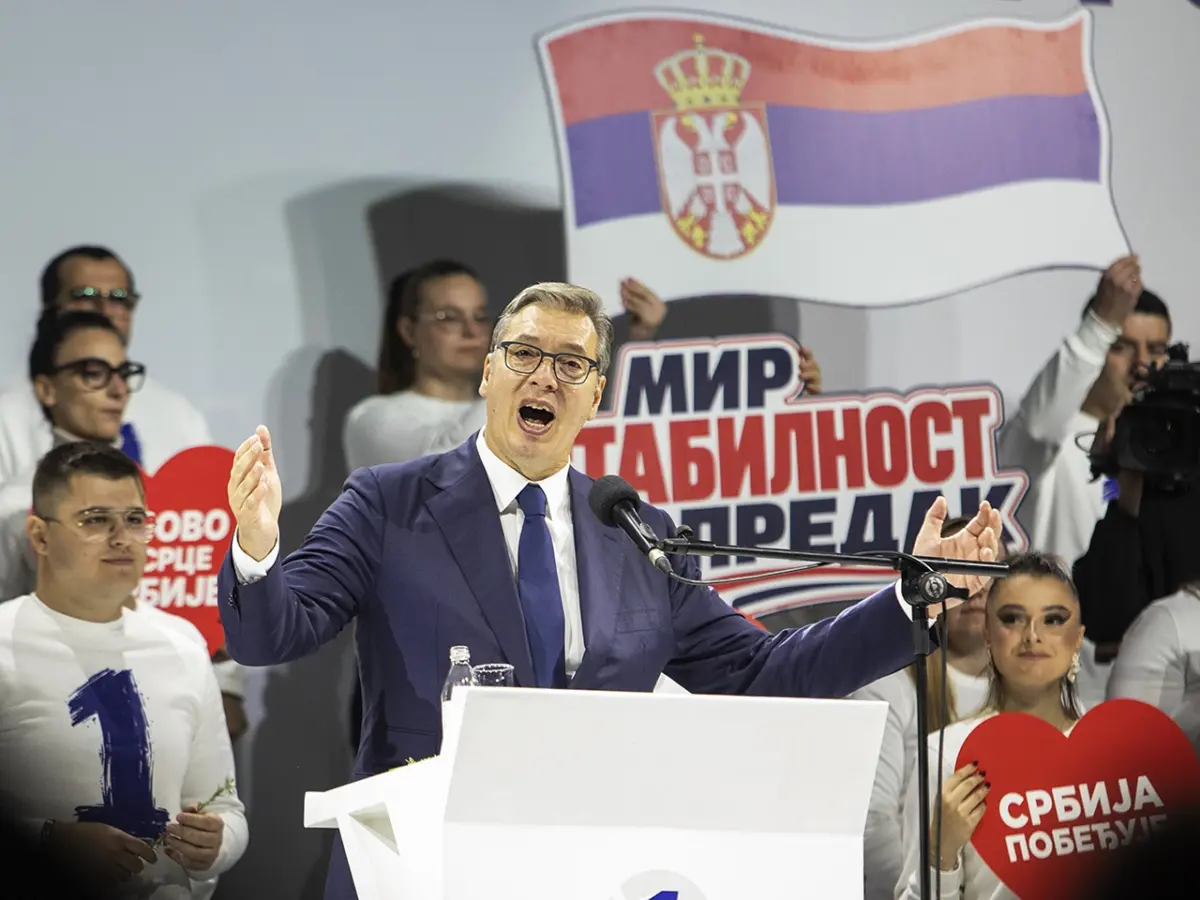
Aleksandar Vučić is facing an entirely unfamiliar challenge. None of the elections held since his Serbian Progressive Party (SNS) first entered government have featured a truly credible alternative proposition for voters. Whether serving as president or prime minister, Vučić has remained the undisputed man in charge, tightening his control over so many facets of government that critics mockingly dubbed him "Superman." Meanwhile, Vučić-friendly media outlets enthusiastically embraced the label, portraying him as the tireless, sleepless protector of the Serbian people.
This time around, however, the political landscape has shifted dramatically. Most traditional opposition parties have stepped aside to allow a clear run for the Student List, a dynamic grassroots anti-corruption movement fielding candidates to run directly against the entrenched former president. In a tactical maneuver that indicates a political wisdom well beyond their years, the students have deliberately chosen not to put themselves forward as a potential ministerial government. Instead, they have nominated uncontroversial academics and respected athletes, alongside a judicious mix of experienced economists and engineers.
At the very top of this candidate list is heart surgeon Ilija Srdanović. If the Student List manages to secure a victory on Sunday, Srdanović stands as the most likely candidate to become the country’s next prime minister. On the campaign trail, Srdanović has proven himself to be a remarkably snappy dresser with a quick wit to match. Yet, much like the rest of the Student List, he possesses zero prior political experience. The movement’s leadership insists that this outsider status is a core strength rather than a fatal weakness. Drawn from a wide and diverse range of professional backgrounds, these student-approved candidates remain crucially untainted by the persistent suspicion of corruption and cronyism that has long clung to most of Serbia’s established political class.
However, the unprecedented nature of the opposition is not the only formidable obstacle that Vučić must contend with. His political kryptonite is arguably the tragic event that originally served as the primary catalyst for the student-led protests. In November 2024, sixteen people tragically lost their lives when a heavy concrete canopy suddenly collapsed at a railway station in Novi Sad, Serbia’s second-largest city. This catastrophe did not involve some forgotten, crumbling piece of ex-Yugoslav architecture; rather, it was a central, high-profile component of Vučić’s own signature infrastructure initiative—the ambitious high-speed railway project designed to seamlessly link Belgrade to Budapest.
Distancing himself from the political fallout of this disaster was always going to be an insurmountable challenge for the incumbent leader. Just two years prior to the tragedy, Vučić had hosted a massive, celebratory public rally at the grand re-opening of the very same facility, standing proudly alongside Hungary’s Prime Minister, Viktor Orbán. From the top of that ill-fated station canopy, the central message delivered during the speeches was crystal clear: the new railway project was intended to transport the country rapidly into a modern future, and voters could firmly trust Vučić to be the strong man behind the wheel.
Above all else, this carefully projected image of competence, strength, and delivery has been the cornerstone of Vučić’s long-standing electoral success. Over the years, political detractors and international election monitors have correctly highlighted the SNS’s overwhelming domination of national media coverage, as well as its recurrent use of state resources to artificially boost its share of the vote at the ballot box. Yet, despite these criticisms, a significant proportion of Serbia’s electorate simply liked the cut of Vučić’s jib. As long as they perceived him as a decisive, strong leader who was visibly making daily life better across Serbia, they were more than willing to look the other way when confronted with persistent allegations of democratic backsliding and authoritarianism.
The fatal disaster in Novi Sad, however, has significantly and perhaps permanently dented Vučić’s carefully cultivated public perception. Now, the overarching question facing the nation is whether the Student List will finally be able to capitalize on the former leader’s newly tainted image where so many other traditional opposition movements have consistently failed. In response to the rising pressure, Vučić has formally resigned his position as president so that he can directly lead the SNS’s slate of candidates for the upcoming parliamentary battle. In essence, he is gambling everything on the desperate hope that enough of his enduring "Superman" aura still remains to carry him through.