The world of architecture was once brimming with radical ideas and cutting-edge design, serving as a cultural frontier where utopian visions, social engineering, and technological breakthroughs collided. Today, however, that spirit of daring innovation appears to have evaporated, replaced by a cautious, inward-looking consensus. The homogeneous, risk-averse projects that now sweep up the industry’s most prestigious awards are not merely a reflection of changing tastes; they are a glaring sign of the times, exposing an industry that has lost its appetite for genuine excitement and bold experimentation.
Once upon a time, describing the Royal Institute of British Architects’ (RIBA) Stirling Prize—the UK’s highest accolade for building of the year—as a moment for "auto-erotic self-congratulation" felt like a sharp critique of institutional vanity. But the reality of recent winners suggests something far worse: an industry that has lost its last shred of imagination. Architectural excitement has become entirely tangential to the awards process. Instead, prizes such as the Stirling function as routine virtue-signalling exercises, awarded not for groundbreaking spatial poetry or tectonic brilliance, but to designs that a jury of peers can point to and tell the wider world are simply "Good Things."
Last year, the prize went to housing for the elderly in the form of the Appleby Blue Almshouse. The year before that, the judges threw their weight behind public infrastructure, celebrating London’s Elizabeth Line. Yet even when evaluated strictly on their own therapeutic terms, these celebrated projects reveal a startling lack of substance upon closer inspection. The Elizabeth Line, which stands as the most expensive completed public-infrastructure project in British history, already looks battered and worn. This premature degradation occurred because the architects chose a porous cladding material that proved fundamentally impossible to repair. Consequently, Transport for London has been left to patch up the multi-billion-pound marvel using faux-concrete-effect stickers. Despite this glaring dereliction of duty to the public purse, award judges were more than happy to overlook structural shortcomings to cleanse their collective professional conscience.
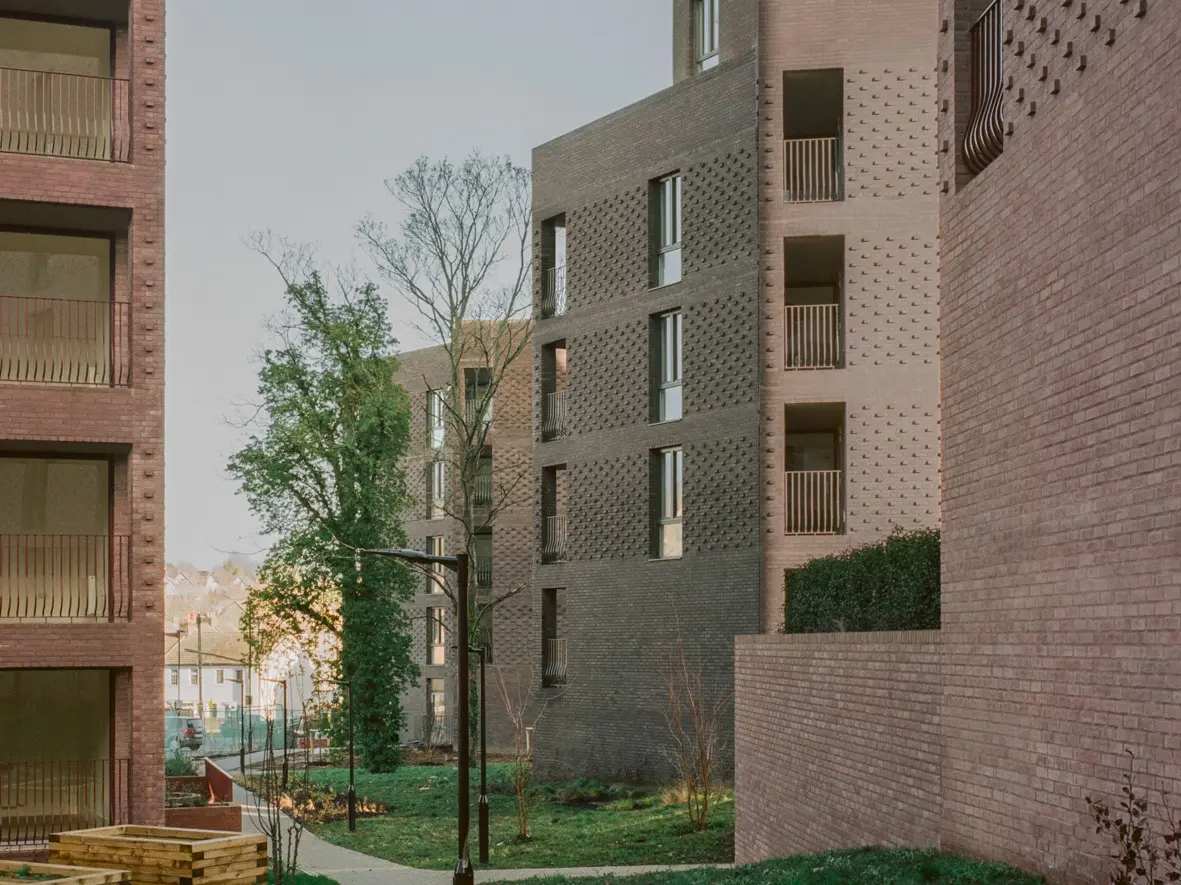
This year, the coveted trophy was handed to Lion Green Road, a residential development designed by Mary Duggan Architects in collaboration with Ruff Architects. The judging panel rushed to laud the project for "addressing the pressing need for national housing," conveniently ignoring the logical reality that virtually any new social housing development, completely regardless of its architectural merit or lack thereof, achieves this feat by definition. It is a baseline expectation of building, not an extraordinary design achievement worthy of national celebration.
Architects have long flattered themselves with the romantic notion that they might single-handedly solve complex socio-economic issues like the housing crisis. From the rise of modular construction to elaborate self-built community systems, architectural history has constructed a centuries-spanning pile of grand ideas aimed at socially re-engineering the nuclear family. Yet the grand contribution of this year’s Stirling Prize winner to this vast intellectual lineage boils down to a "considered arrangement" of brick blocks, officially cited by the panel for its "generous daylight," "open views," and "connection to nature."
To anyone familiar with the twentieth-century canon, these descriptions sound an awful lot like Le Corbusier’s classic "essential joys" of modernist urbanism: sun, space, and greenery. The last time these concepts were genuinely radical propositions was when they were first formulated some ninety years ago. Even the "sculpted," angled facade of Lion Green Road feels like a less-than-coincidental stylistic echo of Frederick Gibberd’s historic The Lawn, which stands as the United Kingdom’s very first residential tower, completed back in 1951. If this routine apartment block truly represents the absolute best of the best that contemporary British architecture has to offer, it is an implicit admission that twenty-first-century design is firmly stuck on rinse and repeat.
Fortunately, public opinion remains a reliable force capable of popping the insular bubbles of architectural elites. One sharp-eyed observer responding to this year’s award announcement captured the prevailing public sentiment perfectly, asking, "Am I missing the point? How is this any different from any new beige housing in London?" The disconnect between the profession and the public it purportedly serves is stark. The fact that the BBC has long since given up on televising the Stirling Prize due to dismal ratings means that yet another golden opportunity for architecture to sit at the forefront of the broader public conversation has quietly gone down the drain.
Awarding the nation’s premier architectural prize to Lion Green Road represents another missed chance to engage the public imagination. But the architectural establishment continues down its insular path regardless, inviting the public to marvel at brickwork rendered in "three subtle shades of brown."