Renowned French designer Vincent Darré has brought his signature eccentric imagination and theatrical flair to Le Magnifique, a newly realized hotel situated on Rue de la Gaîté within Paris’s vibrant 14th arrondissement. Located in a neighborhood historically celebrated for its lively cabarets, theaters, and rich artistic pedigree, the property transforms contemporary hospitality into an immersive, multi-sensory experience deeply rooted in fantasy, classical mythology, and the performing arts.
The building itself carries a rich and unusual architectural history. It originally housed Les Mille Colonnes, a prominent and celebrated theater dating back to the early nineteenth century. Today, its historic, preserved façade serves as a grand portal introducing visitors to a series of elaborate interiors where unexpected color palettes, intricate decorative elements, and distinct nods to Parisian cultural heritage unfold across every floor.
The ambitious hospitality project was initiated in 2024 by visionary hotelier Jacques Blanc, who sought to break away from conventional hospitality design paradigms. Already renowned as the owner of the Bellechasse, a distinct Parisian boutique hotel designed by Christian Lacroix, Blanc approached Darré following an introduction through mutual friends. The ensuing collaboration developed around a shared ambition to forge something deliberately unconventional and daring. As the creative dialogue deepened, Darré’s initial concepts expanded significantly in scope, ultimately culminating in the inclusion of a dramatic, highly customized swimming pool. For Darré—who was born in the 14th arrondissement and has spent a lifetime immersed in the cultural fabric of the Left Bank—the commission also served as a deeply personal opportunity to revisit the artistic landmarks and cherished memories of his childhood.
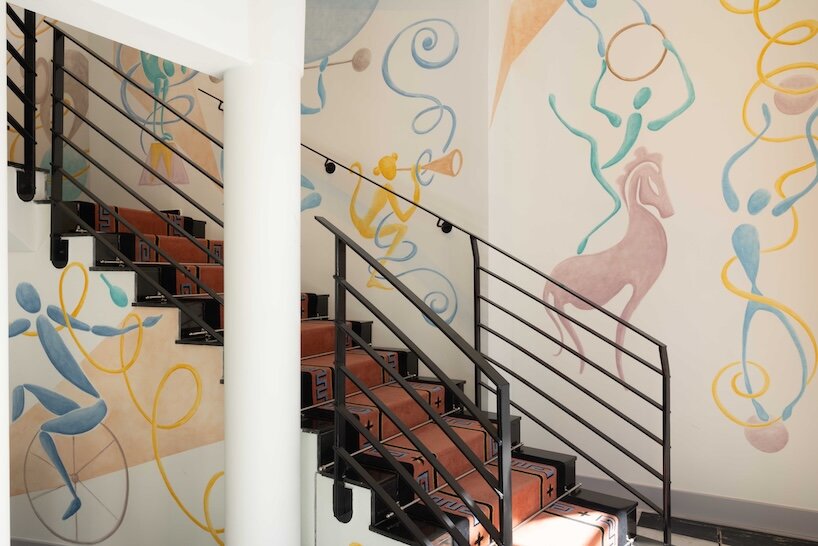
Hand-Painted Frescoes and Sculptural Details Animate Interiors
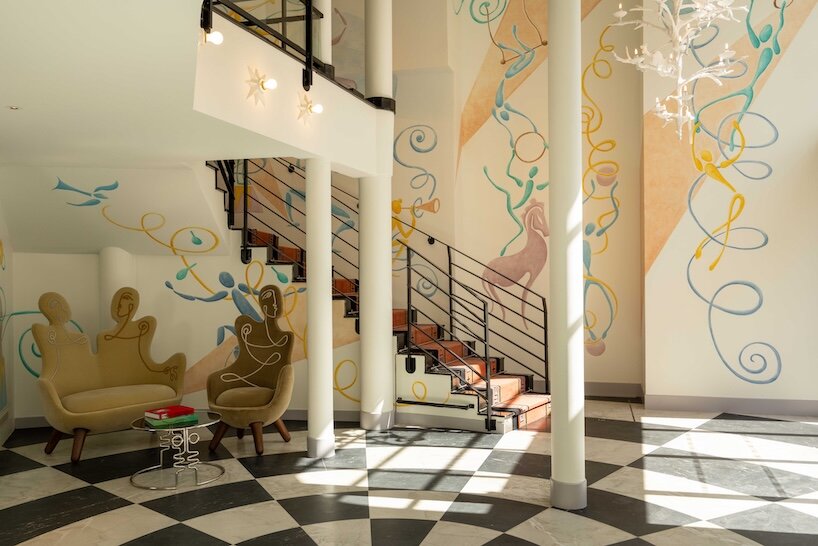
The theatrical narrative of the property begins immediately upon entry into the grand hall, where Darré reinterprets architectural motifs native to the surrounding neighborhood. The columns of the former nineteenth-century theater have been thoughtfully redesigned as a direct homage to those found inside La Coupole, the legendary Montparnasse brasserie, as well as the historic Saint-Germain-des-Prés drugstore, whose iconic columns were once famously crowned with oversized sculptural hands.
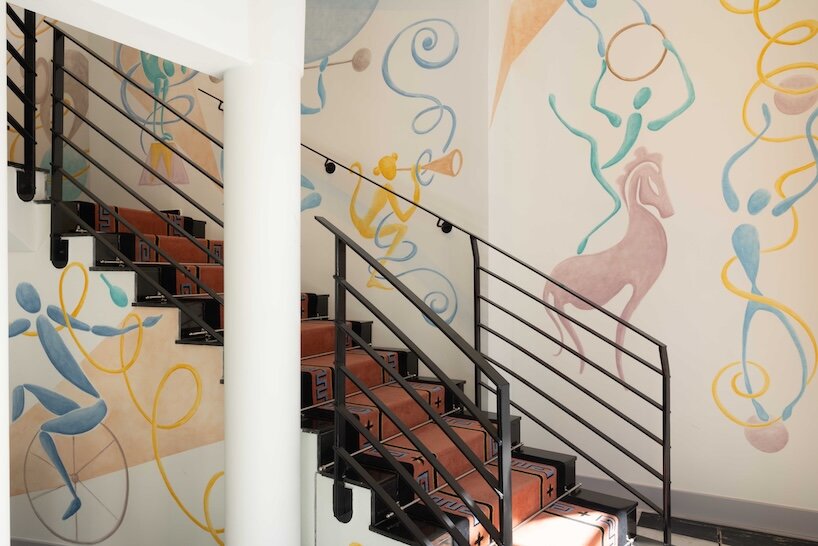
Spanning across the walls of the entrance hall is a large-scale, hand-painted fresco executed by skilled artisans. The composition introduces a vivid parade of colorful figures and swirling decorative motifs clearly inspired by the worlds of fine art and the classic circus. Whimsical white plaster birds emerge directly from the illustrated surfaces, lending an unexpected three-dimensional quality to the expansive walls.
Additional interior details sustain a continuous dialogue between structural architecture and narrative storytelling. The reception desk is meticulously adorned with a collection of antique keys gathered over time, evoking the traditional, tactile front desks of historic European grand hotels while introducing a playful theological nod to paradise and Saint Peter. Nearby, the custom staircase railings are styled to subtly evoke musical scores, gracefully connecting the physical act of moving through the multi-story building to the district’s rich heritage in the performing arts. These considered interventions establish an overarching visual language wherein functional architectural components are seamlessly absorbed into a larger decorative composition, drawing visitors directly into an idealized, cinematic version of Paris shaped entirely by Darré’s personal lexicon.
Le Picabia Bar and a Mythological Pool Celebrate the Performing Arts
At the beating heart of the hotel lies Le Picabia, a sophisticated bar named in honor of the French avant-garde painter Francis Picabia. The venue draws direct inspiration from the moody, seductive atmosphere of historic Parisian theaters. Clad entirely in rich wood paneling and illuminated by rows of warm, glowing bulbs, the space pairs a dramatic curved counter with deeply saturated color surfaces and intricate decorative flourishes reminiscent of classic backstage and auditorium interiors.
Designed to operate in harmonious rhythm with the active performance venues surrounding the hotel, Le Picabia displays real-time showtimes and features a traditional bell that rings to announce the beginning of theatrical performances and the conclusion of intermissions. A grand piano anchors the room, inviting spontaneous musical encounters and welcoming an eclectic mix of theatergoers, local neighborhood residents, visiting artists, and hotel guests alike.
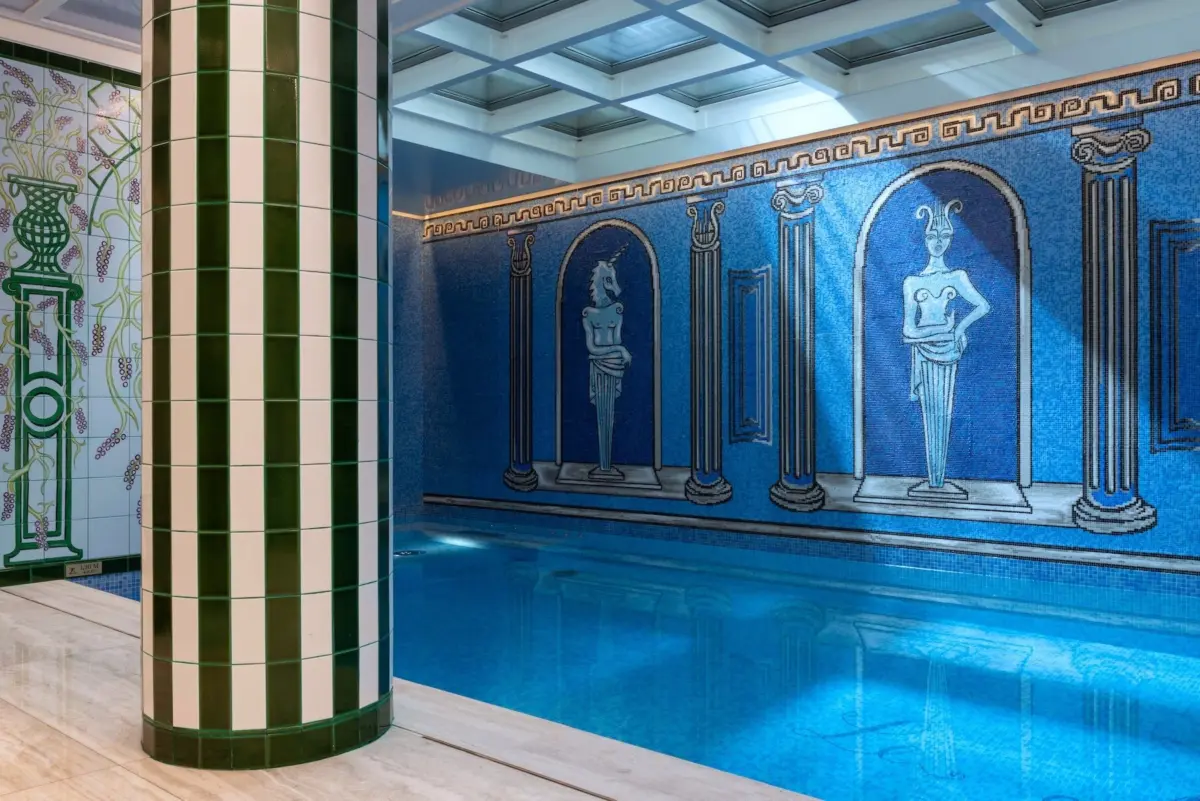
Perhaps one of the most striking and unexpected features of the property is its subterranean-style swimming pool, conceived as an intimate mythological retreat hidden within the dense urban fabric of the building. Clearly visible from the main reception area, the pool is framed by classical columns and embellished with intricate mosaics depicting timeless mythological figures, evoking the serene atmosphere of an ancient Greek palace. The shimmering, blue-tiled basin opens outward onto an internal patio, establishing a fluid visual connection between water, classical architecture, and lush greenery. This decorative treatment underscores Darré’s persistent desire to transport visitors out of the everyday and into imaginative realms, utilizing classical antiquity to extend the hotel’s narrative far beyond the local history of Montparnasse.
Five Themed Floors Reveal Darré’s One-of-a-Kind Guest Rooms
The journey through the property continues upward across five distinct floors, with each level conceived around an entirely unique imaginary universe. A glass-walled elevator—itself heavily decorated with motifs of mermaids, seahorses, and starfish—transports guests between spaces inspired by the Garden of Eden, classical mythology, the deep sea, Art Nouveau, the vast expanse of the Milky Way, and legendary artists from Paris’s storied creative past.
Rather than adhering to a uniform or repetitive decorative scheme, the hotel transitions fluidly between vastly different historical periods and visual reference points. Each level introduces an entirely new chapter in a larger spatial story, reflecting Darré’s overarching philosophy that interior design is fundamentally a form of immersive storytelling where architecture, ornament, and unbridled imagination remain inextricably linked.
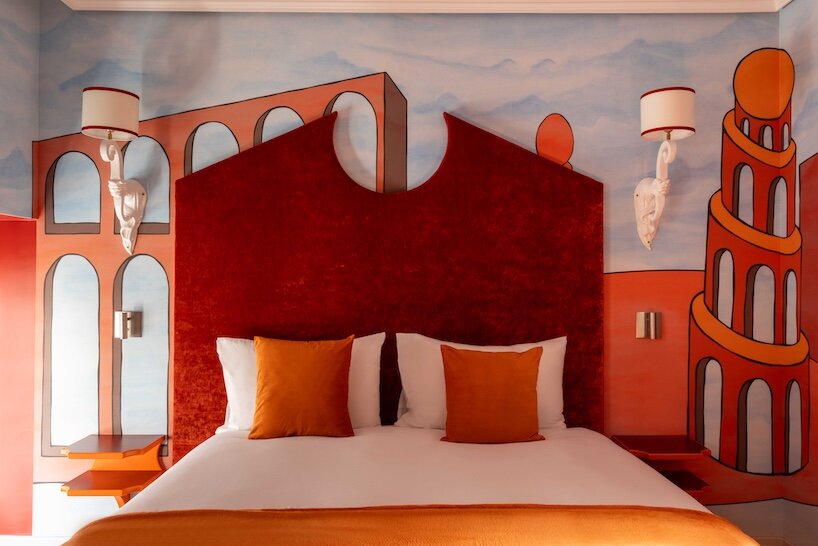
The guest rooms adhere strictly to this guiding principle, with every single chamber treated as an individual artistic composition featuring bespoke pieces imagined exclusively by the designer. Custom furniture, bespoke lighting fixtures, hand-glazed ceramics, intricate carpets, and richly stretched wall textiles combine to form interiors that effortlessly bridge traditional French decorative arts with Darré’s idiosyncratic visual vocabulary.
The very name of the hotel pays deliberate tribute to the brilliant artists and bohemian intellectuals of historic Montparnasse, whose foundational initial—the letter M—inspired the moniker Le Magnifique, while simultaneously nodding to the independent, rebellious spirit of the French Nouvelle Vague. Through its heavily layered, theatrical interiors, the completed project successfully reconnects the historic building with the living creative history of the Left Bank, transforming a simple stay in the French capital into an unforgettable journey through the designer’s singular imagination.