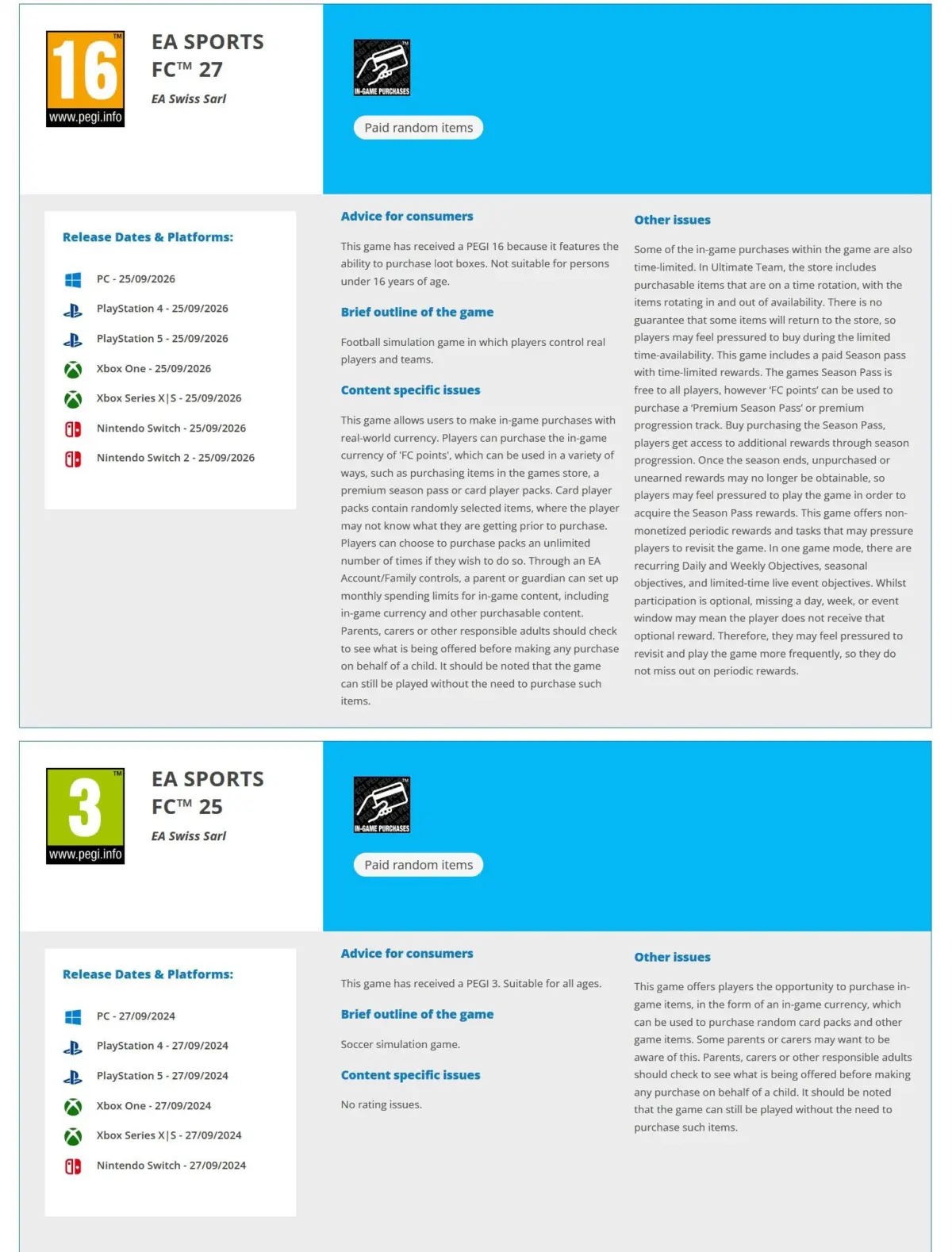
European video game rating authority PEGI has begun aggressively increasing age ratings for games that feature paid random items, a regulatory shift that is causing titles previously cleared for all age groups to jump straight to a PEGI 16 classification. This major policy pivot represents a fundamental shift in how regulatory bodies view the psychological and financial risks associated with modern video game monetization, moving far beyond the traditional concerns of graphic violence and adult content that defined content ratings for decades.

Word of the implementation came directly from Connor Hindle, policy manager for the United Kingdom’s Games Rating Authority. Writing on LinkedIn, Hindle outlined the ongoing changes taking effect across the industry. He explained that since June, newly submitted video games have been assessed against an expanded set of criteria within the broader PEGI rating framework. These updated guidelines incorporate new criteria specifically targeting interactive risks that modern players face daily. As the UK administrator of PEGI, the Games Rating Authority has now begun applying these updated criteria to selected existing digital products already available on the market, driving a wave of retroactive rating adjustments.
These regulatory changes were initially announced earlier in the year, forming a core component of PEGI’s newly established "interactive risk categories." This updated system explicitly monitors features such as the purchases of in-game content, paid random items like loot boxes and card packs, unrestricted communication features, and psychological hooks designed to incentivize continuous play. The introduction of these categories reflects a growing acknowledgment that the ways players interact with video games have radically transformed. While classification systems like PEGI in Europe and the ESRB in North America were originally established in response to concerns regarding on-screen violence and sexual content, the industry’s evolution proved that digital traps and monetization schemes could present risks of an entirely different, more insidious nature.

Consequently, any video game incorporating randomized monetization mechanics—commonly referred to as loot boxes or randomized rewards—is now designated a PEGI 16 rating by default. This rigid standard has resulted in some striking contrasts between older and newer entries in long-running franchises. For example, EA Sports FC 25 and its predecessors managed to secure a lenient PEGI 3 rating, signaling that they were deemed suitable for players of all ages with no prominent content warnings. However, newer iterations like EA Sports FC 27 have been hit with a PEGI 16 classification. While the older titles featured clean regulatory profiles, the newer game comes equipped with a detailed breakdown highlighting various purchase options available to users, including premium currency such as FC points, tiered season passes, and randomized player packs.
While PEGI is effectively dropping the regulatory hammer on loot boxes, microtransactions, and other randomized in-game purchase systems, North America’s equivalent body has chosen a starkly different path. Representatives from the Entertainment Software Rating Board (ESRB) indicated earlier in the year that North America would not follow Europe’s lead on this specific issue. An ESRB representative explained that extensive research conducted by the organization suggested that incorporating non-content-related features directly into the core age rating process could cause significant confusion for parents. Rather than inflating the base age suitability score based on monetization, the ESRB continues to separate content ratings from interactive elements. Illustrating this policy divergence, EA Sports FC 27 retains an E for Everyone rating from the ESRB, accompanied by standard informational descriptors noting that the title offers user interactions and in-game purchases, but avoiding the steep age restriction seen across Europe.