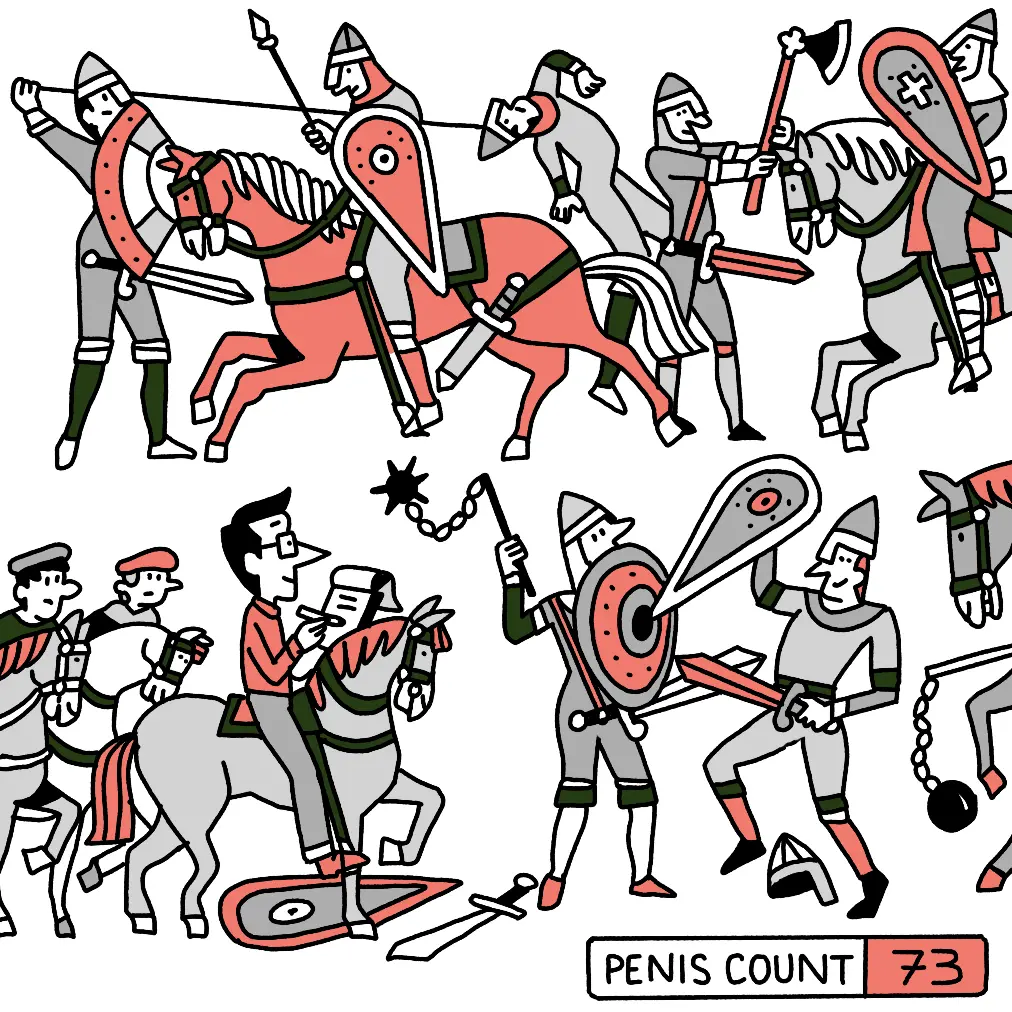
It was a celebration of modern journalism that quickly turned into an exploration of medieval mischief. This week, guests gathered at the grand halls of the British Museum to mark the 40th anniversary of The Independent, the influential newspaper-turned-content powerhouse where I spent close to a decade of my career before joining Project Monocle.
The evening offered attendees a rare cultural privilege that money simply cannot buy. Amidst the clinking of champagne glasses and high-powered media reunions, guests were invited to slip away into the galleries for an exclusive private viewing of the Bayeux Tapestry. The near-1,000-year-old, 70-metre-long embroidery—currently on loan in London from France—is a treasured historical artifact for which securing public viewing tickets is notoriously difficult. Naturally, the answer to the invitation was an immediate and enthusiastic yes.
A Stitched Narrative in the Dark
The historic tapestry is displayed flat inside an elongated glass cabinet, illuminated within a beautifully darkened room. Running the entire length of the display is a digital screen that highlights key narrative moments from the stitched masterpiece, which depicts the dramatic story of the Norman invasion of England in 1066.
The immersive setup invites deep contemplation, but it also presents a logistical hurdle for partygoers trying to balance high-society networking with historical appreciation. If one visitor is determined to take in every intricate detail, bottlenecks form quickly. Standing before the panels, I found myself stuck behind particularly studious art historians and enthusiasts who were determined not to miss a single stitch.
Sensing the mounting queue behind us, my former colleague Ruth offered a characteristically pragmatic solution. Ever the editor, with an instinctive eye for concision and narrative pacing, she suggested we bypass the crowd and execute a speed-reading manoeuvre by jumping in wherever a gap appeared in the gallery line.
"You know what’s going to happen," Ruth reasoned, pointing out that the plot of 1066 is hardly a mystery. "Do you really need to see it all?"
As a purist, I vetoed the proposal immediately. I forbade the shortcut and insisted that Ruth remain trapped in the queue with me. There would be no fast-forwarding through the Norman Conquest on my watch.
Medieval Marvels and Unexpected Anatomy
As we inched along the glass case, one striking artistic element quickly demanded our attention: the surprisingly high volume of penises depicted throughout the embroidery.
The eleventh-century textile featured not only some remarkably large appendages mounted on horseback but also several uninhibited figures displaying their anatomy with the brazen confidence of medieval flashers. Standing before the panels, it was difficult not to let the imagination wander to the daily grind of the anonymous artisans who brought the masterpiece to life.
One could easily picture an eleventh-century embroiderer returning home after a long, exhausting day of stitching horses and soldiers.
"Good day at work, dear?" her husband might inquire over the hearth.
"You won’t believe it," she might sigh, rubbing her wrists. "They’ve got me back on horses’ willies. Today, I had to do a real big one and now my wrist hurts. But they’ve promised me arrows next month. I might even get to stick one in someone’s eye. Any gruel left for dinner?"
Anatomical oddities aside, the tapestry remains an astonishing achievement of visual storytelling. It functions remarkably like a medieval precursor to a modern streaming boxset—a historical equivalent of "Stitchflix" that offers viewers the geopolitical backstory of an invasion, insightful asides into daily domestic life, fierce battle sequences, and just enough bloodshed to keep the audience thoroughly engaged.
Alongside the lesser-known panels are several iconic scenes embedded deeply in the cultural consciousness. There is, of course, the famous depiction of King Harold meeting his end with an arrow through his eye, as well as the appearance of Halley’s Comet streaking across the night sky. Looking up at the celestial embroidery, the comet bore a striking resemblance to a feathered shuttlecock, though I wisely chose not to raise that particular observation as a formal academic challenge.
A Discussion on British Bawdiness with Grayson Perry
Back amid the sophisticated hum of the anniversary party, champagne flute in hand, I found myself introducing myself to Turner Prize-winning artist Grayson Perry. Given that Perry’s own famous narrative ceramics and provocative tapestries share a clear creative lineage with the Bayeux masterpiece, he was the ideal person to consult on the tapestry’s more exuberant artistic choices.
I raised the question of the embroidery’s bawdiness—specifically, its impressive penis count. Perry offered a far wiser and more philosophical perspective than my own, leading us into a fascinating discussion about how vulgarity and irreverence are foundational elements of the British national character that deserve to be openly embraced.
From the salacious tales of Geoffrey Chaucer and eighteenth-century satirical cartoons to the risqué traditions of bedroom-farce theatre, a distinct, unbroken thread of earthy humour runs deep through the history of British culture.
The Great Academic Penis Debate
Curiosity getting the better of me, I turned to the internet upon returning home, searching for the phrase "how many penises in the Bayeux Tapestry"—an addition that certainly adds a unique flavor to my eclectic browser history. My search revealed that the anatomical tally is actually a subject of serious scholarly debate among historians.
Medieval scholar Christopher Monk previously set the definitive academic standard at 94 phalluses, counting 88 equine examples and five human appendages. However, the scholarly consensus has recently been challenged by another academic who claims that an object previously classified as a sword scabbard is, in fact, an additional willy that deserves to be added to the official tally.
Monk, holding firm to his scholarly boundaries, has refused to budge on the new classification. In a recent interview with media outlets regarding the escalating debate, he offered a memorable word of caution: "If you are not careful, you might fall into the trap of seeing penises everywhere." It sounds rather like the intellectual hazard of stumbling blindly into an academic Finnish sauna.
Yet, moving past the comedic headcount debate, perhaps this earthy irreverence explains why modern audiences—and British people in particular—continue to respond with such genuine enthusiasm to the tapestry. Staring down at its ancient panels, we do not merely see a dusty history lesson preserved behind glass. We see recognizable echoes of ourselves, a timeless reminder that while centuries pass, human nature changes very little at all.