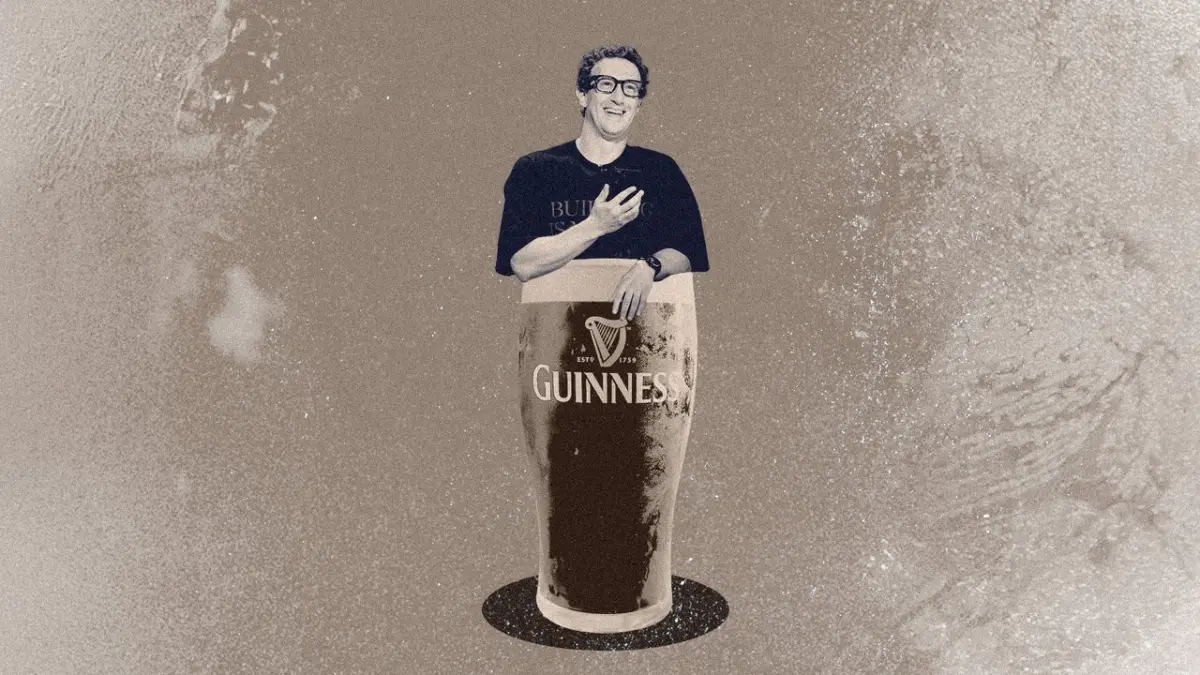
Mark Zuckerberg took a sip of Guinness the other day, and the internet immediately noticed. Specifically, a short clip from the Meta founder’s appearance on a podcast called The Cheeky Pint—which involves talking tech over a beer with host and Stripe cofounder John Collison—caught his notably unenthusiastic facial expression in response to the famous Irish stout. He looks, as one observer put it, as if he has just accidentally swallowed the little paper cup of fluoride at the dentist’s office.
It is a genuinely funny moment, but it raises a broader question: What is the big deal? Zuckerberg is hardly the first person to discover that a heavy, bitter pint of Guinness simply isn’t for everybody. Taste is subjective, and millions of people worldwide prefer lighter lagers, ciders, or non-alcoholic beverages over a traditional stout. Yet, within hours of the episode airing, the internet transformed the fleeting facial reaction into a viral roasting. Commentators across social media platforms dissected his micro-expressions, using the moment to fuel long-running jokes about his famously composed, analytical demeanor, with some even leaning into absurd internet tropes characterizing him as distinctly non-human.
The intense fascination with Zuckerberg’s reaction probably stems from who he is. As a figure who is surreally rich and powerful, he remains effectively cloistered and out of reach from most of the routine frictions of everyday life. Like his billionaire peers, he inhabits spaces he controls entirely—such as sprawling mansions, massive yachts, and private jets—or environments where his public appearances are carefully choreographed and managed, including congressional hearings, major product unveils, and carefully curated lifestyle videos. Meanwhile, other people literally make Hollywood movies speculating about various phases of his career, turning his life into public intellectual property. Seeing a master of the corporate universe do something as fundamentally human and unscripted as wince at an unfamiliar or unpalatable brew is just striking to the public eye.
In a broader sense, these rare, unscripted incidents function as a modern litmus test for authenticity, and perhaps even normality. In an era where corporate executives are heavily PR-trained, catching them off-guard in everyday scenarios offers a rare glimpse behind the curtain. The last similarly high-profile example of this phenomenon was the promotional video of McDonald’s CEO Chris Kempczinski gingerly biting into the fast-food chain’s then-new Big Arch burger. Once again, the internet noticed and quickly judged Kempczinski as a man who clearly did not regularly eat fast food. Competitors like Burger King and Wendy’s noticed the cultural misstep too, swiftly offering their own promotional videos of top executives taking ravenous, enthusiastic bites of burgers, effectively converting the simple physical act of consumption into a high-stakes brand-reputation performance.
These public consumption moments do not always read like the actions of confused outsiders trying to blend in with regular society. Tech leaders handle public exposure in wildly different ways. Elon Musk has, not surprisingly, made his own mark in this unofficial genre with fully characteristic displays of excess, knocking back three beers in his own appearance on The Cheeky Pint, and infamously puffing a blunt during a widely watched interview on Joe Rogan’s podcast. For Musk, leaning into unconventional and unfiltered behavior has long been part of his public persona, turning moments of raw consumption into spectacles that match his established brand.
Other tech executives have taken a completely different approach to humanizing themselves through food. NVIDIA chief Jensen Huang has successfully turned his public food moments into deliberate signals of accessibility, cultural curiosity, and down-to-earth charm. He has been documented by fans and media alike eating simple street noodles in Beijing, trying Korean fried chicken, and joyfully handing out red bean buns to people on the streets of Tokyo. The public response has been so pronounced that there is even a dedicated website tracking his various international food forays and culinary stops.
Yet, for most technology billionaires and corporate executives, such intense public scrutiny of everyday habits is more of an uncomfortable adjustment than a calculated PR strategy. Politicians, for whom performing artificial normality is an essential part of the grueling electoral process, learn the tricks of public consumption early in their careers. They master the art of hoisting a heavy beer with salt-of-the-earth gusto for the cameras, while carefully avoiding classic political gaffes—such as eating pizza with a fork or being photographed struggling with a messy county fair corn dog. Chief executive officers of major technology corporations, in stark contrast, are never traditionally required to rub elbows with the hoi polloi or prove their everyday relatability to voters. When they are suddenly thrust into casual, peer-to-peer settings where public consumption is recorded, the resulting unscripted reactions offer a rare, unfiltered look at lives spent far removed from the ordinary dining and drinking habits of the general public.