Tokyo’s creative landscape is enjoying a vibrant and dynamic season this autumn, offering residents and international visitors alike a rich tapestry of cultural experiences. From cutting-edge spatial audio installations and deep dives into contemporary graphic design to thoughtful reinterpretations of classical Japanese literature through the lens of modern architecture, the city’s galleries and cultural institutions are once again positioning themselves at the vanguard of global art and design.
This month, cultural observers are turning their attention to three distinct exhibitions across the Japanese capital. Together, these showcases capture the breadth of Tokyo’s creative output, bridging the gap between legendary past collaborators, innovative contemporary material research, and centuries-old philosophical musings on the nature of dwelling and impermanence.
“Ryuichi Sakamoto + Shiro Takatani: Ambient Kyoto”
Azabudai Hills Gallery
Azabudai Hills Gallery provides an evocative backdrop for the latest presentation of a monumental, site-specific collaboration between the late, globally revered musician and composer Ryuichi Sakamoto and acclaimed visual artist Shiro Takatani. Based upon Sakamoto’s critically praised 2017 release, Async, the installation—titled “Async Immersion”—expands deeply upon the artist’s foundational concept of secchi-ongaku, or installed music. This term encapsulates the unique spatial experience of sound that Sakamoto painstakingly envisaged and cultivated during the prolonged production of the album.
Within the gallery space, Sakamoto’s intricate, 14-track musical composition is harmonized with a massive 26.4-meter-wide screen displaying Takatani’s striking visual accompaniment. The imagery projected across this expansive canvas includes lingering shots of grand pianos, technical equipment salvaged directly from Sakamoto’s personal studio, and sweeping natural landscapes that slowly unfurl across the display. Significantly, these visual elements remain intentionally out of sync with the audio track, generating a deliberate temporal tension. The resulting spatial experience feels entirely removed from the fast-paced, bustling reality of contemporary life existing just beyond the heavy glass doors of the gallery walls.
Reflecting on the immersive nature of the presentation, Takatani notes the hypnotic quality of the collaboration. Experiencing the work within the continuous, ever-changing interplay of sound and image is, he suggests, akin to watching the natural movement of waves or watching ripples form in the rain—an experience that, despite its repetitive structural elements, never materializes in precisely the same way twice. For those wishing to immerse themselves in this meditative environment, “Ambient Kyoto” remains on view until October 25, 2026.
“Yoshihisa Tanaka: Archive / Achieve”
Ginza Graphic Gallery
Meanwhile, the intricate and multifaceted work of prolific 46-year-old art director Yoshihisa Tanaka takes center stage this month at the prestigious Ginza Graphic Gallery. Over the course of the past two decades, Tanaka has built a distinguished career bridging contemporary art, architecture, photography, and fashion. In recent years, however, his creative scope has notably expanded to include rigorous explorations of paper not merely as a printing substrate, but as a dynamic material and medium in its own right.
This material experimentation has led to high-profile collaborations and avant-garde projects. Among them are experimental paper trainers developed in partnership with athletic footwear brand New Balance, as well as an arresting architectural installation utilizing pleated and folded traditional Japanese washi paper. For the latter project, Tanaka designed undulating, organic forms that served as the stunning visual centerpiece for Issey Miyake’s spring/summer 2024 runway show in Paris.
Tanaka’s ongoing investigation into the physical and expressive possibilities of paper permeates every corner of the Ginza Graphic Gallery exhibition. The basement level of the gallery is densely populated with a comprehensive survey of publications, posters, and exhibition invitations spanning his two-decade career. In contrast, the sunlit ground-floor space shifts focus toward the mechanics of preservation, presenting design materials drawn directly from the corporate and institutional archives of various businesses and universities. Housed within custom containers, display fixtures, and storage units designed by Tanaka and constructed from washi, these artifacts highlight a deeper conceptual mission. By radically reimagining the traditional archive, the art director prompts viewers to carefully consider the enduring cultural value of preserving graphic design heritage and passing it down thoughtfully to future generations. “Archive / Achieve” is open to the public through October 21, 2026.
“Learning from ‘Hojoki’: Tiny Architecture Reweaves Life”
21_21 Design Sight
Further exploring the intersections of history, philosophy, and spatial design, Roppongi’s 21_21 Design Sight is currently hosting an exhibition inspired by one of the most celebrated works of medieval Japanese literature. Written in the 13th century by poet and recluse Kamo no Chomei, the nonfiction essay “Hojoki,” frequently translated as “The Ten Foot Square Hut,” details the severe political turmoil, social upheaval, and environmental catastrophes that ultimately drove Chomei to abandon conventional society and retreat to a humble, secluded dwelling in the forested mountains of Hino near Kyoto.
Now, more than eight centuries after Chomei chose to step away from the civic sphere, his poignant musings on living mindfully within an impermanent, ever-changing world serve as the core intellectual framework for this major Roppongi exhibition. Directed by Atelier Bow Wow co-founder and prominent architect Yoshiharu Tsukamoto, the exhibition employs Chomei’s historical text as a critical lens through which to examine the fundamental essence of architecture and human habitation.
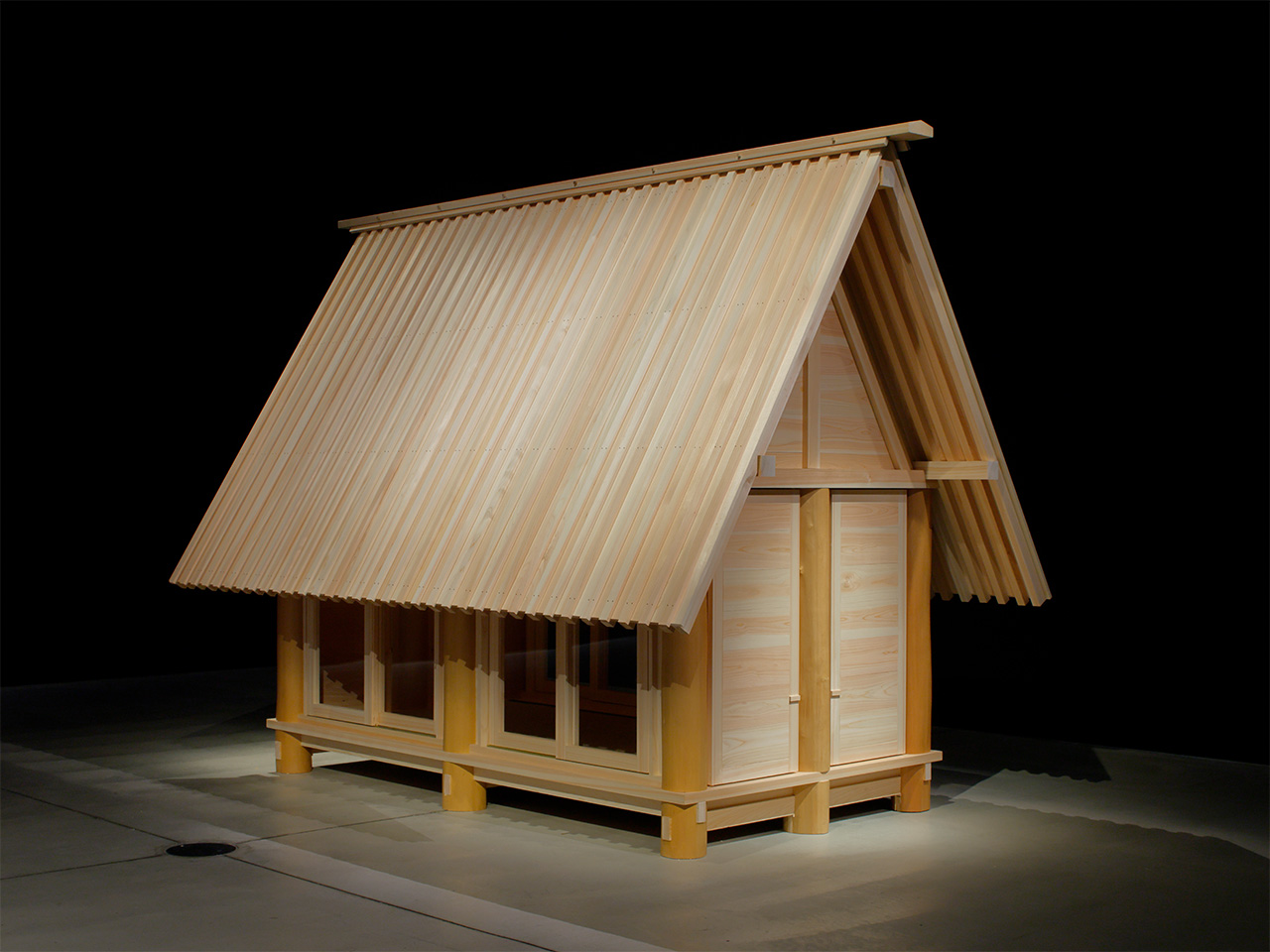
To bring this concept to life, the exhibition invited a diverse cohort of contemporary designers, builders, artists, and architects to craft their own unique, scale interpretations of Chomei’s legendary ten-foot-square dwelling. Participants drew freely from their own professional toolkits, preferred materials, and distinct perspectives on the compounding challenges of contemporary life. Among the notable contributions on display, architects Yusuke Obuchi and Jun Nakamura have refashioned an abandoned agricultural feed silo into an ingenious piece of mobile, "walking architecture." Elsewhere, a collaborative effort by Yusuke Omuro and Kawacho-Gumi has resulted in a specialized storage shed meticulously informed by the literary writings of the late novelist Chotaro Kawasaki.
Each of these diminutive dwellings serves as a standalone probe into larger societal questions, prompting visitors to reconsider the relationship between architecture, community, and sustainability in the modern era. Articulating the core ethos of the project, Tsukamoto observes that in order to successfully navigate and overcome the profound dilemmas and anxieties defining modern existence, society would do well to fundamentally rethink the consumption-driven lifestyles to which contemporary populations have become so accustomed. “Learning from ‘Hojoki’: Tiny Architecture Reweaves Life” remains open to visitors until January 11, 2027.