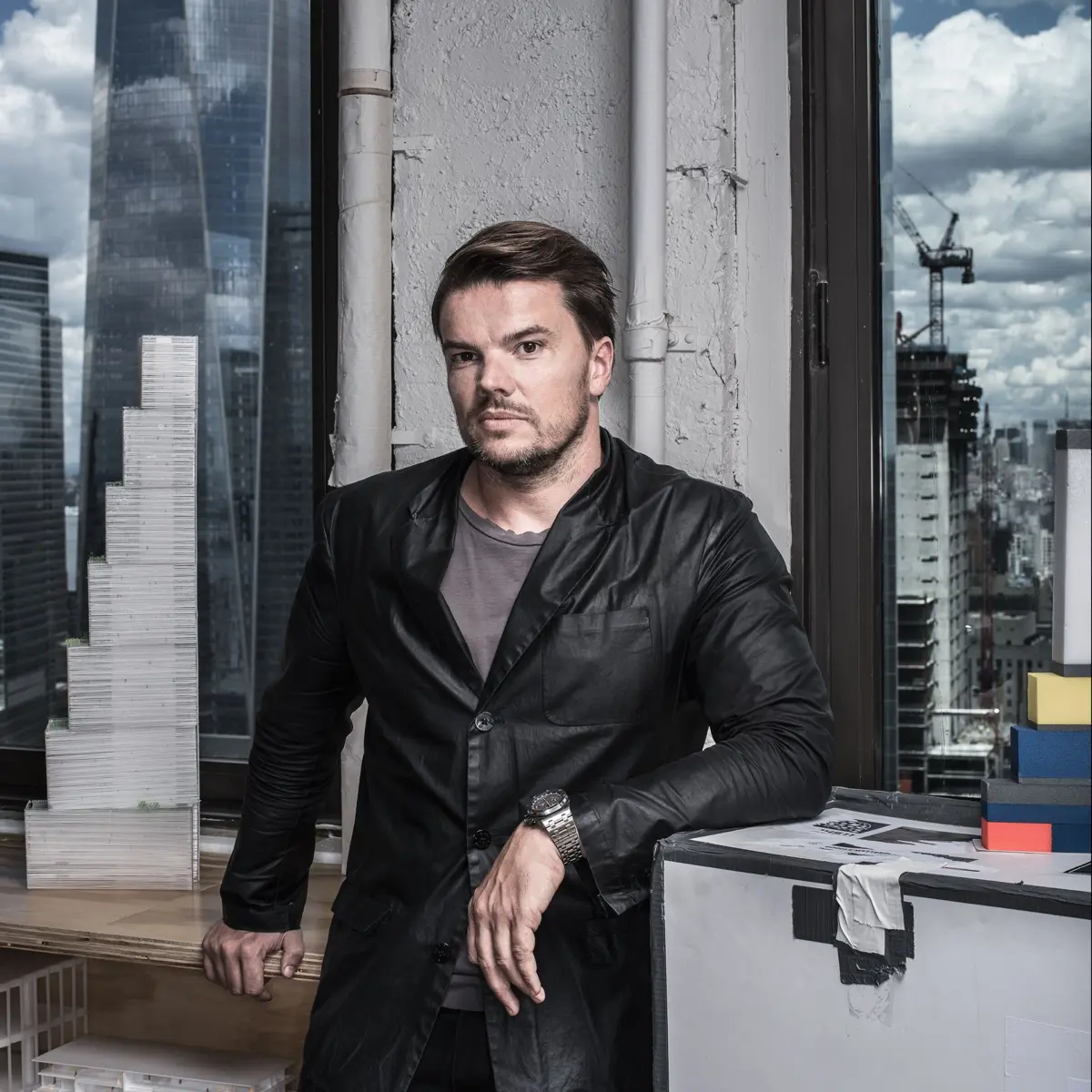
On a misty April day in Lower Manhattan, Danish architect Bjarke Ingels stands on the roof of an old brick building with the collar of his black coat rakishly popped. High above the cobblestoned street, he is shooting a promotional film for the most important commission of his young career: his revolutionary design for the skyscraper known as Two World Trade Center.
Still very much a work in progress, the high-profile project has yet to receive final sign-off from his primary client, media magnate Rupert Murdoch. But the hyper-eloquent 40-year-old architect is not letting doubt stand in the way of his vision. Having obsessed over every line and image, he tells his director that he wants viewers to swoon. At this moment, Murdoch’s plan to relocate his corporate empire is still one of New York real estate’s best-kept secrets. Yet Ingels can hardly contain his excitement, eager to shout the news, quite literally, from the rooftops.
Between takes, Ingels points to a void in the densely packed Manhattan skyline, tracing the profile of a skyscraper that only he can see. From this vantage point, his design resembles a stack of seven distinct blocks, ascending like a staircase toward One World Trade Center, its monolithic neighbor.
"In a way, it is almost like a physical manifestation of the spirit of America," he says. "Out of many, one."
If completed, the tower will stand among the tallest buildings in New York City and serve as the final addition to the master plan for the redeveloped World Trade Center site. The architectural ensemble will ring two cascading pools that pay tribute to the roughly 3,000 people who lost their lives in the terrorist attacks of September 11, 2001. But Ingels is not preoccupied with memorializing the tragedy; he wants to carve out his own history. "The memorial is about the memorial," he reflects. "The tower should be about the living city."

Eclecticism on Demand
Ingels is fond of saying that architecture is "the art of turning fiction into fact." He boasts many talents—as a draftsman, a salesman, and the charming cultivator of his own winning image—but his greatest asset is an exceptional gift for storytelling: an ability to construct a compelling narrative around practical necessities. Often, his designs careen in wildly fantastical directions.
He has built a waste-to-energy plant in Copenhagen featuring a slanted roof that doubles as a recreational ski slope, complete with a smokestack designed to puff a symbolic ring of steam each time it emits a ton of carbon dioxide. For a proposed expansion of Google’s campus in Mountain View, California, Ingels—collaborating with Thomas Heatherwick—conceived an elaborate complex of geodesic domes, envisioning a lifestyle of biking, hiking, and coding beneath a sunlit glass terrarium.
Such imaginative flights have made Ingels famous, and highly sought-after, at an age considered remarkably precocious by traditional architecture standards. However, fame can be a deceptive indicator in his profession, where an architect’s work, much like the light of a star, only reaches the public eye after a years-long journey.
Ingels’ largest completed project to date, a striking pyramidal apartment building under construction along Manhattan’s West Side Highway at 57th Street, is roughly one-third the size of Two World Trade Center. "At the moment we are working seriously on one of the most daunting buildings in downtown New York," Ingels acknowledges, noting, "we still haven’t completed a skyscraper."
With Two World Trade Center, Ingels believes he has devised a way to create an entirely new kind of high-rise work environment, transforming a form that is fundamentally vertical and hierarchical into a dynamic space for horizontal interaction. Now comes the laborious part: proving he is capable of translating that captivating story into hard facts on the ground.

Playfully calling his firm BIG, Ingels approaches architecture with a philosophy he dubs "BIGamy." Rather than adhering to a single, rigid aesthetic, he tailors his ideas to meet demanding client needs—all in the service of creating designs unlike anything seen before.
Navigating Power Brokers and Politics
To realize his design, Ingels has had to continually prove its value to a pair of hard-nosed octogenarians: Rupert Murdoch and Larry Silverstein, the developer who has controlled much of the World Trade Center rebuilding effort. Murdoch and Silverstein still need to finalize a long-term lease, the critical milestone required to finance the $4 billion skyscraper.
"There’s a lot of drama with the deal right now," Ingels admits on the day of his film shoot. "I don’t know how worried I should be."
Even if the parties successfully reach an agreement, numerous other hazards lie ahead: a volatile real estate market, the political melodrama inherent in building on a site of mass trauma, and an often inflexible government bureaucracy, embodied by the Port Authority of New York and New Jersey, the transportation agency that owns the underlying land.
For 14 years, these very factors have conspired to keep the redevelopment process lurching along unpredictably, dashing many ambitious architectural plans. In fact, Ingels’ design directly displaced an earlier concept by Lord Norman Foster. (Turnabout is fair play, as Foster had previously pushed aside Ingels on a project for a national library in Kazakhstan.)

To avoid his predecessor’s fate, Ingels must carefully balance the conflicting demands of Murdoch and Silverstein, who intend to market the top half of the building as premium office space. Simultaneously, he must juggle a growing roster of other high-profile clients who have recently showered business on BIG. While a single triumphant building can make an architect’s reputation, it takes only one disaster to ruin it. Yet Ingels, never short on bravado, claims to relish the pressure, viewing it as a Zen exercise in turning the force of an adversary into one’s own strength.
The first major force Ingels had to overcome at the World Trade Center was institutional inertia. Silverstein initially believed he had a perfectly good design from Foster and harbored serious concerns about Ingels’ early drawings, fearing the stacked structure would appear asymmetrical or even teetering from certain angles. Silverstein nearly rejected the entire deal before an endorsement from the architects of other World Trade Center buildings changed his mind.
The following Monday, the principals gathered in a conference room overlooking the site. Unflappable by nature, Ingels was momentarily knocked off balance by the combative Australian media mogul’s rapid-fire questioning. According to multiple sources, Murdoch’s deepest concern boiled down to a fundamental question: Why doesn’t it fall over?
With assistance from David Childs, the courtly architect of One World Trade Center, Ingels explained that the leaning effect is an optical illusion. The unorthodox stepped form of the building stems from placing the inner core—which houses crucial elevators—in an off-center position. This layout yields expansive interior spaces for newsrooms, panoramic views of the Trade Center plaza from Fox News studios, and sprawling outdoor terraces. Murdoch was ultimately sold.
"Before you get that story, most people suspect that it’s all just follies," Ingels reflects. "The more blatantly the architect can explain why things are the way they are, the better."

In his efforts, Ingels found a powerful ally in James Murdoch, Rupert’s son and corporate heir apparent. The younger Murdoch was the driving force behind the decision to relocate his father’s companies, 21st Century Fox and News Corp., from an aging building near Rockefeller Center.
"We sort of thought, ‘Let’s not hire a starchitect, let’s not build a big tower,’" James recalls. He initially envisioned an open, loftlike, creative workplace, but after an exhaustive exploration of potential sites, he landed at the World Trade Center—and partnered with Ingels, a star who deeply understood his vision. "We were struck by what a great problem solver he was," James says. "This is someone who can take a set of constraints and create something surprising and effective out of them."
Engineering Realities and Design Compromises
The foremost constraint involved Foster’s legacy, or rather the remnants of his foundation. As the result of a political compromise between Silverstein and the Port Authority, Foster’s foundation had already been constructed to accommodate a $4 billion underground transportation hub. The rest of the tower was slated for construction once Silverstein secured an anchor tenant.
However, James Murdoch felt Foster’s stodgy skyscraper failed to meet a media company’s needs, and Ingels was similarly dismissive, describing the design as "a generic extrusion with a flashy hat." Piggybacking a new skyscraper onto Foster’s foundation, however, created intricate structural challenges, particularly in the lobby and lower floors, which had to be engineered to transfer the tower’s immense weight onto preexisting supports.
Ten days after his meeting with Murdoch, Ingels returns to BIG’s offices just as the firm prepares to move into a larger space. Walking over to a whiteboard, he explains the standard constraints of high-rise architecture. "A lot of towers, as they get over a certain height, tend toward a square footprint," he notes, driven by cost, marketing efficiencies, and the physics required to withstand gravity and wind forces. Yet Ingels believed he had figured out how to shape his skyscraper differently. "We just redistributed the calories," he says.

Moments later, Ute Rinnebach, project manager for Two World Trade Center, rushes back from a meeting with the structural engineers bearing discouraging news. Ingels’ idea for retrofitting the foundation involved shoring up walls and columns within the Port Authority’s domain—an approach that proved strictly prohibited. Removing that crucial bit of reinforcement threatened to destabilize the entire structural scheme.
Simultaneously, a facade consultant delivered another blow. To cut costs on the facade—which consultants estimated was running $60 million more expensive than Foster’s design—Ingels had planned to use thinner materials in certain areas. However, New York Police Department security standards mandate that all facades at the World Trade Center utilize heavy laminated safety glass to withstand potential explosions.
"I was like, fuck!" Ingels recalls. "Because that’s a piece of information that hadn’t reached me. I just thought I had an ace up my sleeve, which I didn’t, because the building has to be safe from explosions."
With Silverstein and Murdoch navigating a tense juncture in their lease negotiations, any departure from standard architectural formulas threatened to inflate construction cost estimates. For a few weeks, the fate of the project hung in the balance.
Ultimately, Ingels averted disaster by agreeing to a series of painful structural changes. "I think it still sort of looks like itself," he says hopefully.

As the project gradually stabilizes, Ingels reflects on the broader philosophy that guides his work. "I really like this idea that architecture is the art and science of trying to make everybody happy," he says. "Potentially, somewhere out there, there’s a design that can actually satisfy every dream, by being different."
Drawing an evolutionary parallel, he compares the design process to the animal instincts of fight or flight. "In architecture, sometimes the eureka moment is actually when you give up a stance and say, OK, we have to try something else."
A Rapid Rise to Prominence
This pragmatic acceptance of defeat is an unfortunate truth of the profession. In his 2009 manifesto, Yes Is More, Ingels wrote that "most architectural projects either miscarry or die in early infancy," estimating that out of 200 designs produced during his first eight years, only 11 were built.
Fame has since improved those odds, connecting him with heavily capitalized clients possessing significant political sway. Google, for instance, famously encouraged Ingels to let his imagination run wild, with CEO Larry Page reportedly telling him regarding a parking conundrum, "It’s nothing that $50 million won’t solve." Yet even tech giants face roadblocks; the city of Mountain View ultimately denied the development rights necessary to build Google’s entire 2.5 million-square-foot complex.
Despite occasional setbacks, fresh commissions continue to stream into BIG. In Manhattan, Ingels is simultaneously designing four major additions to the Hudson River skyline alongside the Dryline, a $335 million hybrid park and flood defense system along the East River. In Washington, DC, he is spearheading a master plan for the Smithsonian’s South Mall campus.

Having founded BIG in Copenhagen just a decade ago, Ingels has confounded expectations with a trajectory that defies the traditional, slow accrual of architectural acclaim. "He has just bypassed all the rest of the avant-garde," says Preston Scott Cohen, an acclaimed architect and professor at the Harvard School of Design, where Ingels has also taught. "No one has done it that fast, with that degree of success. You name them, he has just flown right over their heads."
Ingels makes no secret of his ambition to bring artistic vision to profit-driven megaprojects like office complexes and stadiums. Trained under Rem Koolhaas at OMA, Ingels inherited a fearless attitude toward placing ideas on anyone’s table. But while Koolhaas primarily expressed his visionary ideas through theory and publications like Delirious New York, Ingels is determined to make a tangible, physical mark on the urban landscape.
As the Two World Trade Center design moves closer to a public unveiling in June 2015, Ingels secures a final blessing from architect Daniel Libeskind, author of the site’s master plan. Reviewing a glowing model of the tower inside BIG’s conference room, Libeskind offers praise. "Congratulations, that is a super building," he says, before adding a cautionary note: "Between that first smile and the last stone is the challenge of architecture… this complex space filled with what the city really is: economics, society, power brokers, politicians."
As Ingels’ team settles into their spacious new offices on Broadway near Wall Street, the architect remains characteristically upbeat. Surrounded by 170 New York employees and 100 more in Copenhagen, he continues to juggle an array of ambitious projects with boundless enthusiasm.
"A lot of the starchitects have started their careers doing some high-end sculptural projects," Ingels observes over breakfast in Tribeca. "When they suddenly get faced with something that is more governed by the parameters of the practical, they end up almost petrified or paralyzed, because their usual repertoire doesn’t work."

For Ingels, success lies in solving a gigantic equation filled with rigid variables while discovering which ones can be bent. Stepping out into the sunny morning air and gesturing toward the World Trade Center site, he smiles. "Imagine, that’s where it’s going to sit. I think it’s going to be pretty epic."