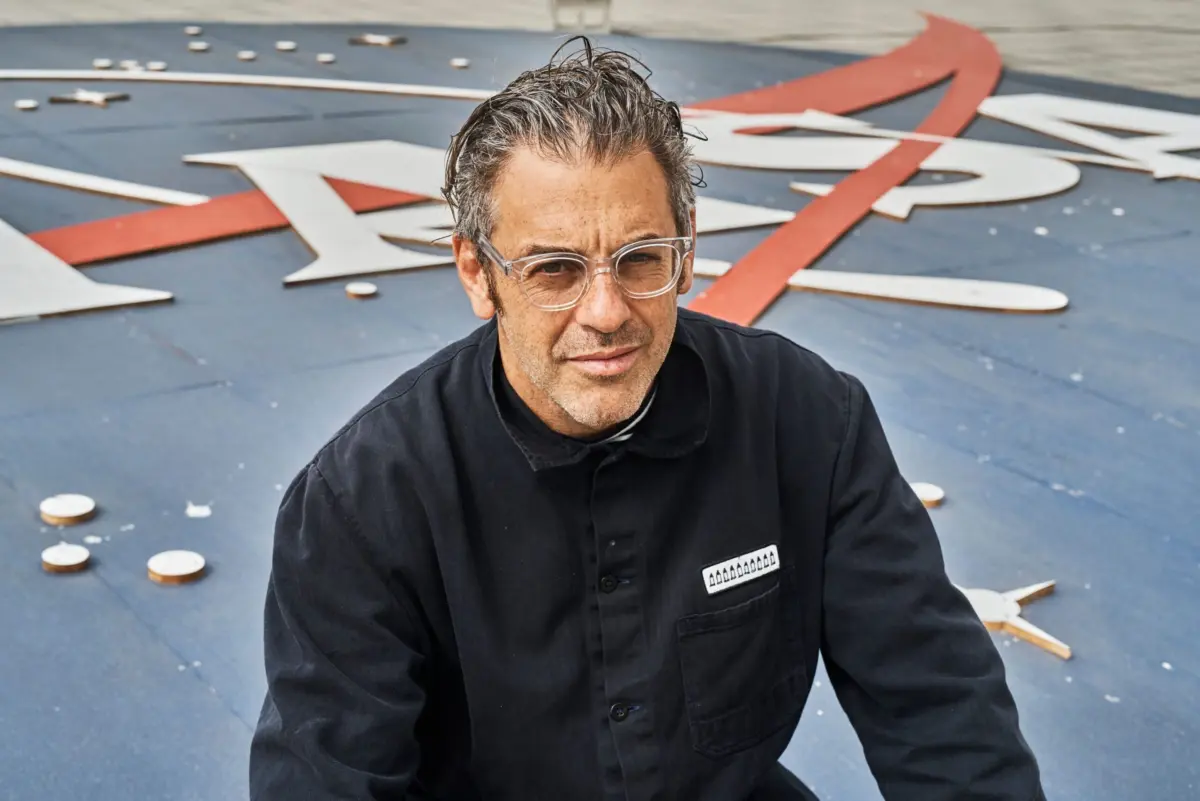
Deep within a labyrinthine lower Manhattan workshop, contemporary artist and sculptor Tom Sachs presides over a chaotic yet hyper-organized empire of cabinets, shelves, and custom sorting systems. Every square inch of the studio reflects a distinct philosophy of labor and creation. Even a standard drill press has been radically overhauled, featuring twin machine lamps spidering from its crown, an automated brush on a retracting cord to whisk away debris, and a chuck key paired with a center punch firmly secured to its face via industrial magnets.

Sachs, who frequently describes himself as a "bricoleur"—someone who cobbles together functional contraptions out of collected or discarded materials—has spent the last two decades rising to international prominence. Over a decade ago, the art world began taking serious notice of his provocative, consumer-skewed sculptures: a cardboard hand grenade tucked neatly inside a mock Hermès box, or a Glock pistol styled and branded with the elegance of Tiffany. Today, Sachs and his dedicated 12-person studio team mount ambitious exhibitions in premier museums across the globe, capturing the loyalty of art collectors everywhere.
On a typical day in the workshop, preparations are underway for a massive, multi-faceted installation at San Francisco’s Yerba Buena Center for the Arts. The project, titled Space Program: Europa, sends a pair of human "astronauts"—actually studio assistants playing the roles—in a plywood mock-spaceship on a simulated mission to Jupiter’s icy moon, Europa, which scientists believe might harbor alien life. It marks the third major installment in Sachs’ ongoing Space Program series. Amidst the flurry of preparation, studio assistant Sam Ratanarat works meticulously to stabilize a mobility cart the astronauts will wheel out onto the alien surface, a task that requires precision welding on titanium rods.

Sachs inspects the work, praising Ratanarat’s initial weld as a masterpiece of craftsmanship. "Talk about material bragging rights," he remarks. "Titanium is up there!" Yet, despite his appreciation for fine welds, Sachs’ disdain for outdated equipment flares up when looking at their aging MIG welder. When he suggests discarding the battered machine, Ratanarat defends it fiercely, noting its constant utility in the shop.
While his team prepares for the Jovian voyage, Sachs tackles a project with a darker historical parallel. Reflecting on past missions, he recalls how the folding-knife manufacturer Spyderco previously provided white Delicas—beloved by knife enthusiasts—engraved with 1970s NASA logos. But Europa requires a different tool entirely. "Europa is a mission about imperialism. We go to another planet, find some Europans, and abduct them," Sachs explains. "So what’s the knife of colonialism? A machete!" True to his bricolage ethos, he begins milling his own from a discarded Japanese lawn-mower blade. With multiple simultaneous shows in New York and the impending Europa landing in San Francisco, Sachs stands at the peak of a two-decade career defined by rough-edged, joyful, and deeply labor-intensive contraptions.

Sachs’ path to becoming the world’s most famous bricoleur was unconventional. As a youth, he was a struggling D-minus student who repeated the ninth grade, felt deeply unpopular, and purchased his clothes at Goodwill only to have them tailored. Somehow, he secured admission to Bennington College, where he met Babs, a senior who taught him the fundamentals of welding and introduced him to the avant-garde works of Constantin Brancusi and Richard Serra. Though she soon left him for another student, the encounter fundamentally shifted his perspective. "She showed me a more complex way of working, to make these objects and talk about them politically, socially, how objects could be used in the rituals of our lives," Sachs recalls. He nursed his heartbreak with an angle grinder.
Years later, filmmaker and space enthusiast Adam Savage encountered a video of Sachs’ replica Lunar Excursion Module on a simulated Mars mission. Intrigued, Savage forwarded the link to fellow space buff Tom Hanks, who not only recognized the work immediately but also knew the artist personally, subsequently facilitating an introduction between Sachs and Savage.

Savage, best known as a maker and former host of television’s MythBusters, discovered an immediate kinship with the artist. Both men share an obsession with meticulous organization, building physical replicas, and constructing workshop infrastructure—such as stands, shelves, and benches—whenever creative block strikes. Sachs even adopted construction techniques from MythBusters, and the two artists frequently trade workshops when traveling between coasts.
This shared ethos extends directly into their creative practices. Savage’s personal obsession involves building hyper-accurate replicas of cinematic props, such as the pistol from Blade Runner, spacesuits from Alien, or the mecha-glove from Hellboy. In doing so, Savage engages in a dialogue with his ten-year-old self, constructing items that feel authentic enough to deceive his adult reality. Sachs engages in a similar conversation with his childhood, but with a different twist: gifting that younger self an endless supply of art materials and granting him total freedom to play.

While Savage layers narrative into his objects through a manufactured patina of age, wear patterns, and historical verisimilitude, Sachs embeds narrative directly into the construction process. The exposed edges of plywood, visible screwheads, greasy fingerprints, and minor tool slips all broadcast the undeniable reality that the object was painstakingly manufactured by human hands. Sachs’ pieces achieve status as fine art because their rituals of creation tell a compelling story about the artist himself.
This intersection of hardware, narrative, and deep-seated ritual is perhaps most vividly demonstrated during Sachs’ specialized tea ceremonies. At the Noguchi Museum in Long Island City, Sachs constructed a teahouse out of plywood and resin, where he serves as tea master to select groups of museum donors. Rejecting traditional Japanese footwear in favor of sneakers crudely cut into sandals, and locking participants’ smartphones inside a Faraday cage, Sachs stages a performance that blends historical reverence with counter-cultural absurdity. Guests smoke from handmade pipes, drink sake from vessels crafted out of stacked plywood circles coated in resin, and snack on Oreos and peanut-butter-topped Ritz crackers.

Sachs draws a direct parallel between this ritualistic approach and his obsession with NASA and space exploration. "Some people are into astronomy because they’re into navigation. Others are interested in where we come from, where science and religion meet," Sachs notes. "And then other people are into it for things that go boom, and space suits and rovers and rockets, and it’s all about the hardware." For Sachs, the hardware and the ritual are inextricably linked; the machinery means nothing without the human rituals that animate it.
This philosophy manifests fully in the elaborate mechanics of his Space Program exhibitions. Structured around the potential for failure—much like NASA itself—the simulated missions leave room for genuine mishaps. For the Europa deployment, astronauts begin in a quarantine trailer before transferring via a scissor lift to the landing module. A model rocket performs the liftoff, filmed with miniature cameras angled to mimic authentic NASA launch footage, before gliding along a length of yarn toward a spinning globe.

Landing remains the ultimate hurdle. If an astronaut operating the vintage Lunar Lander Atari game exhausts her fuel or crashes, a television screen displays a pre-recorded Nixon impersonation reading the speech originally prepared in the event of an Apollo disaster, immediately terminating the performance. Success, however, allows the astronauts to don ice-water-cooled spacesuits, shuffle to an ice-covered pool, drill through the surface under the guidance of mission control, and capture live aquatic organisms—sparking ongoing debates over which creatures will elicit the least backlash from animal welfare organizations before the astronauts ultimately consume them.
NASA engineers have embraced Sachs’ playful yet rigorous simulations. Dave Lavery, a NASA roboticist, notes that beyond the visible plywood edges and weathered paint, every technical detail is traceable to the realities of actual spaceflight hardware. The exhibitions are immersive and entertaining, but they are never parodies.

Ultimately, the intense physical labor required to transport and assemble the massive installations for just a few days of public performance lies at the heart of Sachs’ creative drive. "I love getting my hands dirty. I only feel good if I have a cut somewhere," Sachs says. "If I have a little burn, it means that I’m probably doing something right."
That mutual dedication to physical creation recently culminated in a direct collaboration between Sachs and Savage: building replicas of the futuristic lunch box carried by character Heywood Floyd in Stanley Kubrick’s 2001: A Space Odyssey. While Savage utilized styrene, aluminum, fiberglass molding, and genuine Mylar bubble wrap sourced from NASA to achieve cinematic accuracy, Sachs constructed his version from rough-cut plywood, exposed screws, and resin, allowing the raw wood grain to bleed through the white paint. Both artists completed two versions and exchanged them.

When Savage questioned whether his own obsessively refined props truly constituted fine art, Sachs offered swift reassurance. Pointing to Savage’s Blade Runner blaster, Sachs insisted it was unequivocally a work of art. When Savage countered that he could never bear to part with it in a commercial gallery setting, Sachs smiled in agreement. "It feels like that every single time," Sachs said. "That’s when you know it’s good."