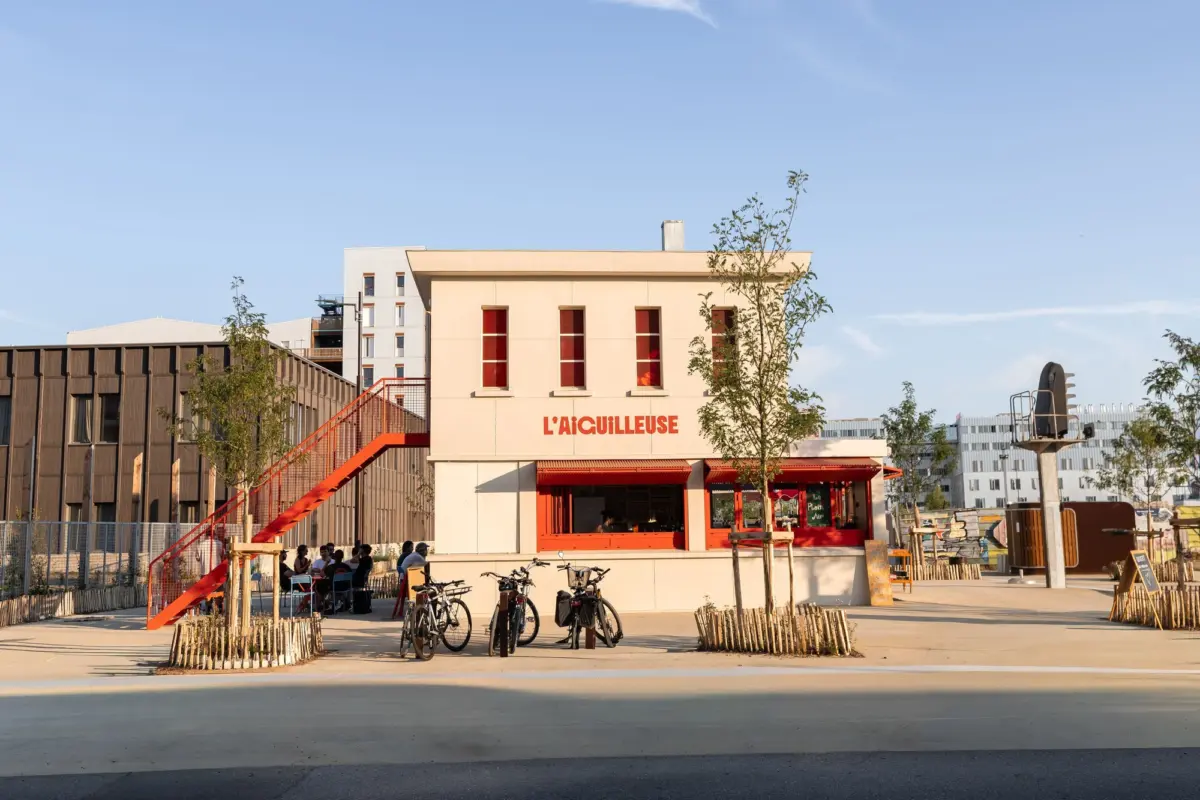
NANTES, France — In the evolving urban topography of western France, the Île de Nantes has long served as a living laboratory for the reinvention of post-industrial territory. Amid the sweeping redevelopment of former docklands and transit yards, small fragments of utilitarian heritage often face an uncertain fate. Yet, in a quiet clearing within the newly developed Jardins de l’Estuaire, an unassuming remnant of twentieth-century infrastructure has found renewed purpose. Studio Téré has completed "L’Aiguilleuse," an adaptive reuse project that converts a decommissioned 1960s railway signal box into an active kiosk-bar, anchoring community life in the heart of the surrounding public park.
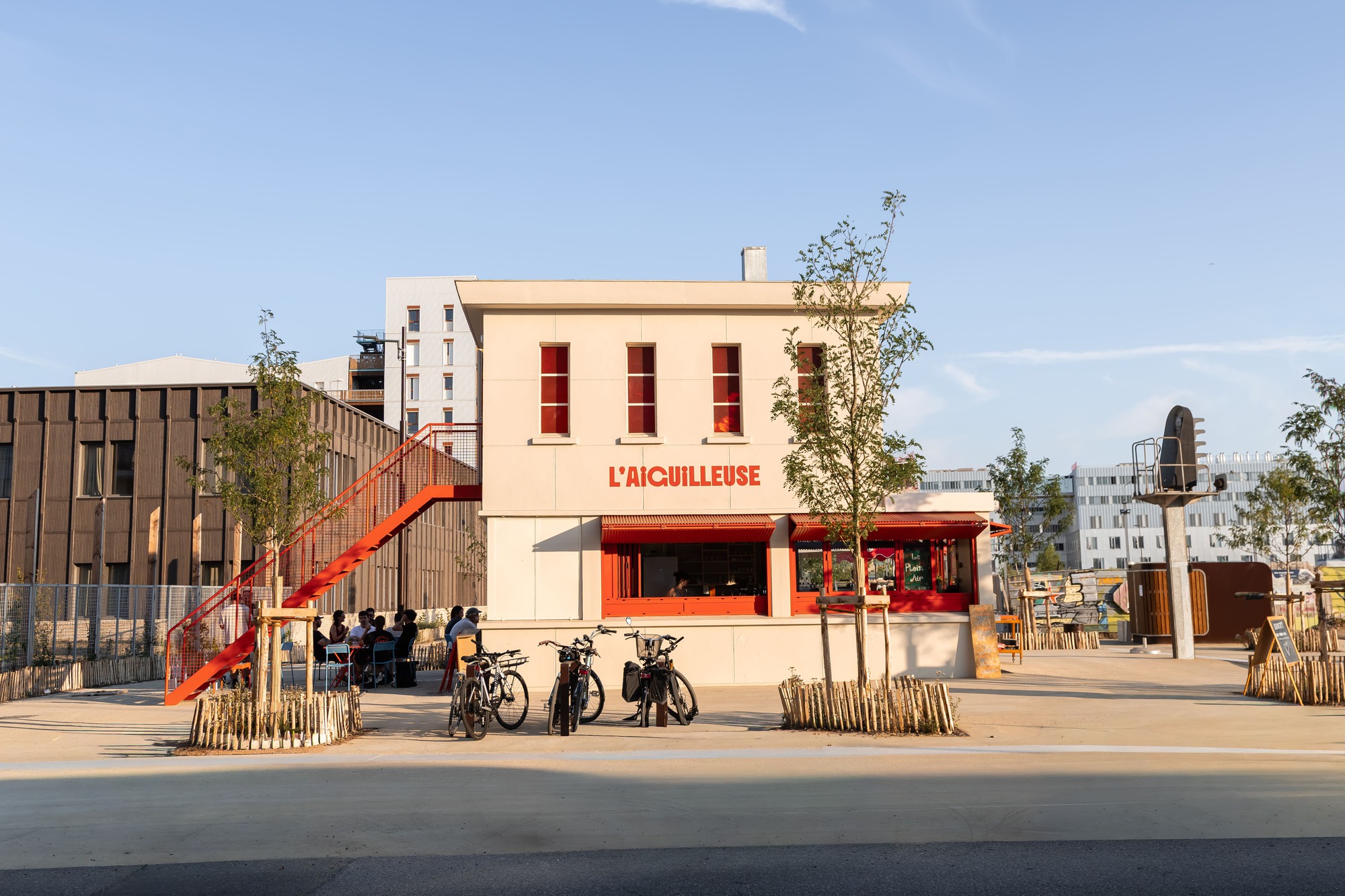
The project takes its evocative name from the French term for a railway switch operator, reimagined in the feminine form to honor the site’s operational past while welcoming a softer, more convivial chapter. Originally conceived during the post-war modernization of the French rail network, the compact pavilion once formed an essential link in the Nantes-État railway system. Perched along the tracks, it was designed with an exacting, singular function: to house the mechanical switches and personnel responsible for directing train movements in and out of the bustling station terminal. From its elevated vantage point, operators once governed the flow of locomotives, freight carriages, and commuter lines that animated the island’s productive core.
Over subsequent decades, however, the landscape of rail freight shifted dramatically. Deindustrialization, infrastructural consolidation, and the gradual decommissioning of historic rail lines slowly dissolved the intricate web of tracks, sidings, and shunting yards across the Île de Nantes. Where iron rails and gravel ballast once dominated the horizon, broad swaths of open ground were cleared to make way for nature, leisure, and contemporary civic infrastructure. Amid this wholesale transformation, the signal box survived almost by chance, stranded like a solitary architectural sentinel whose original context had evaporated around it.
Rather than demolishing the structure to make way for an entirely tabula-rasa park design, the city and the designers at Studio Téré recognized the building’s latent value as an anchor of collective memory. Small-scale industrial remnants frequently possess a sculptural clarity and material honesty that contemporary buildings struggle to replicate. In the case of the signal box, its compact dimensions, robust mid-century construction, and deliberate orientation toward former track alignments offered an authentic physical record of the site’s historical identity.
In conceiving the architectural intervention, Studio Téré approached the structure with a methodology centered on restraint, legibility, and continuity. Adaptive reuse projects of this scale require a delicate balance: the building must be updated to meet modern accessibility, safety, and commercial requirements without erasing the very patina and spatial logic that justify its preservation. The architects sought to establish a dialogue between past utility and present leisure, treating the historic fabric as a resilient shell capable of supporting an entirely new civic role.
The conversion of the building into a kiosk-bar required a comprehensive reimagining of its interior mechanics. Originally built to shelter technical control panels, mechanical levers, and rail staff during all seasons, the interior was organized around technical efficiency rather than public interaction. To transform the interior into an operational food and beverage dispensary, the design team had to resolve complex spatial constraints within an exceptionally modest footprint. Every square centimeter was optimized to accommodate cold storage, prep counters, plumbing, and electrical services, ensuring that the facility could operate seamlessly during peak park hours.
At the interface between inside and outside, the building’s envelope underwent precise surgical modifications. Railway signal boxes were historically designed with prominent glazing to provide operators with unobstructed sightlines over active railway tracks. This intrinsic transparency became a primary architectural asset during the conversion. Studio Téré leveraged these original openings to establish visual connections between the service staff inside and parkgoers relaxing on the surrounding lawns. The openings were reworked to accommodate service counters and ventilation, creating a direct, inviting dialogue with the public realm.
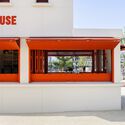
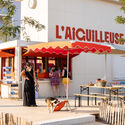
Externally, the project engages directly with the surrounding Jardins de l’Estuaire, a contemporary public park designed to inject lush ecological corridors and expansive green spaces into the post-industrial island. The juxtaposition of manicured turf, meadow plantings, and native trees against the weathered mineral profile of the 1960s signal box produces a striking visual and temporal contrast. The building is no longer an isolated technical object surrounded by industrial hazards; it has become an accessible public pavilion nestled among walking paths and gathering areas.
The presence of the kiosk-bar also activates the park on a functional level. Public parks often run the risk of feeling underutilized or deserted without complementary urban amenities that invite people to linger. By introducing a welcoming hospitality venue, L’Aiguilleuse serves as an informal social hub, drawing residents, office workers, and visitors to pause, converse, and engage with the landscape. Patrons can gather for a morning coffee, an afternoon beverage, or an informal neighborhood encounter, bringing constant, low-intensity animation to the park throughout the day.
Crucially, the preservation of the signal box exemplifies an increasingly vital philosophy within contemporary French and European architecture: the valorization of ordinary or "minor" heritage. While grand monuments, cathedrals, and monumental railway terminals are almost universally safeguarded, modest industrial outposts—such as switch towers, utility sheds, and gatehouses—are frequently discarded as obsolete. Studio Téré’s intervention demonstrates that even the smallest utilitarian structures possess narrative richness and environmental value. Reusing existing building mass diverts demolition waste from landfills, conserves embodied energy, and maintains the tactile continuity of the built environment.
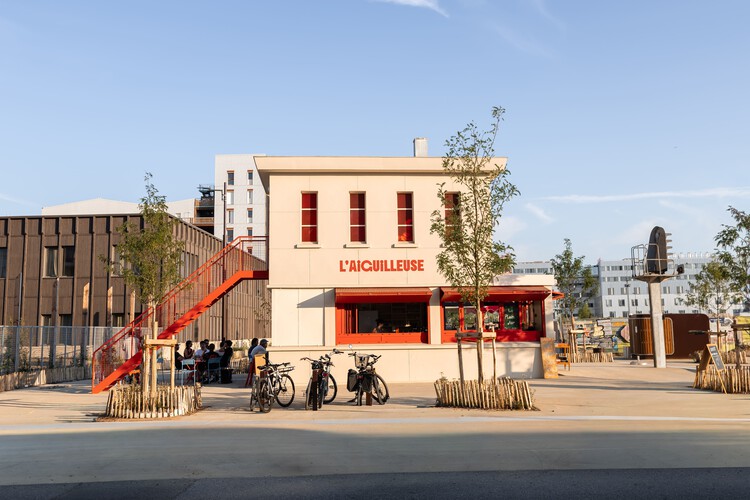
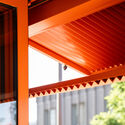
Documented through photographs captured by Nina Ducleux, the project conveys a calm, unpretentious elegance. The imagery highlights the stark contrast between the weathered historic masonry, crisp contemporary detailing, and the surrounding green parkland. Ducleux’s lens captures the pavilion both in quiet solitary moments and in full activation, underscoring how seamlessly the structure has transitioned from directing industrial machinery to hosting communal leisure.
The successful completion of L’Aiguilleuse also reflects the broader narrative of the Île de Nantes, which has spent the past several decades balancing ambitious contemporary urbanism with a deep respect for maritime and rail heritage. From the monumental transformation of former shipbuilding yards to nuanced interventions like this former signal box, the island’s regeneration highlights that urban history is not merely preserved behind museum glass, but can be inhabited, touched, and experienced in daily civic life.
By breathing new life into a forgotten piece of 1960s infrastructure, Studio Téré has achieved a quiet yet meaningful architectural success. L’Aiguilleuse stands as a testament to the idea that thoughtful renovation does not require grand budgets or oversized volumes to effect meaningful urban change. Instead, through sensitive design and a clear understanding of site history, a decommissioned switch box that once controlled locomotives now channels the rhythmic, everyday movements of people through a contemporary public park.