Every summer pool party eventually features a familiar, physics-defying acoustic experiment. A portable Bluetooth speaker sits blasting on the concrete deck, but the moment you submerge yourself to retrieve a dropped pair of sunglasses, the vibrant party playlist vanishes entirely. Above the surface rings out the latest pop hit, while below water level, it is reduced to a muffled thud combined with the steady, dull hum of the pool’s filtration system.
Water is roughly 800 times denser than air, causing nearly all airborne sound waves to bounce off the surface rather than penetrate it. For swimmers, this creates a distinct auditory barrier. Seeking to solve this long-standing acoustic challenge, Hong Kong-based design firm Duramobi has introduced a novel approach: rather than playing music at the water from the outside, the company’s new device plays music directly inside the water.
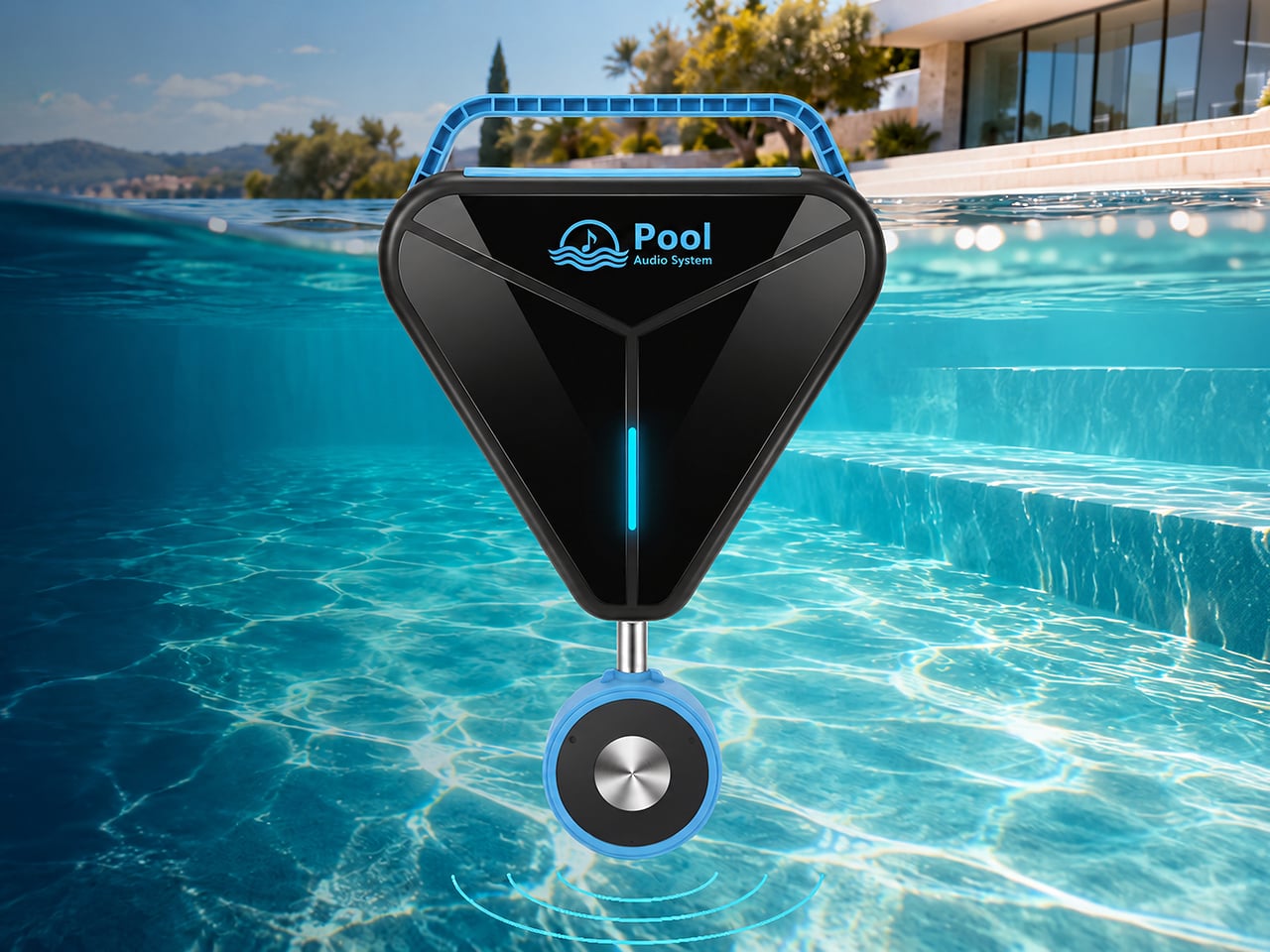
The result of this engineering effort is the Duramobi Pool Audio System W150, a portable underwater speaker designed to hang discreetly off the edge of a pool using a telescopic pole. This design keeps the electronic controls safely dry above the waterline, while a brushed aluminum transducer rests submerged below the surface. A transducer is a sealed acoustic driver that uses mechanical vibrations to excite the water molecules directly. Consequently, everyone submerged in the pool hears the same audio broadcast simultaneously, completely free of specialized earbuds, waterproof straps, or bulky headgear. Furthermore, the system requires no permanent installation, drilling, wiring, or disruptive construction work with concrete saws. It boasts a storage capacity of up to 1,000 songs, delivers more than 12 hours of continuous playback per charge, and includes a specialized Live Voice Remote that enables swimming coaches and instructors to speak directly into the water.
Turning the Whole Pool Into a Speaker
Sound travels approximately four times faster through liquid water than it does through air. Furthermore, the human skull readily conducts these underwater acoustic vibrations directly to the inner ear, creating the distinct psychological sensation that underwater music originates from everywhere at once, rather than from a single localized point.
The W150 capitalizes on this acoustic phenomenon. Its cylindrical transducer pod, anchored by a distinctive brushed aluminum faceplate, pushes kinetic vibrations straight into the liquid medium instead of shouting futilely at the surface tension. According to specifications provided by Duramobi, a single W150 unit can adequately cover an area measuring approximately 20 by 20 feet, making it well-suited for standard backyard swimming pools, hot tubs, and spa environments. Anyone standing or swimming within this coverage zone is immediately surrounded by a rich acoustic field without needing any wearable gear.
To accommodate varying pool depths and water levels, the system features a patented telescopic mounting pole that extends smoothly from 13.4 to 35.4 inches. This ensures the transducer remains optimally submerged whether a pool is filled to the brim or operating a few inches low. All user controls remain housed securely on the dry upper body above the waterline, allowing swimmers and supervisors to adjust settings with wet fingers without needing to dive. For larger installations, the manufacturer recommends scaling the setup: a medium backyard pool measuring 39 by 20 feet typically requires two units, while expansive resort pools measuring up to 82 by 69 feet benefit from a synchronized array of four to six units. Multiple W150 devices can be paired together wirelessly to ensure the entire body of water broadcasts a cohesive audio track rather than conflicting soundscapes.
Beach Club Aesthetics with a Sealed, Chlorine-Resistant Shell
Aesthetically, the main body of the W150 departs from sterile laboratory equipment, opting instead for a sleek, modern silhouette reminiscent of high-end beach club fixtures. Constructed in a triangular form factor, the upper housing features an integrated carrying handle, a clear digital display panel, top-mounted tactile buttons, and a vertical LED light strip that glows gracefully down its faceplate. Customization options include blue, orange, and yellow accent lighting to establish a desired atmosphere.
The composite shell is built using an encapsulated construction method, yielding a certified IP68 water-resistance rating capable of handling continuous submersions up to a depth of 4.9 feet. Duramobi has engineered the exterior materials to withstand prolonged exposure to harsh pool chemicals, including chlorine and salt, preventing premature corrosion. Weighing approximately 4.9 pounds, the unit is easily portable and feels comparable to carrying a packed lunch bag.
The internal battery provides upwards of 12 hours of continuous runtime, easily accommodating a full morning of swim laps followed by an afternoon of relaxed floating, though actual battery longevity varies depending on volume levels and operating modes. A magnetic charging connector eliminates the need for vulnerable port flaps that are easily forgotten or degraded, bringing the battery from zero to full capacity in roughly an hour and a half.
Users can store up to 1,000 tracks directly on the device’s internal memory, allowing smartphones and other media players to remain safely tucked away in bags far from splashing water. For those who prefer live streaming, integrated Bluetooth 5.3 connectivity ensures broad compatibility with modern Android, iOS, and Windows devices. Additionally, the system features four distinct equalizer modes—Home, Spa, Train, and Resort—designed to optimize acoustic performance depending on the environment and the activity taking place.
Coaching Cues That Follow Swimmers Underwater
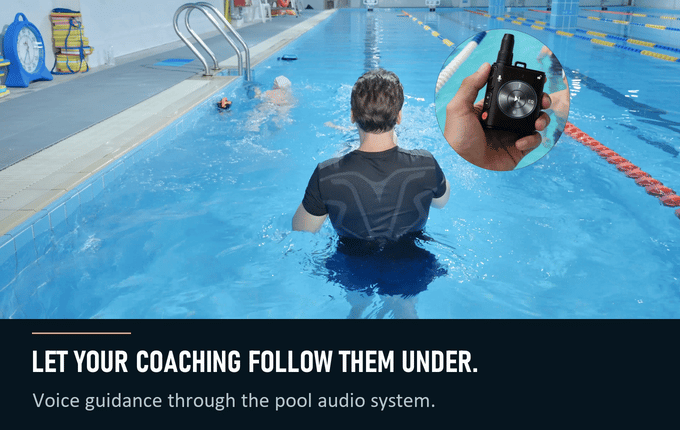
Beyond entertainment, the W150 addresses a classic hurdle in athletic training: the difficulty of shouting coaching instructions to athletes who spend the majority of their practice time underwater. The system includes a dedicated Live Voice Remote, a handheld device that allows a coach to speak clearly and directly into the water.
This remote also doubles as a media controller, allowing instructors to adjust volume, pause tracks, skip songs, or switch equalizer settings without walking back to the main unit mid-set. Coaches can easily layer a rhythmic pace-setting playlist underneath verbal instructional cues, ensuring that every swimmer in the pool receives identical guidance at the exact same moment. This eliminates the need for frantic hand signals or specialized waterproof headphones during team practices.
The potential applications span a wide spectrum, including competitive swim training, synchronized swimming routines, aqua fitness classes, swim schools, hotels, and luxury resorts. Synchronized swimming teams represent a primary beneficiary, as maintaining precise timing underwater is critical to the sport. Meanwhile, hospitality venues gain an ambient soundtrack solution without the high costs and logistical nightmares of trenching concrete pool decks.
The concept of underwater listening holds a rich, if niche, artistic history. In the early 1980s, French avant-garde composer Michel Redolfi staged pioneering underwater concerts where audiences floated in swimming pools and coastal coves with their ears fully submerged. Redolfi famously joked that playing traditional classical pieces like Bach underwater could sometimes sound like listening to Bach from inside a bathroom, underscoring the importance of tailored playlist curation. The W150 translates this artistic ambition into a consumer-accessible format, replacing experimental synthesizers with everyday favorite tracks.
Three-Step Setup and Zero Construction Required
Operating the system involves a straightforward procedure: adjusting the telescopic mounting pole, establishing a Bluetooth connection or selecting tracks from the internal storage, choosing an appropriate equalizer mode, and gently lowering the transducer pod into the water.
Because the system requires no permanent drilling, excavation, or integrated pool hardware, property managers, tenants renting homes, and hotel operators can deploy and remove the hardware with minimal effort. A swim coach sharing a facility with multiple athletic clubs can easily install the equipment before practice begins and pack it away cleanly afterward. Once a session concludes, the unit lifts out of the water just as easily as it went in. Users can then attach the magnetic charger while swimmers towel off, ensuring the system is fully energized for the next scheduled event.